Propane Refrigerator Buying Guide: Brands, Real Running Costs, and What Goes Wrong

There’s a factory in Indiana, run by an Amish company, that builds brand new propane refrigerators using technology from the 1920s. No compressor. No electricity. A small flame that makes things cold.
That’s not a novelty. It’s the whole reason this market exists. Amish communities have needed refrigeration without electricity for a century, and that demand kept absorption refrigeration alive long after the rest of the world moved on to compressors. Off-grid buyers inherited it.
So a propane refrigerator is a genuinely good answer to a hard problem. It’s also an old machine with old failure modes, and most of what’s written about it is written by people selling them. I went through manufacturer spec sheets, retailer listings, repair shops, and owner reports to sort out what’s real. Here’s the version I wish I’d found.
How it works, in one minute
A sealed loop holds ammonia, water, and hydrogen gas. A propane flame heats a boiler, which drives ammonia vapor out of the water. The vapor rises, condenses back to liquid, then evaporates inside the fridge compartment, and evaporation is what pulls the heat out. The ammonia then recombines with the water and the loop starts over.
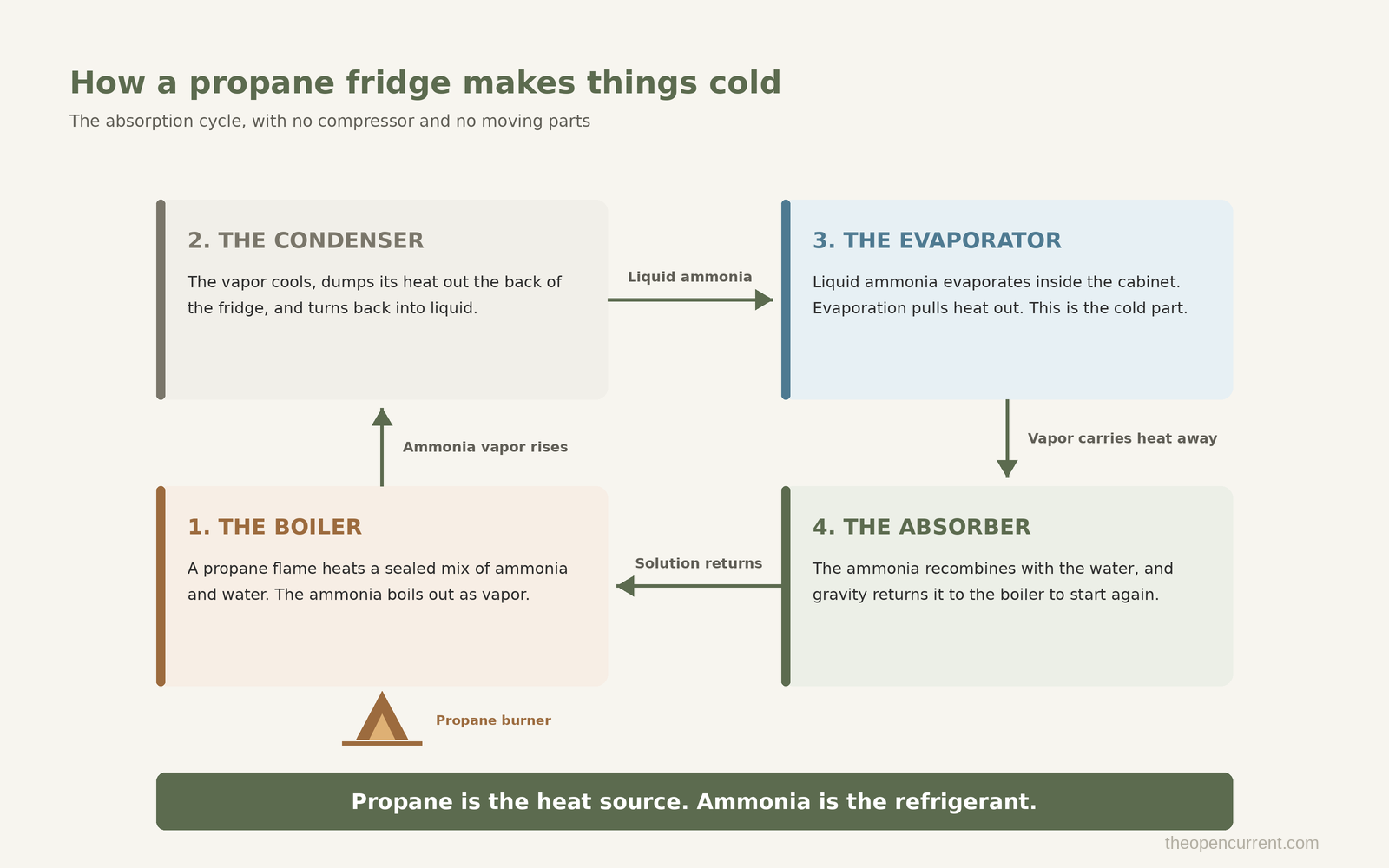
Original diagram. Reuse it with a link to theopencurrent.com.
No pump. No compressor. Gravity moves everything. That’s why these run completely silent and why there’s almost nothing inside to wear out.
One thing worth clearing up, because a lot of people get it backwards. Propane is not the refrigerant in these fridges. The refrigerant is ammonia. Propane is only the heat source, a flame under a boiler, doing the same job an electric element does in a dual-fuel model. The confusion is understandable, because propane genuinely is used as a refrigerant elsewhere, sold as R290 in some compressor fridges. Two different machines, two different roles, same gas.
Should you actually buy one in 2026?
Here’s the part the rest of the internet skips.
The classic argument for a propane fridge goes like this: refrigeration is the biggest continuous load in an off-grid house, so run it on propane and you can build a much smaller, cheaper solar system. You’ll see retailers run the math out to a 40-year payback against a $20,000 solar setup.
That argument was written when solar was expensive. It isn’t anymore.
A modern DC compressor fridge draws somewhere around 40 to 55 watts and runs straight off a 12V or 24V battery bank with no inverter. A 10 cubic foot propane fridge runs roughly $2,700. A comparable DC unit runs closer to $1,900. The propane one costs more up front, burns fuel forever, and has an open flame in your kitchen.
So who should still buy propane?
You should, if your property is genuinely propane-first and you’re already hauling fuel for heat, hot water, and cooking. If your solar array is small and you don’t want refrigeration competing with everything else in January. If you want cold storage that keeps working when your batteries are flat, your inverter dies, or you’re away for three weeks. If you want an appliance with no electronics that a reasonably handy person can service. If you’re in a hunting camp or seasonal cabin where the power system gets shut off between visits.
You probably shouldn’t, if you’re already building a decent solar system with lithium. In that case a DC compressor fridge is cheaper, more efficient, has no combustion risk, and one less fuel to haul. If you want to run the numbers on your own setup, the solar battery calculator will tell you what a 50 watt fridge actually costs you in battery capacity, and the off-grid solar guide covers how the whole system fits together.
I’m not talking you out of a propane fridge. I’m saying the reason to buy one in 2026 is fuel independence and simplicity, not saving money on solar. That argument is past its sell-by date.
The propane refrigerator brands that matter
The market is small. Six or seven brands, maybe forty models, and a lot of those are the same fridge in a different color.
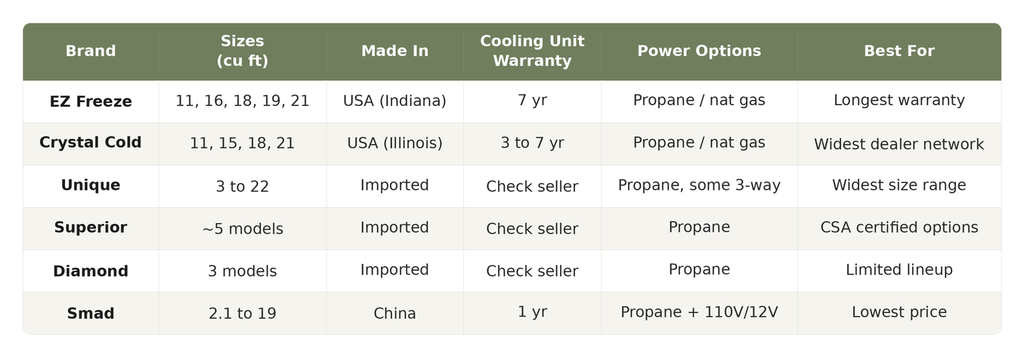
EZ Freeze is the premium pick. Built in Indiana, they make their own cooling units in house rather than buying them in, and every unit gets tested in a 100°F hot room for twelve hours before it ships. Seven years on the cooling unit, three on everything else. They’re the brand most specialist dealers push, and having published hot-room test data is a real quality signal in a category where almost nobody publishes anything.
Two details from their spec sheets worth knowing. Their fuel consumption runs lower than the competition, around 0.24 gallons a day on an 18, and they list the cooling unit as replaceable, which matters more than it sounds. Some competing models in certain sizes have no replacement cooling units available at all, which turns a repairable fault into a dead fridge.
One quirk when you’re shopping them. Their 11, 16, 19 and 21 are fridge-freezer combos, but the 18 is an all refrigerator with no freezer at all, built as a companion to a matching 18 cubic foot all freezer. Great setup if you want serious cold storage on a homestead. Not what you want if you thought you were buying one appliance.
Crystal Cold is the other American option and is also Amish built. Similar sizes, similar quality reputation, wider dealer network.
Which brings me to something I didn’t expect to find.
The Crystal Cold warranty changes depending on where you buy it. Same fridge, same factory. One retailer lists seven years on the cooling unit and says that term is only available through them. Another lists six. Two others list three. That’s not a small difference on a part that costs $750 plus freight to replace and is the single most likely thing to fail.
Nobody is doing anything shady here. Dealers negotiate their own terms. But it means the warranty is a thing you have to actually ask about rather than assume, and it can be worth more than the price difference between sellers. Get it in writing.
There’s a catch worth knowing too: the long cooling unit warranties are conditional on proper ventilation. Box the fridge into a cabinet and you may have voided the only coverage that matters. More on that below.
Unique covers the widest size range, from 3 cubic feet up to 22, plus small chest freezers. If you need something tiny for a cabin or something huge for a full homestead, they probably make it.
Smad is the budget import tier, and they’re the only ones offering multi-fuel flexibility at a low price. Two-way models run propane or 110V, three-way add 12V. Much less track record, shorter warranties.
Superior and Diamond each have a handful of models. Servel is down to about one, Consul is parts only, and Norcold is effectively gone from this space entirely.
What a propane refrigerator actually costs to run
Manufacturers publish fuel consumption, which is more than most appliance categories bother with. Crystal Cold’s own figures:
An 11 cubic foot unit burns 0.28 gallons a day. A 15 burns 0.29. An 18 and a 21 both burn 0.35. EZ Freeze runs leaner, listing 0.24 gallons a day on their 18.
Run that out and an 18 cubic foot fridge uses about 128 gallons a year. At $3 a gallon that’s roughly $380 annually, and every dollar of that is real money leaving your pocket forever. The EZ Freeze figure works out closer to 88 gallons and $265, which over a decade is most of the price difference between brands.
Now compare that to what retailers say. One puts it at 1.5 gallons a week, around 78 gallons a year. That’s noticeably lower than the manufacturer’s own spec sheet, and I’d trust the spec sheet. Your real number lands somewhere in that range depending on climate, how often the door opens, and how well it’s vented, but budget closer to the manufacturer figure and you won’t be surprised.
The purchase itself runs roughly $2,000 to $3,500 depending on size, brand, and finish. Add shipping, because these weigh 265 to 330 pounds and ship freight. Residential delivery and a liftgate cost extra, and some dealers quote substantially cheaper to a commercial address or a freight terminal. Worth asking, it can be a few hundred dollars.
Sizing, including the bit that seems backwards
Standard sizing logic applies. Bigger family, bigger fridge, and 18 to 21 cubic feet is roughly a normal household unit while 11 to 15 suits a couple or a cabin.
But here’s the counterintuitive one, and I only found it buried on a dealer’s page.
In a hot climate, buy the smaller fridge.
Manufacturers often fit the same size cooling unit across several capacities. Crystal Cold’s 11 and 15 cubic foot models use the same absorption unit as the 18. So the smaller cabinets have proportionally more cooling capacity for their volume, which makes them noticeably better at holding temperature when it’s hot outside.
If you’re regularly above 90°F with real humidity, the 11 or the 15 will keep your food colder than the 18 will. Crystal Cold themselves recommend their 21 only for areas that don’t regularly pass 95°F.
That runs against every instinct about buying appliances and it’s the single most useful sizing tip in this whole article.
Worth saying before you size up: not everything in a fridge needs to be in a fridge. Root cellaring gets apples, roots and squash through winter with no power at all, and Practical Self Reliance has a good guide to doing it without building an actual root cellar. Every cubic foot you move out of the fridge is capacity you don’t have to buy or power.
Installation is where people ruin these
Three things, and all three are permanent if you get them wrong.
Ventilation. These are not electric fridges and you cannot treat them like one. An absorption fridge needs a lower and an upper vent to the outside, and the airflow between them is driven by the temperature difference. That airflow does two jobs: it feeds the burner clean combustion air, and it carries combustion byproducts out of your house.
Build it into a closed cabinet or a pantry nook and you get poor cooling, higher fuel consumption, a shortened cooling unit life, a carbon monoxide risk, and quite possibly a void warranty. One dealer flat out says they’re seeing shortened lifespans on units that were boxed in. Never put a cabinet directly above one, and the more clearance on the sides the better. If it has to sit in a tight spot, a floor register underneath pulling air from the crawlspace helps a lot.
Level. The cycle runs on gravity, so tilt stalls it. Roughly three degrees is the limit. Run it off level and the boiler overheats, the rust inhibitor crystallizes, and it blocks the tubing permanently. You don’t fix that, you replace the cooling unit.
Good news is that in a cabin this is a one-time job, unlike an RV where people re-level constantly. Bubble level, shim the feet, done forever. Cheapest insurance in the whole build.
The gas connection. It’s a 3/8 inch male flare fitting, and it should be made and pressure tested properly, the same as you’d treat a furnace or water heater. In some places that legally requires a licensed gas fitter.
One more habit worth starting: write the install date on the back of the unit. Warranty claims on a seven-year part are a lot easier when you can prove when the clock started.
What goes wrong
The fire risk, and the history nobody mentions.
The boiler tube in an absorption cooling unit sits under pressure. Run the boiler too hot, usually from off-level operation, and a seam can corrode from the inside while the outside still looks perfectly fine. Eventually it cracks and releases pressurized flammable gas, including hydrogen, next to an open flame.
This is not theoretical. Dometic recalled 926,877 units over exactly this defect, and Norcold has faced over 10,500 product liability claims. Fire investigators have written technical papers on how to identify it at a scene, including this one on absorption refrigerator fires, which is worth a look if you want the engineering detail. The RV industry started shifting to DC compressor refrigeration around 2018 partly because of it.
Two things keep this in proportion. It’s concentrated in RVs, where off-level running is routine and vibration is constant. And the American homestead brands weren’t part of those recalls. But the mechanism exists in every absorption fridge ever built, which is the real argument for taking the leveling and ventilation seriously rather than treating them as fussy install details.
Carbon monoxide, and the brush nobody knows about.
Burning propane produces carbon monoxide. Vented properly it goes outside. A partially blocked flue means incomplete combustion, which means it doesn’t.
I found a cabin owner whose CO detector went off and who traced it to his propane fridge after five years without service. He was asking whether the long brush that came with the unit was for the flue. It was. Most owners have no idea what that brush is for.
Two things to take from that. Brush the flue periodically, and put a carbon monoxide detector in the room. Not optional with any combustion appliance.
The visual tell is the flame. Crisp blue is right. Yellow or orange means incomplete combustion, and that’s a shut it down and get it looked at situation, not a tweak it later one.
Insects. Mud daubers and spiders nest in burner tubes, and a seasonal cabin sitting empty for months is a perfect invitation. Show up in spring, light the fridge, and you’ve got a wasp nest choking the burner. Put burner inspection on your opening the cabin checklist.
Winter over-freezing. Those outside vents work both ways. In deep cold, subzero air moving behind the unit can drive the compartment well below fridge temperatures and freeze everything in it. Seasonal cabins in cold climates hit this and none of the buying guides mention it.
Heat, at the worst possible time. Absorption performance drops off above roughly 95°F ambient, because the cycle has to dump its heat into the surrounding air. Hottest week of the year is when it struggles most. See the sizing section above.
Buying used. Off-grid folks love a deal, and a secondhand absorption fridge is the one place I’d be careful. Off-level damage accumulates silently over years and the unit looks perfect right up until it doesn’t. You’re buying an invisible clock. Also check that replacement cooling units are still made for that size, because for some older models they aren’t, which turns a $750 repair into a total loss.
Frequently asked questions
Do propane refrigerators need electricity? No. The cooling cycle runs entirely on the propane flame. Most models use a push button igniter and a battery powered interior light, typically D cells. Two-way and three-way models can optionally run on 110V or 12V instead of propane, but they don’t require it.
How much propane does a propane refrigerator use? Between roughly 0.28 and 0.35 gallons a day depending on size, per manufacturer specs. That’s about 100 to 130 gallons a year, or somewhere around $300 to $400 at typical prices.
Are propane refrigerators safe? Yes, when vented and leveled correctly. The burner is enclosed and a thermocouple shuts the gas off if the flame goes out. The real risks come from bad installation, a blocked flue, or long-term off-level operation, all of which are avoidable. Fit a carbon monoxide detector regardless.
Is propane the refrigerant in a propane fridge? No. The refrigerant is ammonia. Propane is only the heat source. Propane is used as a refrigerant in some compressor fridges under the name R290, which is where the confusion comes from.
Do propane refrigerators need to be vented outside? In almost every real installation, yes, with a lower and an upper vent. Some dealers say venting is optional in a large open space with good airflow, but it affects cooling performance, fuel consumption, cooling unit lifespan, and often your warranty. Vent it.
How long does a propane refrigerator last? Cooling units carry three to seven year warranties and well installed units regularly run far longer, often decades. Lifespan is driven almost entirely by ventilation and leveling rather than brand.
Can you run a propane refrigerator on natural gas? Many models are available in a natural gas version or can be converted with an orifice change. It isn’t a swap to improvise, since the orifice size is different. Order the right version or have it converted properly.
What size propane refrigerator do I need? 18 to 21 cubic feet for a full household, 11 to 15 for a couple or a cabin, and smaller units down to 3 cubic feet for tiny spaces. If your climate regularly exceeds 90°F, size down rather than up.
Where to go from here
If you landed here still deciding between propane and running a fridge off your solar system, the honest next step is to find out what a compressor fridge would actually cost you in battery capacity. It’s usually less than people expect. Run your daily loads through the solar battery calculator and see what a 50 watt fridge does to the number.
And if you’ve already decided on propane, the two things worth your attention today aren’t the brand. They’re the vents and the level. Get those right at install and you’ll probably never think about this appliance again.
| Brand | Sizes (cu ft) | Made In | Cooling Unit Warranty | Power Options | Best For |
|---|---|---|---|---|---|
| EZ Freeze | 11, 16, 18, 19, 21 | USA (Indiana, Amish) | 7 yr (3 yr parts) | Propane or natural gas | Longest warranty and in-house cooling units |
| Crystal Cold | 11, 15, 18, 21 | USA (Illinois, Amish) | 3 to 7 yr (varies by seller) | Propane or natural gas | Same build quality with a wider dealer network |
| Unique | 3 to 22 | Imported | Check with seller | Propane, some 3-way | Widest size range including very small units |
| Superior | ~5 models incl. 17 | Imported | Check with seller | Propane | CSA certified options |
| Diamond | 3 models | Imported | Check with seller | Propane | Limited lineup |
| Smad | 2.1 to 19 | China | 1 yr | Propane + 110V, some + 12V | Lowest price and multi-fuel flexibility |