
Submersible Well Pump Buying Guide: Sizing, Specs, and What It Costs to Run Off-Grid

If you’re pulling water out of the ground on an off-grid property, the submersible well pump is the piece of equipment that decides whether you have running water or not. There’s no municipal backup. No neighbor’s spigot. Just you, a hole in the ground, and a motor hanging a couple hundred feet down in the dark.
I spent a while going through manufacturer datasheets, installer forums, and owner reports to put this together, and I noticed something odd. Almost every well pump guide out there is written for somebody with a power line running to the house. They’ll tell you all about GPM and head pressure and then never mention the one thing that actually breaks off-grid water systems, which is what happens to your inverter the instant that motor kicks on.
So this guide covers the normal stuff, sizing, specs, wiring, cost. And then it covers the off-grid part that nobody else seems to write about.
How a submersible well pump actually works
A submersible pump is a long skinny cylinder that lives underwater at the bottom of your well. Motor on one end, a stack of impellers on the other, all sealed up in stainless steel. It pushes water up the pipe rather than sucking it up from the surface.
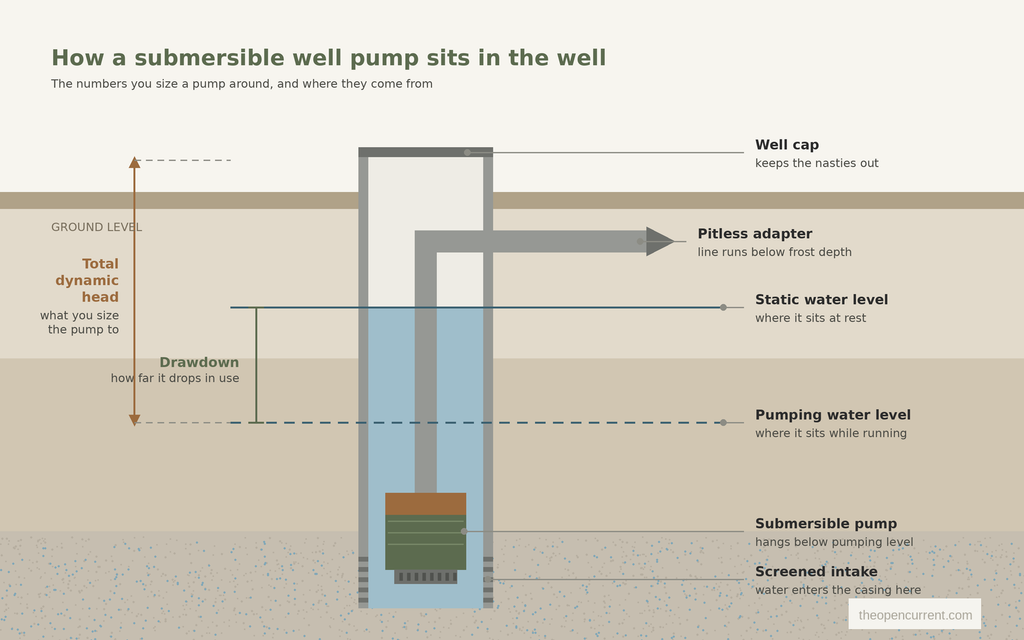
Original diagram. Reuse it with a link to theopencurrent.com.
That push versus suck distinction is the whole ballgame. A jet pump sits above ground and pulls water up using suction, and physics caps that at roughly 25 feet before the water column just gives up. A submersible sits below the water and pushes, so depth stops being the limiting factor. That’s why basically every well deeper than 25 feet uses one.
The other nice side effect is noise. Your pump is two hundred feet underground, so you hear nothing. Jet pumps live in your pump house and sound like it.
Downside is access. When a submersible fails, somebody has to pull a few hundred feet of pipe, wire, and pump out of the well. That’s a rig or a very good day with a pipe puller, and it’s why buying the cheap one twice is a genuinely bad deal here.
The three specs that actually matter
Forget brand for a minute. Get these three numbers right and almost any decent pump will work. Get them wrong and the best pump on the market will still leave you dry or burn itself out.
Total dynamic head, measured in feet. This is how high the pump has to lift water, and it’s not your well depth. It’s the distance from the pumping water level up to your pressure tank, plus the pressure you want at the tank, plus friction loss in the pipe. Rough rule, every PSI of pressure is about 2.31 feet of head, so a 50 PSI cutoff adds roughly 115 feet on top of your lift. People skip this constantly and then wonder why their 200 foot pump in a 180 foot well has no pressure.
Flow rate, measured in GPM. How much water per minute. A typical household runs 8 to 12 GPM. A single shower is about 2.5, a washing machine is around 4. Add up your realistic worst case, which is usually somebody showering while the laundry runs, not every fixture in the house open at once.
Horsepower. This one you calculate last, not first. HP is just the consequence of your head and flow numbers, and oversizing it is not free insurance. A bigger motor means a bigger surge, which on an off-grid system means a bigger inverter, which means real money. More on that below.
Here’s the part that trips people up. Head and flow trade off against each other on the same pump. A pump rated for 10 GPM does not do 10 GPM at 500 feet. It does 10 GPM somewhere in its useful range and drops off hard as depth increases. Every manufacturer publishes a pump curve showing exactly that tradeoff. Read the curve, not the headline number on the box.
Where to get your well’s real numbers
You need three things and there’s a decent chance you already have all of them.
Your well log. Most states require drillers to file one, and a lot of state geology or natural resources departments have them searchable online for free. It’ll list total depth, static water level, and the tested yield of the well.
Your static water level, which is where the water sits when nothing is running. Your pumping level, which is where it drops to during sustained use. That drop is called drawdown and it matters, because your pump needs to stay submerged at the pumping level, not the static one.
Your well’s recovery rate, in GPM. This is the hard ceiling. If your well only recovers at 5 GPM, putting in a 20 GPM pump does not get you 20 GPM. It gets you a pump that sucks the well dry, runs itself in air, and cooks its own motor. Running dry is the single most common way these things die.
2-wire versus 3-wire, explained without the jargon
Every submersible pump comes in one of two configurations and the names are honestly terrible, because both have a ground wire nobody counts.
A 2-wire pump has the starting components built into the motor, down in the well. Simpler install, nothing extra on the wall, fewer things to wire up wrong. The catch is that when a start capacitor eventually fails, the fix is down the hole, so you’re pulling the pump.
A 3-wire pump puts the starting gear in a control box mounted up at the surface. More wiring at install, but when a capacitor or relay goes, you replace a twenty dollar part standing in your pump house instead of renting a rig.
For off-grid there’s a second reason to care. Because the 3-wire setup manages its start through that surface control box, it tends to hit the inverter with a softer surge than a 2-wire of the same horsepower. Not a dramatic difference, but when you’re right at the edge of your inverter’s rating, it can be the thing that decides whether the pump starts or the inverter faults.
Submersible well pump comparison
These are the models that show up most consistently in installer recommendations and owner reports, with the specs pulled from manufacturer datasheets. The last column is the estimated surge draw, which is the number that matters if you’re running off batteries.
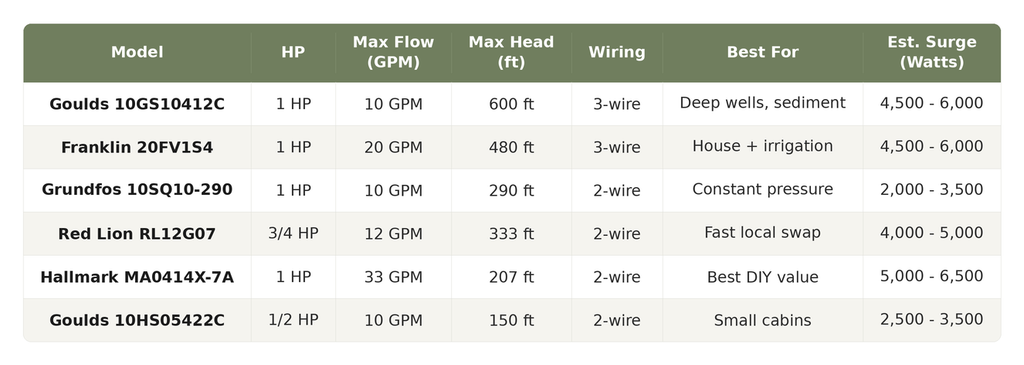
One availability note that matters in 2026. Grundfos and Franklin Electric have been pulling residential SKUs off Amazon in favor of their distributor networks, so those are dealer or plumbing supply orders now, usually a few days lead time. Goulds, Red Lion, and Hallmark are still the reliably available picks if you’re doing the swap yourself.
The off-grid problem: surge
Here’s the thing that grid-connected guides skip entirely.
An electric motor at rest is basically a dead short. It has almost no resistance until the rotor starts turning, so for the first fraction of a second it pulls an enormous amount of current. That’s locked rotor amperage, LRA, and on a submersible well pump it typically runs 3 to 5 times the pump’s running wattage, depending on whether it’s a 2 wire or 3 wire unit.
On the grid you never notice. The utility shrugs it off. On an inverter, that spike is the whole problem. A 1 HP pump that runs at maybe 1,200 watts can demand 5,000 or more for a second or two on startup. If your inverter can’t cover that, it faults out, and you get to enjoy the classic off-grid experience of your water cutting out every time the pressure tank calls.
So the real sizing question isn’t what your pump draws. It’s what it spikes to.
Find the nameplate LRA on the pump or its datasheet, multiply by your voltage, and that’s your starting VA. Add 25 percent of margin. That’s your minimum inverter surge rating. If you’d rather work from your whole system instead of one appliance, the solar battery calculator will get you the daily energy side, and the off-grid solar guide walks through how the inverter fits with the rest of the build.
Soft starters, and the honest version
Search this problem and you’ll find a lot of pages telling you a soft starter is mandatory for off-grid well pumps. They ramp the voltage up over a couple seconds instead of slamming the motor, cutting inrush by something like 40 to 50 percent depending on whose spec sheet you read. Signature Solar and SoftStartUSA both sell units aimed squarely at this, typically in the $200 to $400 range, and plenty of off-grid owners report they solved the problem outright.
But the veterans on the solar forums push back on this, and I think the pushback deserves airtime.
Their argument is that you don’t get something for nothing. A soft starter reduces peak current by stretching the startup out longer. Inverter surge ratings are not just a wattage, they’re a wattage for a duration. So it’s entirely possible to lower your peak below the inverter’s limit and still trip it, because now you’re holding an overload for longer than the inverter tolerates. A pump also has real mechanical load sitting on it at startup, water in the column, head pressure against the impellers, which limits how gently you can actually bring it up.
So the honest answer is that a soft starter often works and is worth trying before you buy a bigger inverter, because the price difference is significant. But it is not a guaranteed fix, and anybody telling you it’s a sure thing is selling something. The alternatives people land on are a genuinely oversized inverter, a 240V stacked inverter setup, a smaller pump, or a Grundfos SQ series pump with soft start electronics built into the pump itself.
There’s also the route around the problem entirely, which is a DC solar well pump feeding a storage tank with gravity doing the pressure work. Slower, lower output, and it won’t run a modern house on demand, but it sidesteps the surge question completely. That’s a different article.
Wire size and voltage drop
This gets underestimated and it kills pumps.
You’re running power a long way, straight down a well, and voltage drops over distance. A motor fed low voltage draws extra current to compensate, and extra current is heat, and heat is what burns out a motor you can’t reach. Undersized wire is a slow-motion pump failure.
The rule most installers work to is keeping voltage drop under 3 percent on the pump run. What gauge that takes depends on horsepower, voltage, and total length of the drop cable, so use the manufacturer’s chart rather than guessing. Franklin Electric publishes an AIM Manual that’s the closest thing this industry has to a bible, with wire sizing tables covering basically every motor configuration. It’s free, and it’s what the pros are actually reading.
Two more things. Use submersible-rated drop cable, not regular building wire, because it lives in water for twenty years. And 240V beats 120V wherever you have the option, since the same power at double the voltage means half the current, which means less drop and smaller wire.
What a submersible well pump costs
Pump alone, most residential submersibles land somewhere between $400 and $1,200 depending on horsepower and brand tier. Budget brands sit at the bottom, Grundfos and Franklin at the top.
The pump is the small number, though. Installed replacement usually runs $1,500 to $3,000 and can go past that on a deep well, because you’re paying for the rig, the labor of pulling several hundred feet of pipe and wire, new drop cable, fittings, a pitless adapter if it needs one, and often a torque arrestor and check valves. Depth drives the cost more than the pump does.
For an off-grid build, budget the surrounding gear too. Pressure tank, pressure switch, wire, possibly a soft starter, possibly more inverter than you planned on. The pump is rarely the expensive part of getting water out of the ground.
Worth knowing before you spend anything: a lot of no-water calls turn out to be a bad pressure switch, a waterlogged pressure tank, or a tripped breaker rather than a dead pump. Check those first. It’s a cheap hour that sometimes saves you a couple thousand dollars.
If you’re replacing rather than specifying a new system, I’ve broken the whole bill down separately in the well pump replacement cost guide, including the depth multiplier and the surge problem that catches people off grid.
How long they last
A decent submersible well pump lasts somewhere in the 8 to 15 year range, and a well matched one in a clean well can beat that comfortably.
What shortens it, in rough order of how often it comes up: running dry because the pump outpaces the well’s recovery, short cycling because the pressure tank is waterlogged or undersized, sand and sediment chewing up the impellers, and undersized wire slowly cooking the motor.
Three of those four are sizing and setup problems, not pump quality problems. Which is the whole argument for spending your effort on getting the numbers right rather than agonizing over brand.
The pressure tank one is worth its own mention, since a failing tank makes the pump start and stop constantly and motor starts are what wear these things out. I went through tank sizing in detail in the well pressure tank guide if you want the full version.
Frequently asked questions
How long does a submersible well pump last? Typically 8 to 15 years. Well matched pumps in clean water regularly go longer, while pumps that run dry, short cycle, or pump sand fail much earlier.
How deep can a submersible well pump go? Residential models commonly handle 100 to 600 feet of total head depending on horsepower and model. The limit is head, not depth, so factor in your pressure setting and pipe friction, not just how far down the water sits.
Do you have to prime a submersible well pump? No. It already sits underwater, so there’s nothing to prime. Priming is a jet pump problem.
What size inverter do I need to run a submersible well pump? Size for surge, not running watts. Take the nameplate LRA, multiply by voltage, add about 25 percent margin. For a typical 1 HP pump running at around 1,200 watts, that usually lands somewhere in the 6,000 to 7,500 watt range of surge capacity, and a 3 wire unit sits at the lower end of that. Nameplate LRA varies enough between models that I’d work it out from your own pump rather than trusting any single figure, and a soft starter may bring it down if it works on your setup.
Is a 2-wire or 3-wire pump better? 3-wire is easier to service, since the failure-prone starting components sit in a surface control box instead of down the well, and it tends to start a little easier on an inverter. 2-wire is simpler to install with nothing extra on the wall.
What gauge wire does a submersible well pump need? Whatever keeps voltage drop under 3 percent over your total cable run, which depends on horsepower, voltage, and depth. Use the manufacturer’s wire chart. Undersized wire is a common cause of premature motor failure.
Can a solar system run a well pump? Yes, and plenty of off-grid homes do it. The inverter has to cover the startup surge, which is the part people miss. The other approach is a DC solar pump filling a storage tank, which avoids the surge issue entirely at the cost of flow rate.
| Model | HP | Max Flow (GPM) | Max Head (ft) | Wiring | Best For | Est. Surge Draw (W) |
|---|---|---|---|---|---|---|
| Goulds 10GS10412C | 1 | 10 | 600 | 3-wire (control box incl.) | Deep wells and water with sediment | 4,500 – 6,000 |
| Franklin Electric 20FV1S4-3W230 | 1 | 20 | 480 | 3-wire 230V | House plus irrigation on one pump | 4,500 – 6,000 |
| Grundfos 10SQ10-290 | 1 | 10 | 290 | 2-wire (built-in VFD) | Constant pressure and easiest inverter start | 2,000 – 3,500 |
| Red Lion RL12G07-2W2V | 3/4 | 12 | 333 | 2-wire | Fast replacement from a local store | 4,000 – 5,000 |
| Hallmark Industries MA0414X-7A | 1 | 33 | 207 | 2-wire (box + splice kit incl.) | Best DIY value at 100 to 200 ft | 5,000 – 6,500 |
| Goulds 10HS05422C | 1/2 | 10 | 150 | 2-wire | Shallower wells and small cabins | 2,500 – 3,500 |