
How Does a Propane Refrigerator Work? The Absorption Cycle Explained

How does a propane refrigerator work? It uses a flame to make things cold. That sentence sounds like a typo, and it’s the reason this technology fascinates people who come across it for the first time.
You’ll see these called a few different things. Propane fridge, gas fridge, LPG fridge, or the technical name, a gas absorption refrigerator. Same appliance. LPG is just what most of the world calls propane, so if you landed here from outside the US, you’re in the right place.
There’s no compressor. Nothing spins. Nothing pumps. You light a small burner at the bottom of the unit and a few hours later the inside is at 38°F, and it’ll hold there for years with no electricity at all.
Here’s how that actually works.
The short version
A sealed steel loop inside the fridge holds three things: ammonia, water, and hydrogen gas. Heat from the propane flame drives ammonia around that loop. At one point in the circuit the ammonia evaporates, and evaporation absorbs heat. That’s the cold.
That’s the whole trick. Everything else is plumbing.
The important bit, and the thing almost everyone gets backwards, is that the cooling doesn’t come from the propane. It comes from ammonia changing state. Propane is just the thing supplying the energy, and an electric heating element does the same job on dual-fuel models.
A short and genuinely interesting history
This design is older than most people assume.
In 1922, two Swedish engineering students, Baltzar von Platen and Carl Munters, built a refrigerator that produced cold from heat using an absorption process, and it could run on electricity, gas or kerosene. Electrolux commercialized it, and that lineage is what became the Servel gas fridge your grandparents might have owned.
Then it got a famous set of fans. Albert Einstein and his former student Leo Szilard heard about a family killed by toxic fumes leaking from a broken refrigerator seal, and set out to build something safer. Their reasoning was that a fridge with no moving parts has nothing to wear out and nothing to fail, so they designed one around the absorption idea and patented it in 1930.
To be accurate about it: the propane fridge in an off-grid cabin today is a descendant of the von Platen and Munters design, not literally Einstein’s version, which used an electromagnetic pump and never caught on commercially. Freon arrived, compressors got cheap, and absorption refrigeration got pushed to the margins.
It survived in two places. RVs, because you can run it on a tank. And Amish communities, because it needs no electricity at all. That second one is why you can still buy a brand new absorption fridge from a factory in Indiana in 2026.
How a gas absorption refrigerator actually works
The boiler. The propane flame heats a mixture of ammonia and water. Ammonia boils at a much lower temperature than water, so it boils off as vapor and leaves most of the water behind. This is the only place energy enters the system.
The water separator. Some water vapor gets carried up with the ammonia, and it has to come out. In the separator that water condenses and drains back down to the boiler, so only pure ammonia carries on. Get water past this point and the cycle loses efficiency.
The condenser. The hot ammonia vapor rises to coils on the back of the fridge, where it gives up its heat to the room air and condenses back into a liquid. This is why the back of a propane fridge is warm, and why ventilation matters so much. If that heat has nowhere to go, the cycle stalls.
The evaporators. The liquid ammonia flows into coils inside the cabinet, where it meets hydrogen gas. The hydrogen lowers the partial pressure, which lets the ammonia evaporate at a low temperature. Evaporation takes energy, and it takes that energy from whatever’s nearby, which is your food. That’s the cold. There are actually two sets of coils, in order: the freezer coil gets the ammonia first and runs coldest, then what’s left passes to the food compartment coil and keeps cooling, just less aggressively. That’s why the freezer works even though there’s only one cooling circuit.
The absorber. The ammonia vapor, now carrying heat out of the cabinet, meets the water that got left behind in step one. Ammonia dissolves readily in water, so it gets reabsorbed into solution. The hydrogen doesn’t dissolve, so it rises back to the evaporator coils and goes round again. It never leaves that little loop.
And back to the start. Gravity returns the ammonia and water solution to the boiler, and the whole thing runs again. Continuously, silently, for as long as there’s a flame.
There’s no pump, no compressor and no fan anywhere in that list. Just heat, three fluids and gravity, which is also why the thing has to sit level to work.
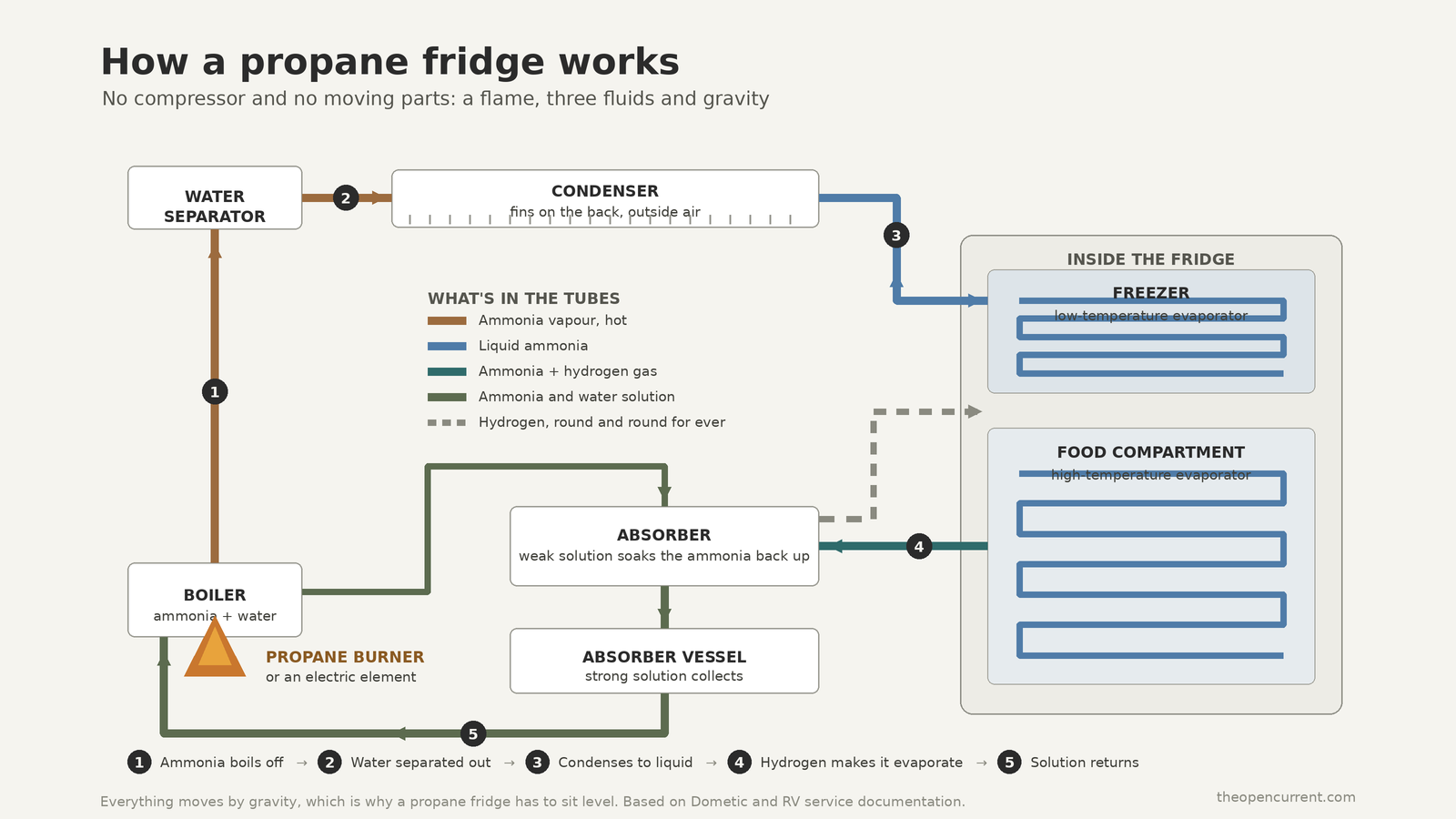
Original diagram. Reuse it with a link to theopencurrent.com.
So is propane the refrigerant?
No, and this trips up a lot of people.
The refrigerant is ammonia. Propane is the heat source, doing the same job a wood fire would do if you could control it precisely enough.
What makes it genuinely confusing is that propane really is used as a refrigerant in a completely different kind of fridge. It’s sold as R290 and it’s the working fluid in some modern compressor fridges, chosen because it has a very low global warming potential compared to the old fluorocarbons.
So both statements float around online and both are true, just about two different machines. In an absorption fridge, propane burns. In an R290 compressor fridge, propane circulates and never burns.
Why there are no moving parts
In a compressor fridge, a motor physically squeezes refrigerant gas, and that pressure change is what drives the cycle. Motor, pistons, seals, all of it wearing out slowly.
An absorption fridge replaces all of that with heat and gravity. The boiler creates the pressure difference by boiling, and gravity moves the liquid back down. There’s nothing to lubricate, nothing to wear, and nothing to hear.
That’s the absorption cycle, and it’s why the proper name for one of these is a gas absorption refrigerator. There’s no compressor anywhere in it.
That’s why these things run absolutely silently, and why a well installed one can last decades. It’s also why the two install details matter so much. It runs on gravity, so it has to be level, and it dumps heat to the air, so it has to be vented. Get either wrong and you’re not fighting a quirk, you’re fighting the physics the whole design depends on.
I went through both of those in detail, along with what actually goes wrong with these, in the propane refrigerator buying guide.
Absorption versus compressor, in plain terms
A compressor fridge is more efficient. That’s not really in dispute. It moves more heat per unit of energy, which is why almost every fridge on earth uses one.
An absorption fridge trades that efficiency for independence. It doesn’t care whether you have electricity. It has no electronics to fail. It makes no noise. And it runs off a fuel you can store in a tank in the yard for years.
For a house on the grid that trade makes no sense. For a cabin at the end of a dirt road, it can make a lot of sense, though modern DC compressor fridges have narrowed the gap considerably. That’s the comparison worth thinking through before you spend the money, and it’s the first thing I cover in the buying guide.
If you’re working out total propane draw across the property, how much propane a tankless water heater uses covers the biggest single consumer.
Frequently asked questions
How does a propane refrigerator work without electricity? The propane flame provides all the energy the cooling cycle needs, and gravity circulates the fluids. No pump or compressor is involved, so no electricity is required. Most models use a battery for the interior light and a push button igniter.
What is the refrigerant in a propane fridge? Ammonia. Water and hydrogen gas are also in the sealed loop, with water absorbing the ammonia and hydrogen lowering the pressure so the ammonia can evaporate at low temperature.
Why does a propane refrigerator have to be level? The cycle relies on gravity to return the ammonia and water solution to the boiler. Tilt it more than about three degrees and the solution stops circulating properly, the boiler overheats, and the damage is permanent.
Why does the back of a propane fridge get hot? That’s the condenser dumping the heat it pulled out of the food compartment. Every fridge does this, absorption or compressor. It’s why these need proper ventilation to work correctly.
How cold does a propane refrigerator get? Normal refrigerator temperatures, around 34 to 40°F, with freezer sections reaching typical freezing temperatures. Performance drops when ambient temperature goes above roughly 95°F, because the condenser has a harder time shedding heat.
Are propane refrigerators noisy? No. They’re completely silent, because nothing inside them moves. You may occasionally hear a faint gurgle from the cycle, and that’s it.
How long has this technology been around? The commercial version dates to 1922, when two Swedish students built the first practical absorption refrigerator. Einstein and Szilard patented their own take on it in 1930. The fridges sold today work on the same principle.
Where to go from here
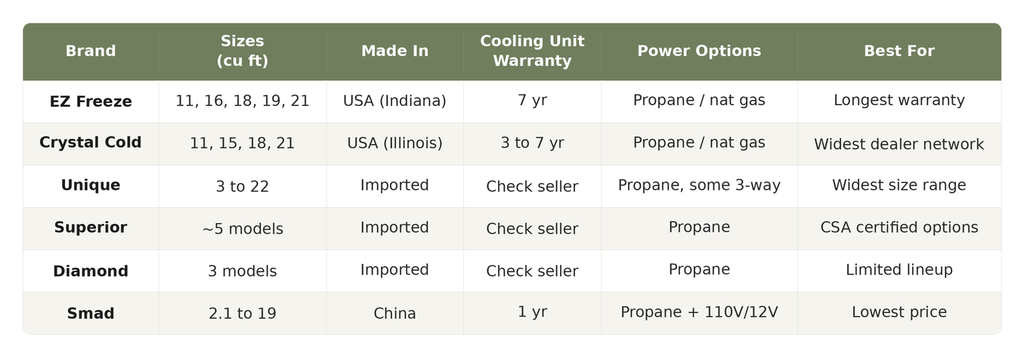
If you’re reading this because you’re weighing one up for a cabin or a homestead, the physics is the easy part. The decisions that actually matter are which brand, what size, how to vent it, and whether a DC compressor fridge would serve you better in 2026.
That’s all in the propane refrigerator buying guide, including the two install mistakes that kill these things and a running cost comparison using manufacturer fuel figures rather than marketing ones.
A compressor fridge is a motor that kicks on and off around the clock, which is exactly the kind of steady daily draw that decides how long your batteries last. Run the propane version and that load simply isn’t in your bank’s life at all.