Wood Stove Water Heater: Can You Safely Heat Water With a Wood Stove?

A wood stove water heater sounds like the dream. Free hot water from a fire you’re already feeding? Sign me up.
I went down this rabbit hole for a while, and the honest answer surprised me. Yes, it can be done. But for most people with a modern wood stove, the right answer is don’t bolt a coil into it. Woodheat.org, one of the most respected independent wood heat sites around, opens its own article on this by saying it can be done, but it’s not easy, cheap, or without risks.
So this guide covers the four ways people actually heat water with wood, why a coil and a modern EPA stove don’t get along, the explosion risk and the simple rules that prevent it, the insurance problem nobody mentions, and the setup that genuinely makes sense.
The four ways people heat water with a wood stove
- A coil or water box inside the firebox. The most common DIY idea and the most problematic, for reasons I’ll get to.
- A collector on the stovepipe, either a coil or a water jacket around a section of flue.
- A collector bolted to the outside of the stove, usually on the back, out of the fire itself.
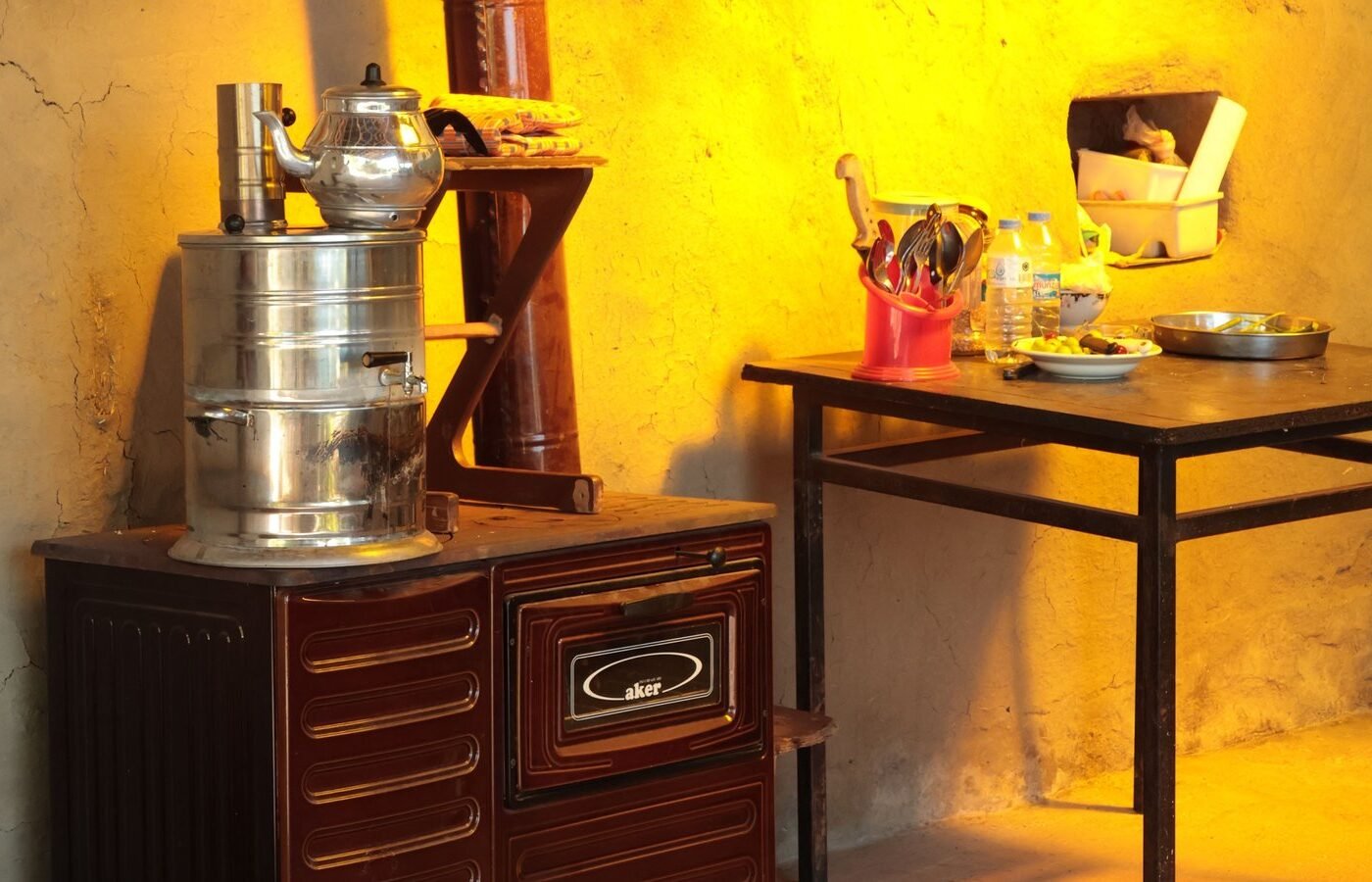
- A wood cookstove with a built-in reservoir or factory water option. This is the purpose-built route.
Before any of these: if you were hoping to run in-floor radiant heat off your wood stove, stop there. Woodheat’s take is blunt. A retrofitted wood stove is the wrong device for radiant floors, you’ll never get enough heat out of it, and if you’re lucky you’ll get enough hot water for washing. Think showers and dishes, not heating the house. Sorry.
What it costs
| Setup | Price | The catch |
|---|---|---|
| Wood cookstove with reservoir | $4,699 (Pioneer Princess, stove only) | Reservoir can’t be added later |
| Same cookstove, no reservoir | $4,299 | No hot water at all |
| Low pressure flue heat exchanger | AU$789 to AU$889 (Australia) | No proven US equivalent |
| Coil added to a modern stove | Cheap in parts | Voids the listing, can foul the burn |
| Custom DIY loop | No reliable price | Often uninsurable |
A few notes on those. The cookstove prices are Lehman’s listings for the Pioneer Princess. The flue exchanger is a product from Solazone, an Australian company. For custom and DIY systems I couldn’t find a trustworthy installed price, and I’d rather leave that line honest than make one up.
Why a coil and a modern EPA stove don’t mix
This is the part most DIY videos skip.
Modern EPA certified wood stoves burn clean because they run a hot firebox with secondary combustion. Stick a water coil in there and you’re pulling heat out of the exact place the stove needs it. Woodheat says that’s the biggest obstacle to heating water with a modern stove: any collector that robs heat from combustion would almost certainly create a dirty burn that would fail the stove’s certification. That’s why most makers of EPA certified stoves don’t offer water collectors at all.
A dirty burn isn’t just an emissions thing. A coil in the firebox cools the fire, which normally means smoky fires and too much creosote. And creosote is basically chimney fire fuel, so that’s a hard pass.
The one setup Woodheat showed working well with a firebox collector had a very specific owner. She runs her cookstove hot, never turns it down much and never tries to burn all night. Her house is efficient enough that short, hot fires are all she needs. If that’s not how you run your stove, a firebox coil is going to fight you.
Putting a coil inside the flue pipe has its own problems. A long time moderator on Hearth.com advises against putting anything inside the flue, because it makes the chimney harder to clean and the acids in the exhaust can attack the coil.
The explosion risk, and the rules that prevent it
Here’s the part I really want you to read.
Water turns to steam at 212°F at normal pressure, and steam takes up enormously more space than water. A water collector sitting in a fire with no way for that pressure to escape is a bomb. That’s not an exaggeration, and there’s a documented case.
In the fall of 2005 a cookstove in Prince Edward Island, Canada, blew apart. The firebox and ash box section separated from the oven. The water collector was a cast iron box fitted into the firebox, sold as an accessory by the stove’s own manufacturer. So this wasn’t some sketchy DIY build.
What happened? New tenants lit the first fire of the season without knowing to open the ball valves on the supply and return pipes. The water in the collector had nowhere to go. Woodheat’s conclusion is that it wouldn’t have happened if a pressure relief device had been installed between the collector and any shut off valve. They also say, flat out, that wood fired hot water systems should never be in rental housing.
A second story from one of their readers: a coworker put a heat exchanger in a furnace firebox without proper controls, made high pressure steam, and the solder joints failed in what sounded like several small explosions. Oof.
So here are the safety rules, straight from Woodheat’s guidance:
- Put relief valves in the right places. Directly at the exit of the collector and at the highest point in the system. Temperature and pressure relief valves are preferred, because they open before the water flashes to steam.
- Never put a shut off valve between the collector and its relief valve. That’s the Prince Edward Island stove. Kitchen Queen owners on the forums repeat the same rule: no isolation valves between the heating coil and the relief valve.
- Prefer a thermosiphon over a pump. Convection flow systems are the safest and most reliable because they don’t need a pump or electricity. A pumped system needs even more safety devices, like battery backup, because a power cut stops the flow while the fire keeps burning.
- Size the storage tank big enough to soak up the heat from each burn between uses, both to avoid overheating and because recovery is slow.
- Plumb the relief valve to a drain, so if it ever blows, it’s dumping scalding water somewhere safe.
How a thermosiphon loop works
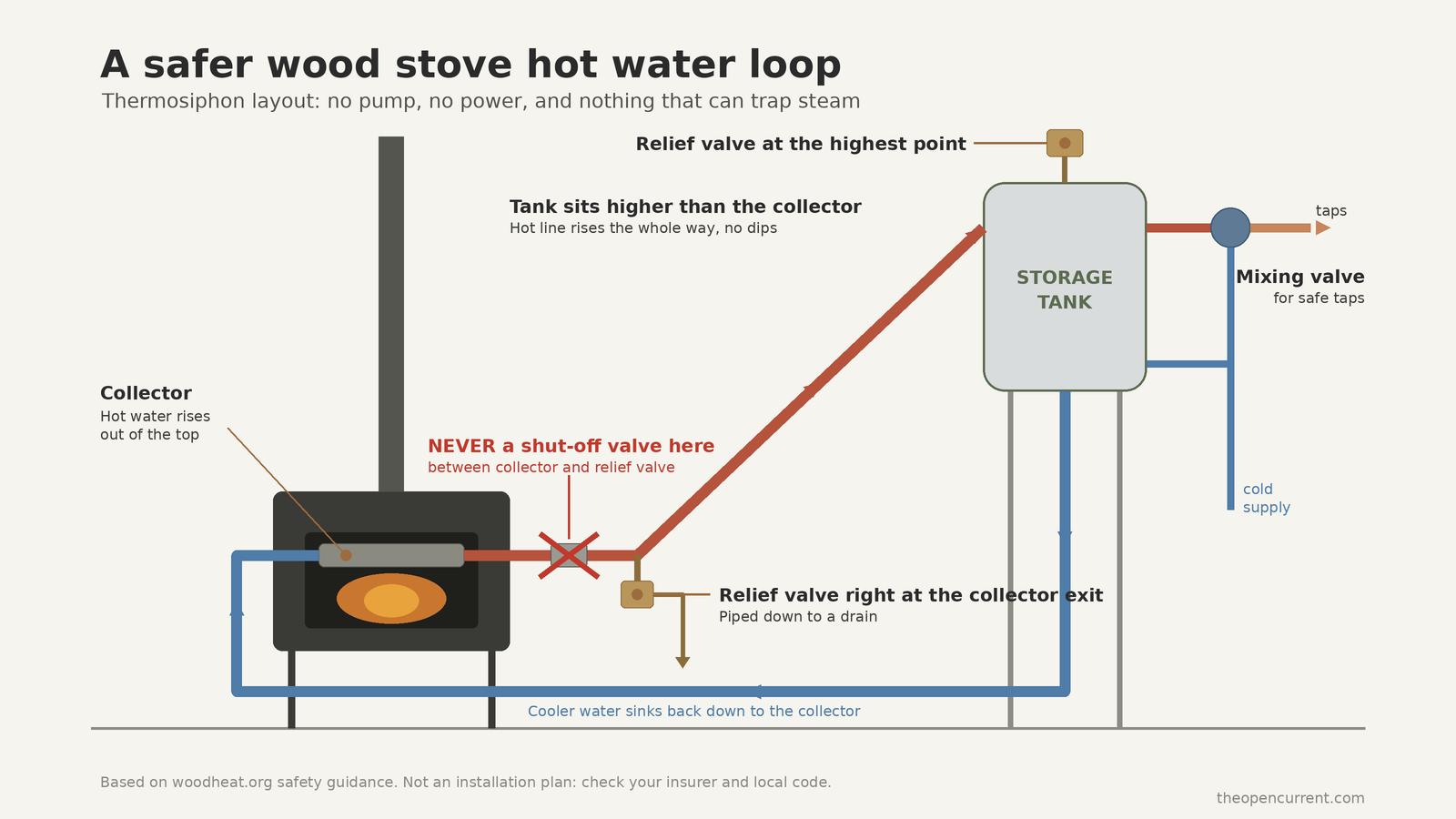
Original diagram. Reuse it with a link to theopencurrent.com.
A thermosiphon uses the fact that hot water rises. The loop connects to the bottom and top of the storage tank, and the tank has to sit higher than the heat source. Heated water rises out of the collector into the top of the tank, and cooler water sinks from the bottom of the tank back down into the collector. No pump, no power.
In the good cookstove install Woodheat profiled, the tank was mounted above the stove and the installer used 3/4 inch pipe with 45 degree elbows throughout, to keep the flow moving freely.
Fair warning, though. Thermosiphons look dead simple on paper and are a pain to actually get right. One longtime permaculture forum member said they’re often talked about but very difficult to get working, let alone working well and reliably. A masonry heater builder on another forum said long horizontal runs are the killer: friction and heat loss fight you, so insulate the hot line well and go up to bigger pipe.
The short version: rise, rise, rise. Keep the tank higher than the collector, keep the pipe runs short and steep, and don’t route the hot line in dips.
The scald problem
This one gets missed because people are so focused on the steam risk.
A wood heated loop doesn’t have a thermostat. One owner on a tractor forum reported his wood stove loop running at about 180°F, heating his tank to within a few degrees of that. That’s way too hot to come out of a shower.
A mixing valve manufacturer’s instructions warn that water above 125°F can cause severe burns, and that a water heater should never be set above 120°F without a properly working thermostatic mixing valve. So any wood heated system that feeds your taps needs a thermostatic mixing valve, sometimes called a tempering or anti scald valve, between the tank and your fixtures. Valves exist for exactly this. Caleffi makes one rated for inlet water up to 185°F with an adjustable 85 to 120°F output.
This isn’t optional. Especially with kids or older folks in the house.
Insurance, UL listings and code
This is the quiet dealbreaker.
Modifying your stove can void its listing. A Hearth.com moderator put it plainly: modifying a stove obviously voids its warranty, but more importantly it voids its UL and other approval listings, which might put you in violation of building codes and will probably cause problems with your insurance.
Insurers really do check. On a home inspector forum, an insurance agent described an underwriter who needed to confirm a stove was UL listed before a deadline or the policy would be cancelled.
Custom systems are a hard sell. Woodheat says they don’t know of any insurance company that will cover the custom systems they profiled, and suspect many insurers would refuse any wood heated hot water system except, perhaps, ones inside boilers.
And here’s the irony. The Prince Edward Island stove that exploded would probably have passed an insurance inspection, because its collector was certified for use with that stove. Certified doesn’t mean safe if somebody closes the wrong valve.
Rules also vary by place. One Canadian poster on Hearth.com said heat recovery devices on the stovepipe aren’t allowed there. I can’t confirm that for every province, so treat it as a reason to call your local fire inspector before you build anything.
My advice: call your insurance company before you buy a single fitting.
The setup that actually makes sense: a cookstove with a reservoir
If you want wood heated hot water, the cleanest route is a stove built for it.
Wood cookstoves have a big advantage here. The Pioneer Princess at Lehman’s is listed to UL 1482, and cookstoves are nationally exempt from EPA regulations. That’s why the “coil fouls the EPA burn” problem doesn’t apply to them the same way.
It costs $4,299 without a reservoir and $4,699 with one. Here’s the catch: the reservoir must be ordered with the stove and can’t be added later. So decide now.
How much hot water? One review of the Princess says the reservoir gives you up to 9 gallons of hot water whenever the fire’s going. That’s legit handy for dishes and washing up. It’s not gonna run your showers.
Some cookstoves also offer a firebox coil that feeds a bigger tank, and here owners warn you can get too much of a good thing. One Kitchen Queen owner said the coil makes so much hot water it over humidifies the house, and another said it can boil 24 gallons an hour. That’s owner talk, not a spec sheet, but the pattern is clear. Size the tank and the plumbing for the output.
The summer problem
No fire, no hot water. Sounds obvious, right? It still catches people every single year.
A wood stove water heater is a winter system. Come summer you still need hot water, so you need a second heater anyway, usually propane. That changes the math, because you’re not replacing your water heater, you’re adding a winter helper to it. I compare the propane options in my tankless vs tank water heater guide, and if you’re going propane tankless, check how much propane a tankless water heater uses before you size the tank.
If you’re feeding wood heated water into a propane heater as preheat, check that heater’s manual for how hot its incoming water is allowed to be, and put the mixing valve in the right place. Don’t guess on this one.
If you’re on a well, you’ve got one advantage
Here’s a detail from Woodheat I didn’t expect. Houses on city water are actually more vulnerable to over pressure, because they don’t have a pressure tank with a bladder to soak up expanding water. A well system’s pressure tank helps keep system pressure down.
That doesn’t replace relief valves. It just means your well setup is a little more forgiving. My well pressure tank guide covers how those tanks work.
Questions to ask before you buy or build
- Is my stove EPA certified, and will adding a collector void its listing? Ask the manufacturer directly.
- Will my insurance cover it? Get the answer in writing.
- Is this legal here? Call your local fire inspector or building department.
- Where exactly are the relief valves? One at the collector exit, one at the highest point, no shut off valves in between.
- Is it a thermosiphon or pumped? If pumped, what happens when the power goes out with a fire burning?
- Is the tank higher than the collector, and how big is it?
- Where’s the thermostatic mixing valve?
- What heats my water in summer?
Mistakes that cost real money, or worse
- Putting a coil in an EPA stove and turning a clean burner into a creosote machine.
- Installing a shut off valve between the collector and the relief valve.
- Skipping the mixing valve and scalding somebody at the tap.
- Using a pump with no backup for when the power goes out and the fire keeps burning.
- Building first and calling the insurer after.
- Buying a cookstove without the reservoir and finding out it can’t be added later.
- Forgetting summer, then being surprised you still need a propane or electric heater.
- Putting a wood fired water system in a rental.
FAQ
Can you heat water with a wood stove?
Yes, but it’s not easy, cheap or risk free. The safest options are a cookstove built with a water reservoir, or a properly designed system with relief valves in the right places, no shut off valves between the collector and its relief valve, and a mixing valve before your taps.
Is it safe to put a water coil in a wood stove?
It can be dangerous. If the water can’t circulate or vent, it turns to steam and can explode, which is exactly what happened to a cookstove in Prince Edward Island in 2005. In a modern EPA certified stove, a firebox coil can also cause a dirty burn and more creosote.
Does adding a hot water coil void my wood stove’s warranty?
Modifying the stove typically voids the warranty and its UL listing, which can create building code and insurance problems. Check with the manufacturer and your insurer first.
How much hot water does a wood stove make?
Less than people hope. A cookstove reservoir like the Pioneer Princess holds up to about 9 gallons. Woodheat.org says a retrofitted stove is best thought of as enough hot water for washing, not for heating the house.
Can I heat my radiant floor with a wood stove?
Woodheat.org says a retrofitted wood stove isn’t the right device for in floor radiant heat, and you’d never get enough heat out of it to make a dent in radiant heating needs.
Do I still need a regular water heater?
Almost certainly. A wood stove only makes hot water when a fire’s burning, so you’ll need another source in summer.
Where to go next
If you’re planning a full build, the off-grid cost calculator shows what your water heating choice does to your total power and cost.
If you’re working out the propane side of things, my tankless water heater cost guide breaks down what a backup unit really costs.
And for how the water gets to your heater in the first place, start with my off-grid water systems hub.