Solar Panels in Series vs Parallel: What Actually Decides It Off Grid

Ask the internet about solar panels in series vs parallel and you’ll get the same answer every single time. Series is bad in shade. Parallel is good in shade. Off you go, champ.
Cool. Not useless exactly, but not the decision you’re actually making either.
Here’s what I found after spending an embarrassing chunk of this month reading DIY Solar Forum threads: if you’re building off grid, the series or parallel question mostly gets answered for you before shade ever enters the chat. It gets answered by what charge controller you already bought. By how cold it gets where you live. And by how far your panels sit from your batteries, which for most of us is “further than I’d like.”
Shade comes fourth. By the time you get there, usually only one option is still standing anyway.
I’ll walk through all four. But if you close this tab in ten seconds, take this with you: the wiring mistake that actually costs people money isn’t a shading mistake. It’s a cold morning in January.
Series and parallel solar panels: the mechanics in thirty seconds
Two ways to hook panels together. They do opposite things.
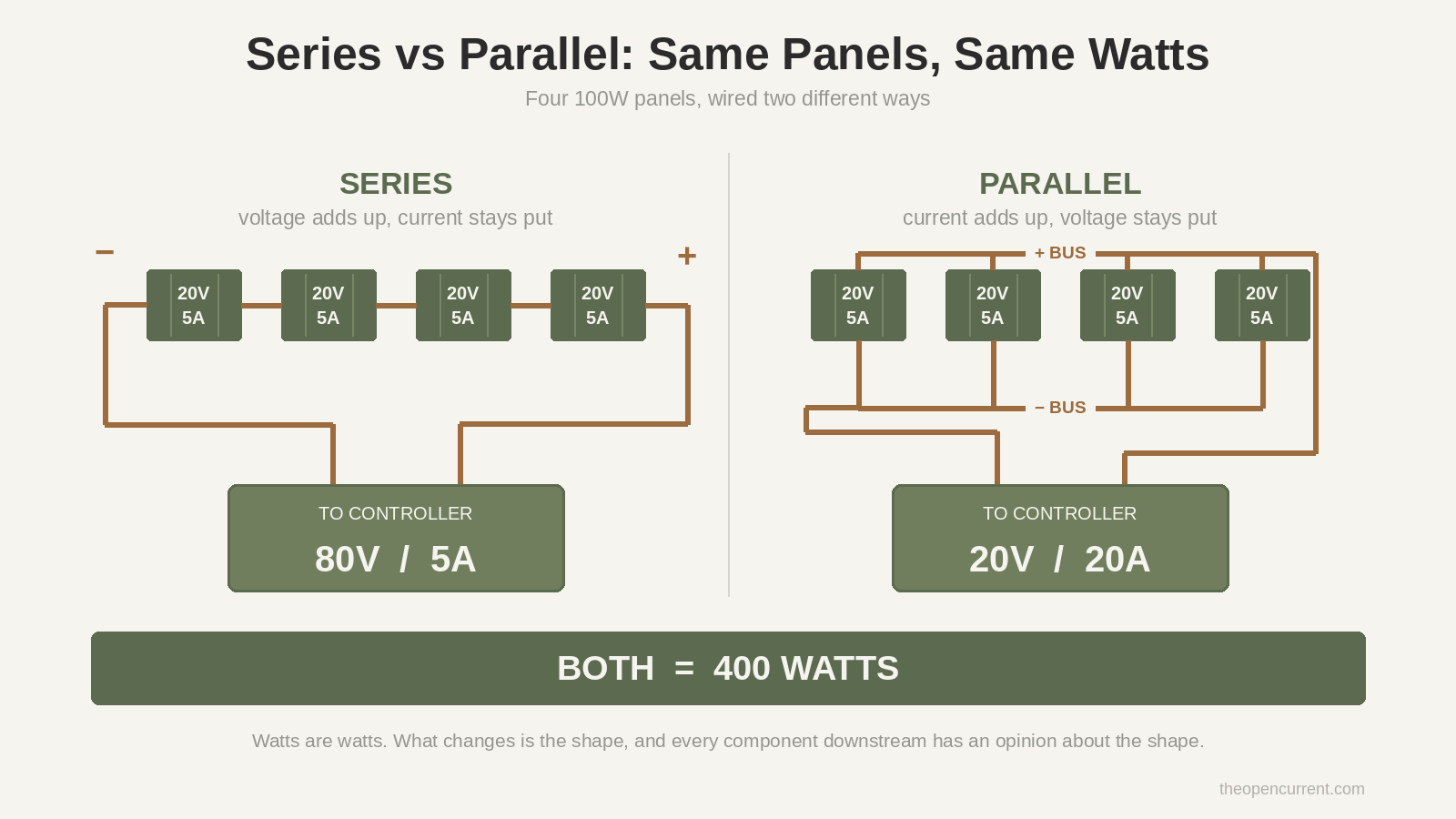
Series. Positive of one panel to negative of the next, like batteries stacked in a flashlight. Voltage adds up. Current stays put.
Four panels at 20V and 5A each, wired in series: 80V at 5A.
Parallel. All the positives hold hands, all the negatives hold hands. Current adds up. Voltage stays put.
Same four panels in parallel: 20V at 20A.
Both give you 400 watts. Watts are watts. Nobody’s inventing free electricity here. What changes is the shape of that power, and every single thing downstream has an opinion about the shape.
Original diagram. Reuse it with a link to theopencurrent.com.
Solar panels in series vs parallel, at a glance
| Series | Parallel | |
|---|---|---|
| Voltage | Adds up | Stays put |
| Current | Stays put | Adds up |
| Wire gauge you’ll need | Thinner | Fatter |
| Long run to the house | Cheap | Brutal |
| Works with a PWM controller | Not really | Yes |
| Starts making power in low light | Earlier | Later |
| One shaded panel | Drags the string, but less than you’ve read | Helps less than you’ve read |
| Fusing | One for the array | Per string once you hit three strings |
| How it kills your gear | Cold weather voltage | Too many amps into the controller |
Thing one: MPPT or PWM, and why this settles it before anything else
A lot of guides breeze right past this and it drives me nuts, because it’s the whole ballgame.
A PWM controller, Pulse Width Modulation, is basically a fancy light switch. It connects your panel to your battery, flicks that connection on and off very fast, and that’s how it controls charging. What it absolutely cannot do is convert voltage. Amps in equals amps out. Any voltage above what the battery wants gets dumped on the floor and forgotten about.
So picture it. You wire four panels in series into a PWM controller, you’ve built yourself a lovely 80V array, and the controller walks over to your 12V battery and hands it five amps. That’s it. You paid for 400 watts and you’re getting about seventy.
Seventy.
With PWM you want parallel, and you want panel voltage that roughly matches your bank. This is the cheapest mistake on this entire page and it happens constantly, because PWM controllers are dirt cheap and they come bundled in a lot of starter kits.
An MPPT controller, Maximum Power Point Tracking, is a proper DC to DC converter. It takes whatever voltage the array gives it and turns the extra into charging current instead of heat. Watts in, watts out, minus a few percent for the conversion. With MPPT, high voltage isn’t waste, it’s just a different delivery route.
MPPT has a floor too, and people trip over this one. Your array voltage has to sit meaningfully above your battery charging voltage before anything happens at all. Generally about 5V above, sometimes more. Which means a single 12V panel will never charge a 24V bank. Not on the sunniest day of your life. It just sits there.
There’s a bonus here that matters way more off grid than it does on a roof in Phoenix. Higher string voltage means you cross that minimum threshold on less light, so you start making power earlier in the morning and you keep making it when the sky goes the colour of wet cement. If you’re limping through December on two sun hours, that’s not a footnote, that’s your worst month getting better. I went into why winter sun hours are the number that actually sizes your system in the off-grid solar guide.
Thing two: the cold weather number that quietly murders charge controllers
Okay. This is the one. If you skim everything else, read this bit.
Your charge controller has a maximum PV input voltage. Victron are decent about this and just put it in the model name: a 100/30 takes 100V max on the solar side and pushes 30A max to the battery. A 150/35 takes 150V. Nice and honest.
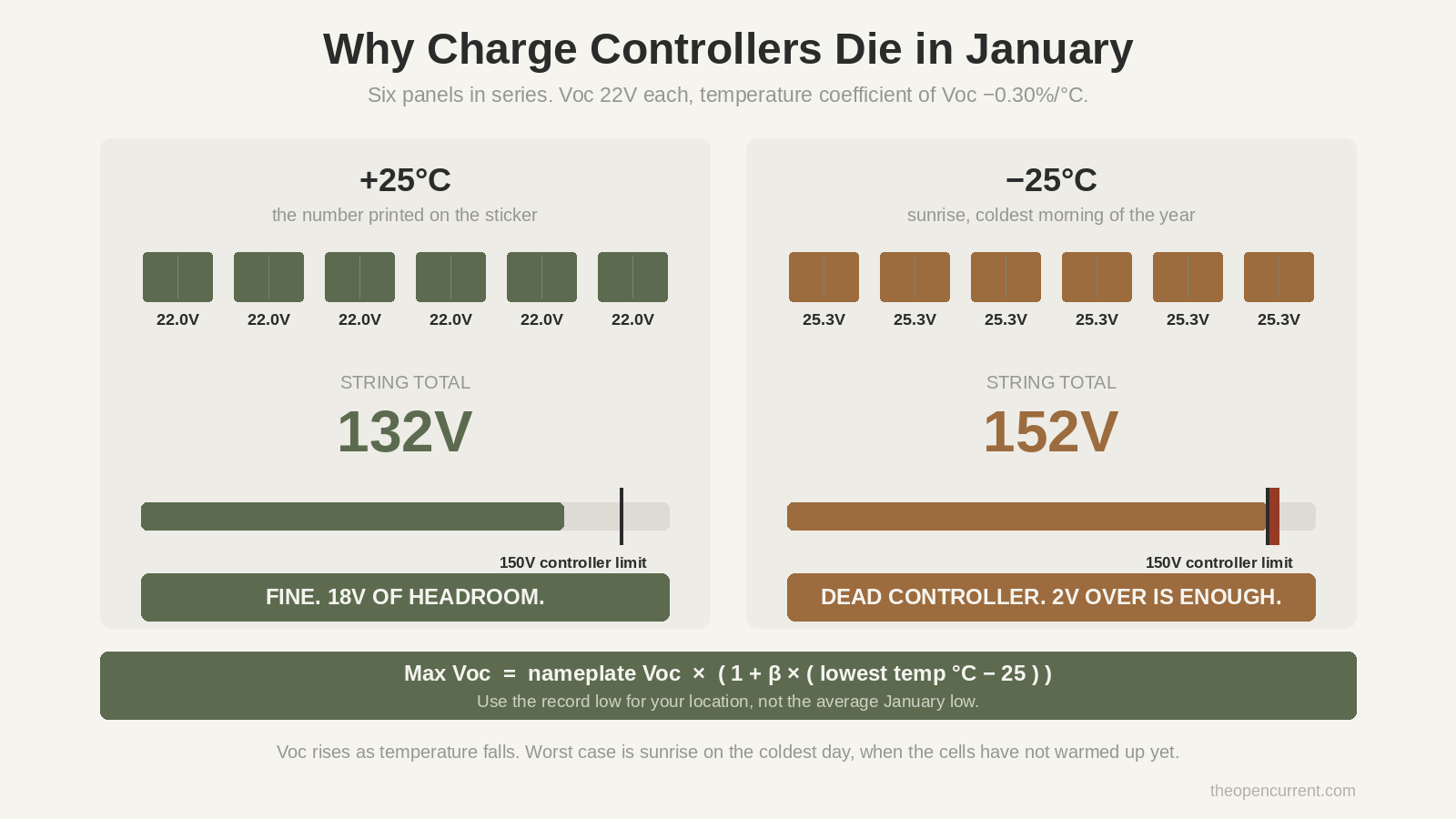
So you flip your panel over, read Voc 22V off the sticker, do a bit of maths, and wire six in series for 132V. Comfortably under 150. Crack a beer. Job done.
Except the Voc on that sticker is measured at 25°C, which is 77°F, which is a pleasant spring afternoon. And here’s the thing that catches basically everybody the first time: solar panel voltage goes up when it gets colder.
Not down. Up.
Every panel has a temperature coefficient of Voc printed on its datasheet, usually somewhere between -0.25% and -0.35% per degree C. Negative coefficient, temperature falls, voltage climbs. Run that over a proper cold snap and your comfortable 132V string becomes 145V, then 152V, and then your controller lets out the magic smoke.
The magic smoke, for the record, is not covered under warranty.
Here’s the formula if you want to run it yourself, and you should:
Max Voc = nameplate Voc × (1 + β × (lowest temp in °C − 25))
Where β is that temperature coefficient off the datasheet, as a decimal. So -0.30%/°C becomes -0.003.
For “lowest temp” you want the record low for your location. Not the average January low. Not what it was like last winter. The record. The NEC wants the lowest expected ambient temperature, and Article 690.7 hands you a correction factor table if you’d rather skip the arithmetic entirely. Worth checking which code cycle your county is actually running though, because that table has shuffled around between editions.
That design temperature spans roughly -40°C in northern Minnesota to about +5°C in southern Florida, so this is a five alarm fire in Montana and barely a rounding error in Tampa. Know which one you are.
And now the genuinely sneaky part. Worst case is sunrise on the coldest day of the year, because the cells haven’t warmed up at all yet and cell temperature is basically just air temperature. We’re talking about maybe two minutes a year.
Which means a badly sized string will run absolutely beautifully for an entire season, and then kill your controller one morning in January while you’re still in bed. There’s a guy on DIY Solar Forum who ran his setup for about a year with zero drama, flipped his PV disconnect one cold morning, and watched 154V land on a 150V controller.
The forum consensus on this is not gentle and nobody hedges it. Never exceed the Voc limit. Not once, not briefly, not “ah it’s probably fine.” Going over on amps you’ll usually survive. Going over on volts is how you buy a new controller.
Leave yourself 10 to 20% headroom under the max PV voltage. Cold climate? Go wider. The money you save squeezing one extra panel into a string is not worth the phone call to the shop.
Original diagram. Reuse it with a link to theopencurrent.com.
Thing three: the amp limit nobody told you about
Your controller has two current ratings and roughly everybody looks at one of them.
The obvious one is output current to the battery. That’s the second number in the Victron name. That’s what it shoves into your bank.
The sneaky one is maximum PV input current, which usually shows up on the datasheet as max PV short circuit current. Parallel adds amps, so this is the wall parallel builds smack into. Four 320W panels in parallel is north of 50 amps of input. Most small controllers will not take that, and the failure mode is not a polite little error message on the app.
There’s a thread on DIY Solar Forum that I think about a lot. Guy does exactly this. Cooks an 80A controller. Buys another one, different brand. Trips the breaker again. Swaps the breaker for a bigger breaker, which, sure, that’s one approach. Then spends the rest of the thread absolutely certain his batteries are shot.
Three controllers deep before anyone in the thread pointed at the array.
The other trap here is treating the wattage rating as permission. A controller rated to output 900 watts does not thereby give you a hall pass to blow through its voltage or current limits to get there. Limits are limits. The wattage figure is what it’ll deliver once you’re already inside them, not a target to aim at from outside.
So check three numbers, not one. Max PV voltage, max PV input current, max output current. Your array has to clear all three, and the voltage one has to be calculated cold.
Thing four: how far is your array from your batteries?
This is the bit the van life crowd genuinely cannot help you with, and for most off grid builds it’s the biggest factor of the lot.
In a van, the panels are eight feet from the battery. Great. Meanwhile on actual property, your array goes where the sun is and your house sits where the ground was flat, and those two spots are almost never the same spot. A hundred feet is normal. Three hundred is common. Five hundred happens, and those people have my sympathy.
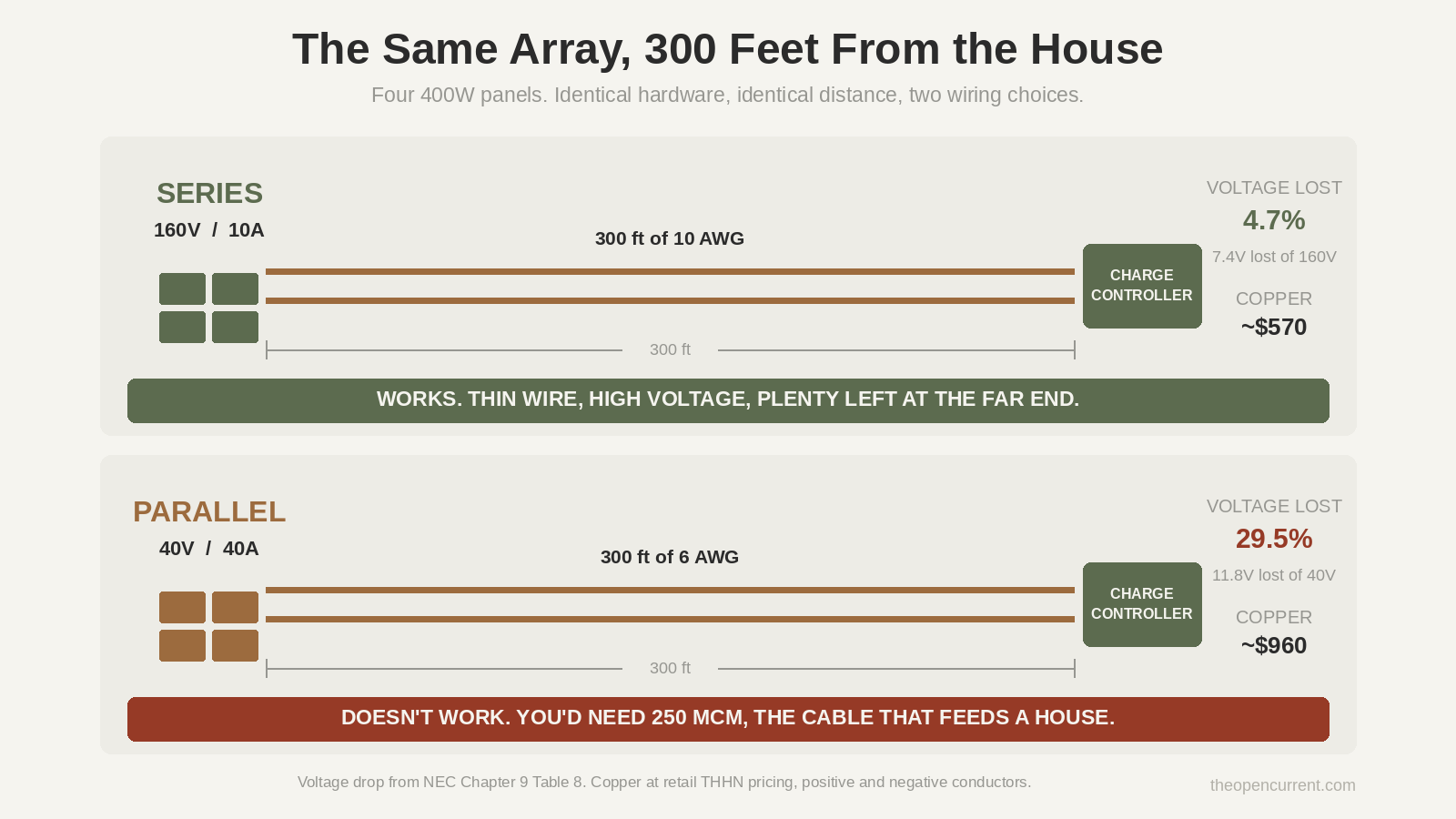
Copper is sold by the pound and current is what sets your gauge. Wire has to be sized for short circuit current times 1.25, so four 400W panels in parallel is around 55 amps, which wants something like 6 AWG on any run past about ten feet. Now go price 6 AWG at 300 feet. Twice, because you need a positive and a negative. That’s roughly $960 of copper against about $570 for the 10 AWG the series version needs.
But the cost isn’t even the real problem, and this is the bit that made me redo my own numbers.
Run those same four panels in parallel and you’re pushing 40 amps down the wire at 40 volts. Over 600 feet of 6 AWG conductor, that’s about 11.8 volts gone. On a 40 volt array. You’ve lost 29.5% of your voltage before it ever reaches the controller, and depending on your bank you may now be under the MPPT’s minimum input entirely, which means you get nothing at all.
Wire it in series instead and it’s 160 volts at 10 amps. Same 600 feet, thinner 10 AWG, and you lose 7.4 volts out of 160. That’s 4.7%, which is fine.
To get the parallel version down to a comparable loss you’d need something like 250 MCM. That’s service entrance cable. That’s the stuff that feeds a whole house. For four solar panels.
So parallel at 300 feet isn’t expensive. It’s broken. There’s a difference, and it’s worth being precise about it.
Worth saying that the ground wire goes out there with them. A long run to a ground mount is exactly where people are tempted to drive a rod at the array and call it done, and that isn’t what a rod does. Soil resistance is far too high to clear a fault, so the equipment grounding conductor still has to make the whole trip back.
Somebody on DIY Solar Forum ran 300 feet on 10 gauge THWN and calculated under 1% loss, then paralleled his string pairs at the inverter end and got it closer to half a percent.
Ten gauge. At three hundred feet. That’s the whole argument right there.
Standard advice for a long ground mount run is to push string voltage as high as your gear safely allows, purely because higher voltage means lower current means less copper means you still have money for batteries.
One counterintuitive thing while we’re here, because it surprised me. Voltage drop matters far less in PV wiring than it does in AC wiring. An MPPT will cheerfully take whatever voltage shows up at its terminals and convert it. So as long as you’re still above battery voltage plus that minimum margin, and the wire is fat enough to carry the current without cooking itself, a few percent of drop costs you close to nothing. Your real constraint on wire size is ampacity and safety. Not efficiency.
If you’re building a ground mount at any real distance, series is almost always the answer, and the copper bill is why. Same logic as well pump surge sizing your inverter, honestly. A component limit decides the design. Your preferences weren’t invited.
Original diagram. Reuse it with a link to theopencurrent.com.
Series-parallel, which is what most real builds actually look like
Past about four panels you generally stop picking a side and start doing both.
You wire panels into series strings to get the voltage up, then parallel those strings to get the current you want. It’s written 2S2P, meaning four panels in two series pairs with the pairs paralleled. Or 3S3P for nine. S is how many in series, P is how many strings. That’s it, that’s the notation.
This is how you land inside all three of your controller’s limits at once instead of pinning one of them to the ceiling. You also keep a bit of shade resilience while still getting a sane voltage for that long run.
One myth worth putting down: you do not need an even number of panels for series-parallel. What you need is for every parallel string to be identical, same panel count and same model. 3S3P with nine panels is completely fine. Nobody is counting your panels. There is no panel inspector.
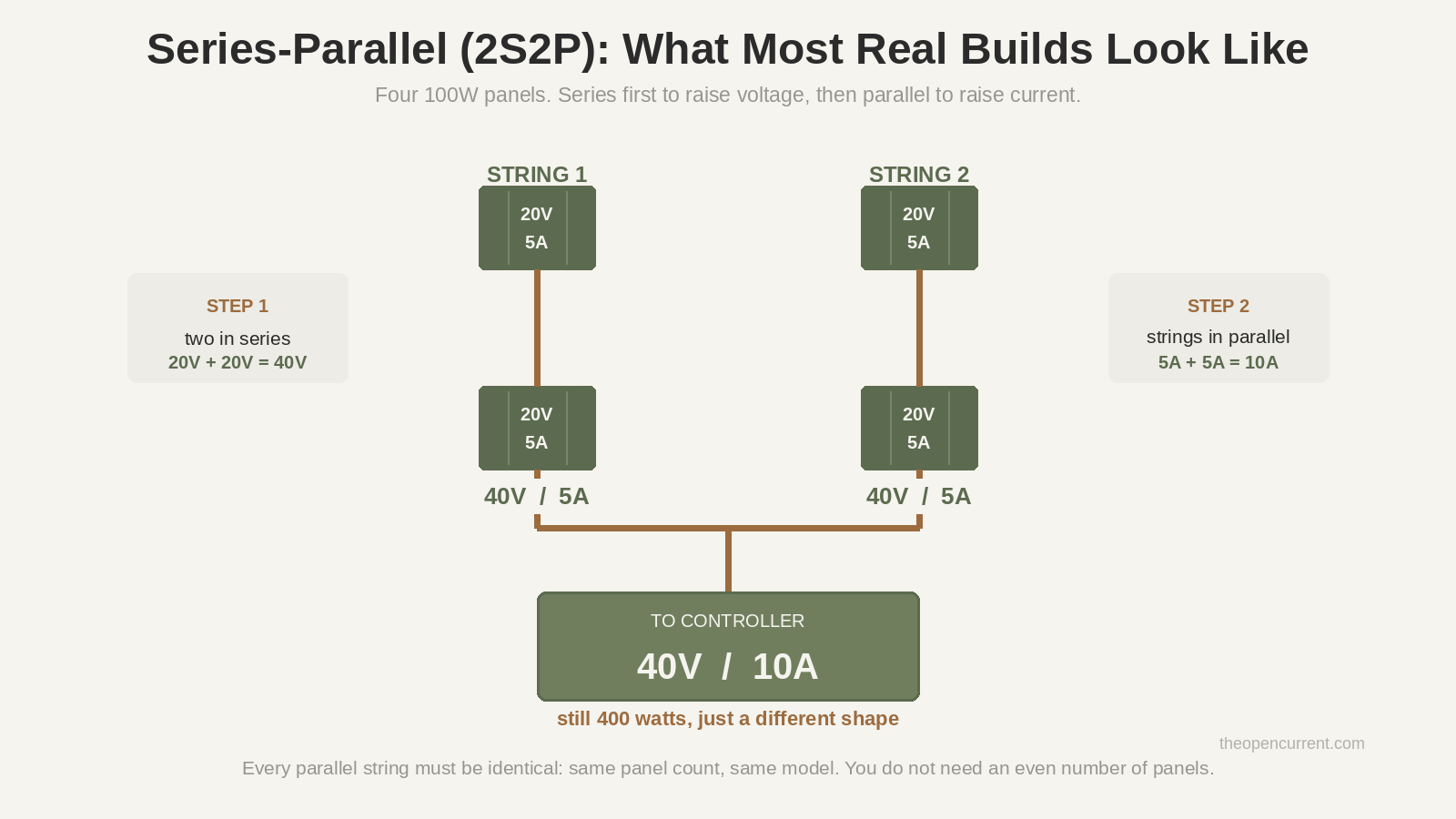
Original diagram. Reuse it with a link to theopencurrent.com.
The honest bit: shading is oversold
Right, shade. And I’m going to argue with the standard advice here, because I think it’s lazy.
You’ve read that one shaded panel in a series string tanks the whole string. Broadly true, since in series the weakest panel sets the current for everybody. But the internet version of this is way more dramatic than reality.
Every modern panel has bypass diodes sitting in its junction box. Shade hits part of a panel, the diode routes current around the shaded section instead of the whole string falling over. You lose that panel’s contribution and a small diode drop. You don’t lose the string. Your array does not commit seppuku because a cloud went past.
And here’s the part that genuinely made me sit up. A single series string with one shaded panel can perform as well as, or better than, two parallel strings feeding one MPPT input with one panel shaded. Why? The controller only has one operating point for everything on that input. Shade one string and you drag the tracker away from where the other string wants to sit.
Read that again, because it’s the good bit. The parallel arrangement you specifically chose for shade resilience may be handing you none, unless those strings go to separate trackers.
So, honestly:
- Properly bad shading? Neither wiring choice saves you. You want microinverters or DC optimizers, or you want the array somewhere else. Wiring is not a shade fix. It’s a shade mitigation at best, and a fairly weak one.
- Occasional or partial shading? Bypass diodes are handling more of this than you think.
- No real shading? Which is most ground mounts, since you sited it out in the open deliberately, being a sensible person. Then this whole section is irrelevant and you should be optimizing for voltage and copper instead.
And look, if you’re contorting your wiring around a shade problem you could fix by moving the array forty feet, just move the array. The array doesn’t have feelings about it.
Mistakes I keep tripping over in the forums
Buying the controller before designing the array. The controller’s limits determine your wiring, so doing it in that order is backwards. Loads first, then array, then buy the controller to fit, with headroom for the panels you’ll inevitably add later. Because you will. Everyone does. Adding panels to a maxed out controller means buying a whole new controller. If you haven’t worked out your daily draw yet, the off-grid cost calculator will get you a number to design against.
Using average winter temperature instead of record low. Your array does not fail on an average day. It fails on the worst one.
Mixing panel models in series. In a series string the lowest current panel sets the pace for everyone, like the slowest hiker in the group. Put a 13A panel in series with a 10A panel and you just threw away about 23% of the better one. Parallel is far more forgiving about mixing, as long as the voltages are close, within a volt or two of Vmp. Worth knowing if you’re buying used panels, which plenty of off grid builders do, and honestly should.
Assuming your combiner box is wired the way you think it is. There’s a thread where a guy was reading 176V out of a box that should have been putting out 85V, because the thing was wiring his strings in series instead of paralleling them. Put a meter on the output before you connect it to anything expensive. Thirty seconds.
Skipping fuses, or grabbing the wrong ones. Three or more parallel strings need per string overcurrent protection under NEC 690.9. One or two strings don’t strictly need it, though I’d still do it. Size at 1.56 times the string’s short circuit current. And use fuses rated and marked for photovoltaic use, which the 2026 code spells out. Code adoption lags publication by years and varies by state so your county may still be on an older cycle, but the automotive fuses rattling around in your truck glovebox were never the right answer here anyway.
Treating max wattage as the only spec that matters. Covered above but it earns a second mention, because it’s how a startling number of fried controller threads begin.
Questions to answer before you buy anything
Work through these in order and honestly, the wiring answer mostly falls out on its own.
- Is my charge controller MPPT or PWM? PWM shoves you toward parallel. MPPT opens up series.
- What’s the max PV input voltage, and what’s the record low where I live? Run the cold Voc maths. Leave 10 to 20% headroom.
- What’s the max PV input current? Not the output amps. The input limit. Different number, same datasheet.
- What voltage is my battery bank? 12, 24 or 48V changes the minimum array voltage you need to make anything happen at all.
- How far is the array from the batteries? Price the wire both ways before you commit to anything. My rough read is copper starts driving the answer around fifty feet and pretty much is the answer past a hundred and fifty. Rule of thumb though, not gospel. Run your own numbers.
- Am I adding panels later? You are. String sizing now decides what fits later.
- Do I actually have shading, or do I just have trees somewhere on the property? Be honest with yourself.
- Are all my panels the same model? If not, keep the odd ones out of the same series string.
FAQ
Is series or parallel better for solar panels? Neither, universally, and anyone who tells you otherwise is selling something. Off grid, series usually wins because of long wire runs and better low light performance, provided your controller is MPPT and your cold weather voltage stays inside its limit. Parallel wins with a PWM controller, with short runs, and when your panels are genuinely mismatched.
Can I mix series and parallel solar panels? Yep, and past four panels you probably should. It’s called series-parallel, written 2S2P or 3S3P. Only rule is that every parallel string has to be identical in panel count and model.
Do solar panels in series or parallel produce more power? Exactly the same. Four 100W panels are 400 watts either way. What changes is the voltage and current split, and how much of that your controller can actually make use of.
Does series or parallel charge faster? With MPPT, about the same, though series tends to start earlier in the morning and hold up better under cloud because it crosses the controller’s minimum voltage sooner. With PWM, parallel charges considerably faster, because all that series voltage above the battery is just binned.
How many solar panels can I wire in series? However many keep your cold weather Voc under the controller’s max PV voltage, with headroom. Take the panel’s Voc, apply the temperature coefficient at your record low, multiply by the number of panels, stay 10 to 20% under the limit. Then stop.
Solar panels in parallel vs series, which is safer? Neither. They just fail differently. Series bites you through cold weather voltage frying the controller. Parallel bites you through amps, either blowing past the controller’s input limit or cooking undersized wire on a long run. Honestly? Series-parallel is the safest of the three, because it keeps both numbers sitting in the middle of their range instead of pinning one right at the top.
What happens if I exceed the charge controller’s voltage? Sometimes you get a protective fault and a second chance. Often you get permanent damage and no warranty cover. Treat it as a hard limit, not a suggestion.
Do I need fuses for parallel solar panels? Three or more parallel strings, yes, per NEC 690.9. One or two, not required but still sensible. Use PV rated fuses sized at 1.56 times the string’s short circuit current.
Where to go next
- Free solar battery calculator. Array sorted? Now size the bank that sits behind it.
- How to go off grid with solar. The full system picture, including why winter sun hours are the number that actually sizes everything.