Off-Grid Solar Kit Buying Guide: What’s Actually in the Box, and What Isn’t

Search for an off-grid solar kit and you’ll get a hundred pages telling you which ten to buy. Almost none of them tell you the thing that actually matters, which is that a kit is sized and sold on the one number that decides the least.
Every kit on the market is named after its panel wattage. 400W, 1200W, 5000W. That number tells you almost nothing about whether the thing will keep your lights on in February, because panels aren’t the constraint. Storage is. As one guy on the DIY Solar forum put it, no matter how many panels you have and no matter how big your inverter is, if you run out of power at 2am it’s all useless.
So this guide is built the other way round. What a kit actually contains, what it quietly leaves out, how to size one off your real numbers instead of the sticker, and the specific situations where buying components separately is the better call.
What’s actually in an off-grid solar kit
Four things, and if any one is missing you’re not looking at a complete system.
Panels. Rated in watts, almost always monocrystalline now. This is the number on the box.
A charge controller. Regulates what comes off the panels into the battery. You want MPPT, not PWM. MPPT harvests meaningfully more from the same panels, and the gap gets wider in cold weather and low light, which is exactly when you need it.
A battery bank. Lithium iron phosphate is the standard worth paying for in 2026. Real cycle life in the thousands, usable depth of discharge around 80 to 90 percent, and it doesn’t punish you for partial charging the way lead acid does.
An inverter. Converts stored DC into the AC your house runs on. Pure sine wave, not modified. Modified sine wave will run a lightbulb and quietly cook anything with a motor or a circuit board in it.
Plenty of things sold as kits are just a panel and a controller in a box. If a listing doesn’t name all four components with real specs, it isn’t a complete system and the price isn’t comparable.
Size it off kilowatt hours, not watts
Here’s the switch that makes everything else make sense.
Panel wattage is a peak rating under lab conditions. What you care about is kilowatt hours per day, which is wattage multiplied by the real sun hours where you live, minus system losses. The US average is just under 5 peak sun hours a day. Most of the continental US sits around 4 to 4.5, the desert southwest tops 6, and the Pacific Northwest and Alaska run closer to 3.5. You can pull the exact figure for your address from NREL’s PVWatts calculator, which is the Department of Energy’s own production model and free to use.
Here’s the number that matters more than the average, though. Winter daily production can run 25 to 50 percent below the annual figure. So your worst month, not your average month, is what you size against.
Rough working figure: a 1,000W array in decent sun produces somewhere around 4 kWh a day. Not 24. That gap between rated watts and delivered kilowatt hours is where most bad kit purchases happen.
So the sizing order goes like this. Add up what you actually use in a day in kilowatt hours. Decide how many days you need to run with no sun, which for a full time off-grid house is realistically 2 to 5. Size the battery bank from those two numbers. Then size the array to refill that bank in your worst month. Then size the inverter for your biggest simultaneous load, plus surge.
That’s the opposite of how kits are marketed, and it’s why people end up with the wrong one.
One more thing kits gloss over: how the panels get joined together. Wiring them in series vs parallel doesn’t change your total watts, but it completely changes the voltage and current arriving at the controller, and a kit that ships with a PWM controller wants a very different answer than one with an MPPT.
I built the solar battery calculator to do exactly this part, because it’s the step everybody skips. Run your loads through it before you look at a single product page.
What each kit size actually does
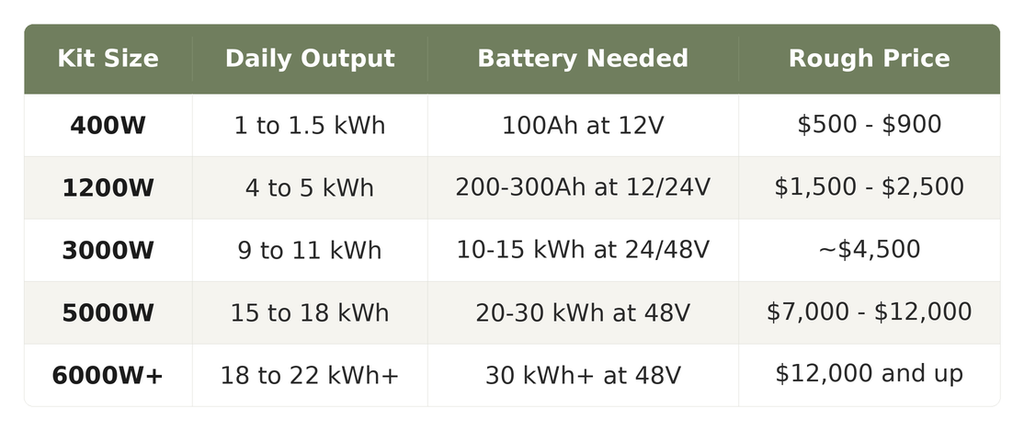
One thing worth calling out about that bottom tier. The 600 to 1200W segment is the most crowded part of the market, and it’s crowded because van life and overlanding have exploded, not because it suits cabins. If you’re reading roundups where every kit lands in that range, you’re reading content written for someone sleeping in a van three nights a month. A full time cabin needs several times that.
The kits people actually end up looking at
These are the names that come up over and over. I haven’t had these on a bench, so what follows is what each one contains according to the manufacturer specs, and more usefully, what each one doesn’t.
Renogy starter kits, 200W and 400W. The best selling kits in the category and the ones most likely to disappoint an off-grid buyer. The 400W RV kit is four 100W panels, a 30A PWM charge controller, wiring and connectors. No battery. No inverter. And the controller is PWM rather than MPPT, with a hard 400W ceiling, so there’s no room to add panels later without replacing it. Fine for a shed or topping up an RV house battery. Not a house system, despite what the wattage suggests.
Rich Solar 1200W 24V complete kit. A genuinely complete one. 60A MPPT controller, 3000W inverter, two LiFePO4 batteries. Around $1,500 and up. Worth checking which variant you’re looking at, because Rich Solar sells several 1200W configurations and the contents differ substantially between them.
EcoWorthy 1200W. Six 200W panels, controller, inverter, battery and mounting hardware. Roughly 4 to 6 kWh a day in good sun, which covers lights, a small fridge, device charging and not much else. Popular as a first system because the whole thing arrives in one go.
Renogy 1.2kW Essential kit. A step up in seriousness. Four 320W PERC panels, a 9.6 kWh battery bank, and a 48V 3500W inverter charger rated to 7000W surge. That surge headroom matters if you’ve got a pump. It’s also one of the few kits that actually includes circuit breakers.
SunGoldPower, 6000W and 8000W. This is the tier where 240V appliances become possible, which is the dividing line between “powers the essentials” and “powers the house.” Their 8000W kit pairs 5400W of panels with a 10.24 kWh battery. Note that battery to array ratio, it’s on the thin side for full time use and you’d likely want to expand it.
Signature Solar and EG4. Rack mounted battery systems and whole-house inverters. This is the top tier and it’s where the battery economics I mentioned above bite hardest, so price the storage separately before committing.
Where to buy matters too. The rough consensus is that under about $1,500 Amazon is fine and gets you easy returns. Above that, buying direct from the manufacturer or through a specialty retailer like altE or Solar Electric Supply gets you actual design support, which at that price is worth more than the convenience.
One note on batteries in the smaller kits. For a 1200W system, an AGM lead acid bank runs roughly $300 to $600 and lasts 3 to 5 years. LiFePO4 runs $800 to $2,500 and lasts 10 to 15. On a permanent installation the lithium is cheaper per year before you even count the extra usable capacity. If a kit’s price looks unusually good, check which chemistry it shipped with.
What kits leave out, and what it really costs
The kit price is not the system price. Not close. Here’s what routinely isn’t in the box.
Mounting for your actual site. Kits include panel brackets, sometimes. They don’t include a ground mount rack, roof flashing for your specific roof type, or the concrete for posts. A proper ground mount for a mid-size array is real money and real labor.
The wire runs. Kits ship with short pigtails between components. They do not include the run from your array to your equipment, which is often 50 to 150 feet, has to be sized for voltage drop, and gets expensive fast in copper.
Disconnects, breakers, fuses and grounding. Every one of these is required, none are optional, and most kits include few or none of them.
Permits and inspection. Depends entirely where you are, but budget for the possibility.
A generator and the transfer setup. Almost every real off-grid system has one for the February stretch where the sun doesn’t show up for a week.
Realistic planning advice: take the kit price and add 30 to 50 percent for everything above. If that number breaks your budget, you’ve learned it now rather than halfway through the install.
The battery problem nobody mentions
This is the single biggest reason to think twice about a kit.
The battery is the most expensive component in an off-grid system, and it’s the one kits skimp on hardest. The panels and the inverter look impressive on the listing. The battery is where margin gets made.
The numbers people quote on the forums are brutal. Buying a pre-racked battery setup from a kit retailer can run around $10,000 for 30 kWh of storage. Sourcing cells and building the same capacity yourself lands nearer $7,000 for close to 90 kWh. That’s not a small premium for convenience, it’s a different product entirely.
Now, building your own battery bank is a real project with real safety implications, and it isn’t for everyone. But it’s worth knowing the gap exists, because “the kit came with a battery” is doing a lot of quiet work in a lot of purchase decisions.
The honest middle ground most people land on: buy the panels, controller and inverter as a matched kit if you want the compatibility guarantee, and buy the battery separately from a dedicated supplier. You keep the easy part easy and stop overpaying for the expensive part.
So should you buy a kit at all?
A kit makes sense if you’re building something small to medium and you want compatibility guaranteed. If this is your first system and you’d rather not spend three weeks checking whether a controller’s voltage window matches your panels’ Voc in cold weather. If you want one warranty and one phone number when something goes wrong. If your time is worth more than the premium, which for plenty of people it genuinely is.
Buy components separately if you’re building anything approaching whole-house scale, where the kit premium runs into thousands. If you already understand load math and voltage windows. If you want a specific inverter, which is usually the component people care most about and the one kits give you least choice over. Or if you’re in it for the learning as much as the power, which is a perfectly good reason.
There’s no universally right answer here. What’s wrong is buying a kit because the box made the decision feel simpler than it is.
The mistakes that actually bite people
Sizing off today instead of the winter. Your worst production month can be a third of your best one. Size for February and you’re fine all year. Size for the annual average and you’ll be running a generator every winter.
Forgetting phantom loads. Everything with a standby light, a clock, or a wifi chip is drawing power constantly. Across a whole house it adds up to a real slice of your daily budget and it never appears in anyone’s mental math.
Ignoring startup surge. Motors pull several times their running wattage for a second or two when they kick on. A well pump is the classic offender, and it’s exactly the thing that makes an adequately sized inverter fault out. I went through that in detail in the submersible well pump guide if you’ve got a pump in the picture.
Undersizing the wire. Voltage drop over a long run is lost power, permanently, every single day for twenty years. Copper is expensive once. Losing eight percent of your production forever is expensive continuously.
Buying PWM to save money. A cheaper controller that harvests less from the same panels is a false economy that compounds daily.
No room to expand. Off-grid energy use grows. Buy a charge controller with headroom above your starting array and you can add panels later. Buy one sized exactly to your kit and you’re replacing it.
Trusting the brochure number. Rated wattage under lab conditions is not what your roof produces in November in Vermont.
Frequently asked questions
What size off-grid solar kit do I need? Work backwards from daily kilowatt hours, not panel watts. Add up your real daily consumption, multiply by your desired days of autonomy for battery sizing, then size the array to refill that in your worst production month. A small cabin might need 1 to 2 kW of panels, a full time house usually 5 kW and up.
Can an off-grid solar kit really power a whole house? Yes, at the larger sizes, though “whole house” usually means a house whose loads were designed around the system. Electric heat, electric water heating and air conditioning change the math enormously.
What does an off-grid solar kit cost? Kit prices have dropped roughly 18 percent since 2022. A complete 3 kW kit with panels, lithium battery, inverter and controller now starts around $4,500. Add 30 to 50 percent for the things kits don’t include.
Is a kit cheaper than buying components separately? Usually not on price, particularly on the battery. You’re paying for matched compatibility and a single warranty. Whether that’s worth it depends on how much you value your own time and how confident you are specifying components.
How long do off-grid solar kits last? Panels are typically warrantied 25 years and often outlive it. Quality LiFePO4 batteries run thousands of cycles, realistically a decade or more. Inverters and controllers are usually the first things to need replacing.
Do I need a generator with an off-grid solar kit? Most full time off-grid setups have one. Not for daily use, but for the run of dark days where sizing for that scenario with panels and batteries alone would cost far more than a generator does.
Can I add panels to a kit later? Only if the charge controller has headroom above your starting array. Check its maximum input rating before you buy, because it’s the cheapest bit of future-proofing available.
Where to go from here
If you take one thing from this, make it the sizing order. Kilowatt hours first, then battery, then array, then inverter. Every expensive off-grid mistake I came across while researching this traces back to someone doing that backwards and starting with a panel wattage that looked about right.
Run your real numbers through the solar battery calculator first. Then go shopping, with an actual figure in your head instead of a vibe.
And if you’re earlier than that, still working out whether off-grid is the right move at all, start with the off-grid solar guide, which covers how the whole build fits together before you spend anything.
| Kit Size | Daily Output | What It Realistically Runs | Battery Needed | Rough Kit Price | Best For |
|---|---|---|---|---|---|
| 400W | 1 to 1.5 kWh | Lights, phones, laptop, small fan | 100Ah at 12V | $500 to $900 | Shed or weekend cabin |
| 1200W | 4 to 5 kWh | Adds a small fridge and water pump | 200 to 300Ah at 12V or 24V | $1,500 to $2,500 | Seasonal cabin or van |
| 3000W | 9 to 11 kWh | Adds full fridge, tools, well pump | 10 to 15 kWh at 24V or 48V | around $4,500 | Small full-time cabin |
| 5000W | 15 to 18 kWh | Most loads in a small house | 20 to 30 kWh at 48V | $7,000 to $12,000 | Full-time off-grid home |
| 6000W and up | 18 to 22 kWh+ | Whole house including 240V loads | 30 kWh and up at 48V | $12,000 and up | Homestead with heavy loads |