Perc Test Guide: What It Costs, What It Means, and What Happens If Your Land Fails

There’s a test that costs around $1,300 and decides whether a piece of rural land is worth what you’re about to pay for it, or worth almost nothing at all.
It’s called a perc test, and it’s the single most important thing to understand before you buy raw land that isn’t on a municipal sewer. Get it wrong and you can end up owning acreage you’re legally not allowed to build a house on.
I came at this from the off-grid side, working out what you actually need to check before buying property. This one kept coming up first, before water, before power, before any of the fun parts. So here’s the whole thing: what the test is, what it costs, what the numbers mean, and what your options are if the answer comes back bad.
Before you book a perc test, know where your property lines actually are. Setbacks measure from the boundary, so a spot that percs beautifully can still be unusable if it sits inside the setback. I’ve laid out what that costs and how the pricing works in the land survey cost guide.
What a perc test actually measures
Perc is short for percolation. The test measures how fast water drains through your soil, and the result is given in minutes per inch, or MPI. Lower is faster.
That number matters because if you’re not on a sewer line, your wastewater has to go somewhere, and that somewhere is a septic drain field. A drain field works by letting treated wastewater soak into the ground. If the soil won’t absorb water at a reasonable rate, the system backs up. If it absorbs too fast, the wastewater reaches groundwater before the soil has filtered it.
So the county isn’t being difficult. They’re making sure your sewage doesn’t end up in the aquifer that your well and your neighbor’s well both draw from.
Your perc rate also determines how big the drain field has to be. Fast soil at around 5 MPI needs relatively little trench per bedroom. Slow soil at 45 MPI needs a lot more. That’s why two lots a mile apart can need completely different drain field footprints for the same house.
How the test works
The process is simple enough that people are often surprised it costs what it does.
Two or more holes get dug in the area where the drain field would go, typically 30 to 50 feet apart, 6 to 12 inches across, and 18 to 36 inches deep. A couple of inches of clean gravel goes in the bottom.
The holes get presoaked, then filled with water, and the technician measures how long the water level takes to drop a set distance. That drop rate, converted to minutes per inch, is your perc rate.
In most states a licensed soil scientist, a professional engineer, or a registered sanitarian has to perform or supervise it. Some places let a septic installer do preliminary testing, but the health department usually sends its own inspector to witness or verify before any permit gets issued.
Start with your county health department. They set the rules, they decide how many holes and how deep, and most of them keep a list of approved evaluators. Hiring somebody who isn’t on that list is a good way to pay for a test twice.
What the numbers mean
Thresholds vary by county, so treat these as general rather than gospel.
Somewhere in the range of 5 to 60 MPI is the typical pass window for a conventional system. Around 30 MPI or better is comfortable.
Slower than roughly 60 MPI usually means dense clay or compacted soil, and that’s a fail in most jurisdictions. One real example I came across: soil draining at 90 minutes per inch, well past the county limit, where the alternative system would have cost close to $35,000.
Faster than about 1 to 5 MPI can also be a problem, because sand and gravel let water through so quickly that the soil doesn’t filter it properly before it reaches groundwater. People rarely expect this one. If you’ve got your result in hand, I built a tool that reads it back to you: enter your MPI and it tells you where that sits, what it means for your drain field, and what to do next.
This matters again if your field ever fails, because the soil in your replacement area decides what you’re allowed to rebuild and what it costs. That’s in the drain field replacement cost guide.
What it costs
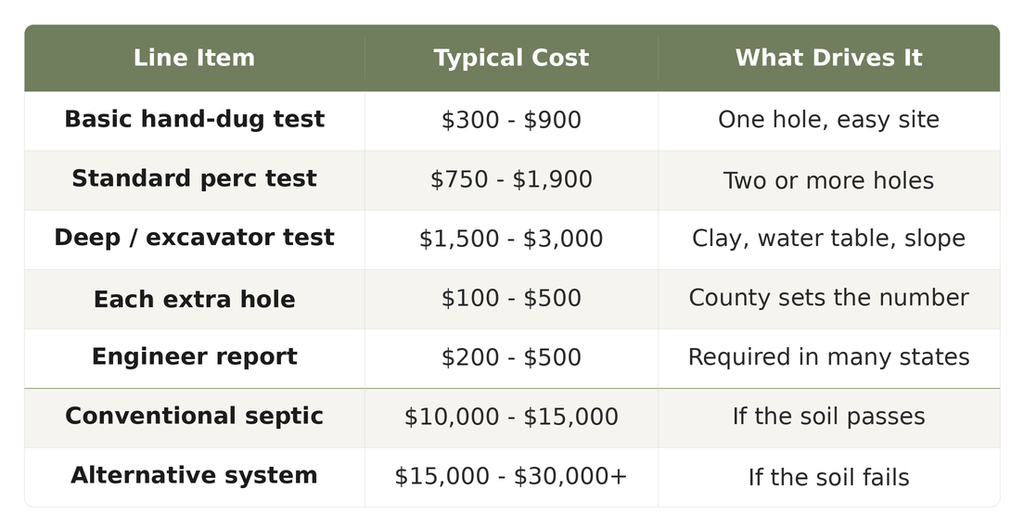
The national average for a perc test lands around $1,300, with most falling between $750 and $1,900. A basic single hand-dug hole on an easy site can be as low as $300. A large parcel needing machine-dug holes can run to $3,000.
What drives the number: how many holes your county requires, how deep they have to be, whether they can be hand-dug or need an excavator, how accessible the site is, and whether a full engineering report is bundled in.
Look at that table again though, because the test cost is not the point. The point is the two rows at the bottom. A conventional septic install runs somewhere around $10,000 to $15,000. An engineered alternative system runs $15,000 to $30,000 and sometimes well past it.
A $1,300 test is buying you information about a $30,000 decision. That’s the whole argument.
What happens if it fails
This is the part that catches people, so let me be direct about it.
In most counties, land that fails a perc test and has no approved alternative cannot be built on for human habitation. Not “it’s harder.” You don’t get a building permit. The land is worth whatever it’s worth as a hunting lease or a woodlot, and not much more.
That said, a fail isn’t automatically the end. Here’s the ladder of options, roughly in order of cost.
Retest somewhere else on the parcel. Soil varies enormously over short distances. If you tested in the low spot and there’s a better-drained rise two hundred feet away, that’s worth checking. You’ll pay for the second test, but it’s cheaper than everything below. If there’s an existing system on the property rather than bare land, a septic inspection is the equivalent check, and it has the same power to end a deal.
Test at a different time of year. A high seasonal water table can fail a site in March that would pass in September. Counties vary on whether they’ll allow this, and some deliberately require testing in the wet season for exactly that reason.
Engineered or alternative system. Mound systems, drip irrigation, aerobic treatment units, pressure-dosed systems. These treat the wastewater harder before dispersing it, so they work in soil that won’t take a conventional field. Budget $10,000 to $25,000 rather than $3,000 to $8,000, plus more maintenance for the life of the system, plus more maintenance for the life of the system. I’ve broken all of these down properly in the septic system cost guide, including the continuous power draw an aerobic unit puts on an off-grid system.
Sewer connection. If the parcel is near a sewer district, extending a line might genuinely be cheaper than fighting the soil. Worth a phone call before assuming otherwise.
Walk away. Which brings us to the most important thing in this whole article.
The one sentence that protects you
Make your offer contingent on the land passing a perc test.
That’s it. That’s the thing. Every source I read, from soil scientists to land investors to building advisors, lands on the same advice, and it’s the difference between a bad outcome and no outcome.
In the 90 MPI example I mentioned, the buyer had a perc contingency in the contract. The test failed, they walked, and it cost them nothing but the price of the test. Without that clause they’d have owned an unbuildable parcel.
A failed perc test is also a completely legitimate reason to renegotiate hard rather than walk, if you still want the land. The seller now knows what you know.
And if the seller pushes back on including the contingency, that itself is information.
Red flags to look for before you spend anything
You can’t tell a perc rate by looking. But some sites are worth being suspicious about before you pay for a test.
Standing water or soggy ground weeks after rain. Cattails, rushes, willows and other water-loving plants. A low spot that everything drains toward. Heavy clay you can roll into a ribbon in your hand. Visible bedrock or a lot of surface rock. A steep slope, where water runs off rather than soaking in. Neighboring lots with mound systems visible, which tells you the whole area has bad soil.
None of these are conclusive. All of them mean go in expecting to need the test result before you commit.
Where this sits in the bigger picture
A perc test is the first of several things that decide whether rural land is actually usable. The others are water, access, and power.
Water is the one most people underestimate next. Drilling a well runs into the thousands and you find out what you got after you’ve paid. If you’re at this stage, the off-grid water systems guide covers how the whole water side fits together, from what’s in the ground to what comes out of the tap.
Do these checks in the order that can kill the deal fastest. Perc test first, because a fail ends it. Then water. Then legal access. Then everything else.
Frequently asked questions
How much does a perc test cost? Nationally around $1,300 on average, with most between $750 and $1,900. A basic hand-dug test on a simple site can be $300, and a large parcel needing excavator-dug holes can reach $3,000.
Who pays for the perc test, buyer or seller? Usually the buyer, as part of due diligence. Sellers sometimes have recent results available, and splitting the cost is a reasonable thing to propose. Either way, insist on a contingency rather than relying on old paperwork.
How long does a perc test take? The fieldwork is usually a few hours to a day, though presoaking can mean a second visit. Getting scheduled is often the slow part, and results plus county paperwork can take a couple of weeks.
Can I do a perc test myself? You can dig a hole and get a rough idea, which is genuinely worth doing before you pay anyone. But no county will issue a septic permit on a homeowner’s own test. The official version has to be done or supervised by a licensed professional.
What is a good perc rate? Broadly, 5 to 60 MPI passes in most places, with 30 or better being comfortable. Slower than 60 usually fails. Faster than about 5 can also fail, because the soil isn’t filtering properly. Check your own county, since thresholds vary.
Does a failed perc test mean the land is worthless? For building a house, often yes, unless an alternative system is approved. The land may still have value for recreation, timber, or agriculture. But you shouldn’t pay residential building-lot prices for it.
Do I need a perc test for an off-grid property? If you’re putting in a septic system and you’re not on a sewer, yes. Composting toilets change the picture for blackwater in some jurisdictions but you’ll still usually need a plan for greywater, and rules vary enormously by county.
How long are perc test results valid? Depends entirely on the jurisdiction. Some accept results for years, others require a fresh test after a couple of seasons or if site conditions change. Ask the health department rather than assuming.
| Line Item | Typical Cost | What Drives It |
|---|---|---|
| Basic hand-dug test | $300 to $900 | Single hole on an easy accessible site |
| Standard perc test | $750 to $1,900 | Two or more holes; national average around $1,300 |
| Deep or excavator-dug test | $1,500 to $3,000 | High water table, clay, slope or a large parcel |
| Each extra test hole | $100 to $500 | County sets how many holes are required |
| Engineer or soil scientist report | $200 to $500 | Required in many states, sometimes bundled |
| Conventional septic install | $10,000 to $15,000 | Passing soil and a standard drain field |
| Engineered alternative system | $15,000 to $30,000+ | Mound, drip or aerobic system after a failed test |