Septic System Cost: What You’ll Actually Pay to Install One in 2026

Septic system cost runs anywhere from $3,000 to $40,000, and the spread isn’t about how nice a system you pick. It’s about what your dirt will let you build.
That’s the thing nobody tells you up front. You don’t choose your septic system. A hole in the ground and a stopwatch choose it for you, and by the time you know the number it’s already decided. Your budget has almost nothing to do with it.
So here’s what the bill actually breaks into, why the drain field is the expensive half, and the line item that only shows up if you’re off grid.
What a septic system actually costs
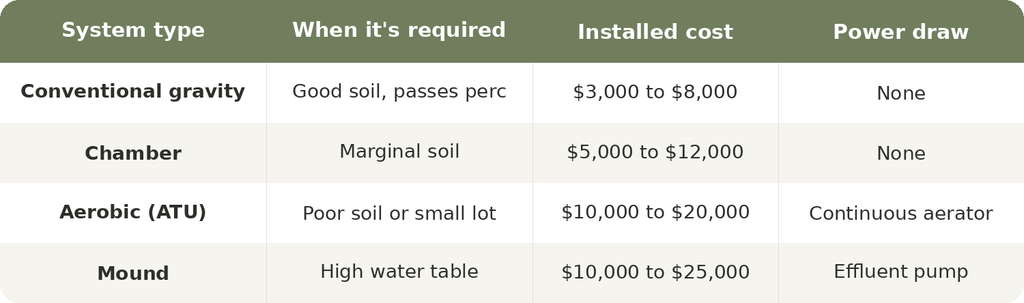
Roughly 70 percent of installs are conventional gravity systems, so if your soil is decent that’s the number you’re working with. The rest of the range is what happens when it isn’t.
The jump from conventional to aerobic or mound isn’t a small step up. It’s two to three times the price, and it’s not optional. If your perc test comes back bad, the county isn’t going to let you install the cheap system anyway.
The perc test is the whole ballgame
Your percolation test measures how fast water drains through your soil. That single number decides which systems you’re allowed to build, which decides your cost.
Your soil drives septic system cost more than anything else on the quote. Pass with good soil and you’re in conventional territory at $3,000 to $8,000. Marginal soil pushes you to a chamber system. Fail properly, or have a high water table or shallow bedrock, and you’re looking at mound or aerobic at $10,000 to $25,000.
In big chunks of rural Texas, Florida, Arkansas and Missouri, aerobic systems aren’t a fallback. They’re the only permitted option, full stop. The EPA’s onsite wastewater guidance covers the full range of system types and why soil conditions decide which one you’re allowed to build.
If you haven’t done the test yet, that’s step one, not step five. I’ve covered what it involves and what it costs in the perc test guide, and if you’ve already got results you don’t understand, the perc test results tool will translate them.
What’s actually in the bill
Septic system cost breaks down into seven line items on a conventional install:
- Septic tank: $500 to $2,500 for the unit. A 1,000 gallon concrete tank is the common minimum
- Drain field: $2,000 to $10,000, and this is 40 to 60 percent of your total
- Excavation: $1,500 to $5,000
- Distribution box, piping, fittings: a few hundred
- Permits: $200 to $1,500
- Perc test and soil evaluation: $250 to $1,000
- Labor: typically 40 to 60 percent of the project
Two things jump out of that list.
The tank is the cheap part. People fixate on tank price because it’s the thing you can picture, but the drain field costs three to five times more and does most of the actual work.
And permits and the perc test are usually quoted on top, not included. If a number looks low against everything above, that’s often why. Ask whether it’s in there.
Tank sizing runs by bedroom count, not square footage. One to two bedrooms needs 750 gallons minimum, three bedrooms 1,000, four bedrooms 1,250, five or more goes to 1,500 and up. Counties set their own floors and plenty require 1,000 gallons regardless.
The off-grid cost nobody counts
Here’s where every other septic cost guide leaves you hanging, because they’re all written for somebody with a power company.
An aerobic system runs an air compressor continuously. That’s the whole principle. It injects oxygen to feed bacteria that break waste down faster than the anaerobic bugs in a conventional tank. On grid that’s a modest line on your electric bill and nobody thinks about it.
Off grid it’s a 24 hour a day parasitic load on your battery bank. Not a spike, not an occasional draw, a constant one, through every cloudy week in January. It’s arguably the worst shape of load an off-grid system can carry, because you can’t shift it to the middle of a sunny afternoon.
Mound systems usually need an effluent pump. The whole point of a mound is that your drain field sits above natural grade, so something has to push water uphill. That’s a motor, and motors surge hard on startup. Same problem I went through in the well pump replacement cost guide, where startup surge is the most common reason off-grid inverters trip.
If you want to see what that does to a whole system rather than just this one line, the off grid cost calculator prices your water, wastewater, heating and appliances together and tells you what the lot draws.
So the real off-grid math isn’t just which septic system you can afford. It’s whether your power system can carry it.
A failed perc test can cost you twice. Once at the county office, and again when you have to grow your array and bank to run the thing they made you install. Work out what that continuous draw does to your storage before you sign, not after. The solar battery calculator will get you a number.
One honest note: sources disagree quite a bit on what aerobic systems cost to run, somewhere between a couple hundred dollars a year and a couple hundred a month once you count maintenance contracts and chlorine. Get the actual aerator wattage off the spec sheet for the unit you’re quoted and do your own math. That’s the only number that matters for your system.
The composting toilet thing, honestly
This is the part where I tell you the clever workaround mostly isn’t one.
The assumption in off-grid circles is that a composting toilet means you skip the septic bill entirely. For most people that’s wrong, and it’s an expensive thing to be wrong about after you’ve bought land.
Your sinks, shower and laundry still produce wastewater, and greywater has to go somewhere the county approves of. On top of that, building codes in many jurisdictions require a legally habitable dwelling to have a flush toilet connected to an approved sewer or septic system. Installing a composting toilet doesn’t make that requirement disappear. Several states require a full septic system regardless of what your toilet does.
Rules vary a lot. Arizona permits composting toilets as sole treatment with a permitted greywater dispersal system. Massachusetts wants the compost buried on site and greywater into a septic or hauled away. Washington requires all greywater through a septic system. There’s no national standard and your county is the authority, not a blog post.
But here’s the version that does work. Some installers will size a much smaller tank and drain field for greywater only, on the basis that the composting toilet handles the blackwater. That can cut your septic cost by 40 to 60 percent, which on a mound system is real money. It’s not free, and it’s not automatic, but it’s a genuine conversation to have with your designer and your county before you spend $20,000.
Call the health department before you buy a toilet. Not after.
Mistakes that cost people real money
Not asking what happens to your driveway. One homeowner had their asphalt driveway wrecked by the excavator getting to the site, and when they asked the contractor to split the repair they were told it was their own fault for not saying they didn’t want their driveway damaged. Site access and restoration is real money and it is almost never in the quote. Ask, in writing, what condition the site gets left in.
Taking a quote that won’t itemize. You want tank, drain field, excavation, permits, perc test and labor broken out separately. Without that you can’t compare two bids, and you can’t tell whether the cheap one is cheap or just incomplete.
Not knowing where the existing tank is. On a replacement, roughly 63 percent of homeowners can’t point to their tank, and locating it adds $75 to $150 to the job. Check your original paperwork or look for a diagram on the tank lid before the truck shows up. If you’re buying rather than replacing, get the system inspected before you close. I’ve covered what that costs and what a real one involves in the septic inspection guide.
Assuming rural means no rules. Rural counties care about wastewater more than suburban ones do, because bad sanitation contaminates wells, and out there everybody’s on a well. Yours included.
Budgeting for the tank instead of the system. Worth repeating because it’s the single most common version of sticker shock. The tank is $500 to $2,500. The system is $3,000 to $25,000.
Skipping the second quote. Same advice as every other trade. Get three, insist on itemized, and be suspicious of anything wildly cheaper rather than relieved by it.
How long it all lasts
Concrete tanks run 40 years or more. Plastic tanks 20 to 30. Drain fields 25 to 30 years if you look after them.
Pumping every three to five years is the single most useful thing you can do, and it’s cheap compared to what it prevents. A failed drain field can’t be chemically rescued back to health. Once it’s gone it’s a replacement, and replacement means digging up your yard again. I’ve gone through what that costs, and how to tell a repairable field from a dead one, in the drain field replacement cost guide.
Watch for slow drains everywhere at once, sewage smell outdoors, or soggy ground over the field. Caught early you might get away with a distribution box repair or rerouting effluent. Caught late you’re buying a new field.
Frequently asked questions
How much does it cost to install a septic system? A conventional gravity system on decent soil runs $3,000 to $8,000 installed. Aerobic and mound systems run $10,000 to $25,000. Engineered systems for difficult sites can reach $40,000.
What’s the cheapest septic system? Conventional gravity, at $3,000 to $8,000. No moving parts, no electricity, gravity and soil do the work. You only get to use one if your soil passes.
Why is my quote so much higher than the average? Almost always soil, water table or access. A failed or marginal perc test moves you up a cost ladder that has nothing to do with the house you’re building.
Does a septic system need electricity? A conventional gravity system needs none at all. Aerobic units need continuous power for the aerator. Mound and some engineered systems need a pump. That distinction matters enormously off grid.
Can I use a composting toilet instead? Usually not instead, sometimes alongside. Greywater still needs legal disposal and most codes still require a connected flush toilet for a habitable dwelling. Check with your county before spending anything.
How often should I pump it? Every three to five years for most households. More if you’re running a bigger family through a smaller tank.
Where to go from here
Get the perc test done first, because your septic system cost depends entirely on that result. There’s no point pricing systems you may not be allowed to install.
Then get three itemized quotes and read them against the breakdown above. If a number is missing, it isn’t included.
And if you’re off grid, work out the continuous load before you agree to an aerobic system. The cheapest septic system is the one your soil allows, but the cheapest system to live with is the one that doesn’t eat your battery bank every night in December.
Next:
- Off-Grid Water Systems for how the whole water picture fits together
- Land Survey Cost for finding your property lines before you site anything
| System type | When it’s required | Installed cost | Power draw | Typical lifespan |
|---|---|---|---|---|
| Conventional gravity | Good soil, passes perc | $3,000 to $8,000 | None | Tank 20 to 40+ years, field 25 to 30 |
| Chamber | Marginal soil, less gravel | $5,000 to $12,000 | None | Tank 20 to 40+ years, field 25 to 30 |
| Aerobic (ATU) | Poor soil or small lot | $10,000 to $20,000 | Continuous aerator | Tank 20 to 40+ years, aerator 5 to 10 |
| Mound | High water table or shallow bedrock | $10,000 to $25,000 | Effluent pump | Tank 20 to 40+ years, pump 7 to 15 |