
Drain Field Replacement Cost: What It Runs, and What to Check Before You Spend It

Drain field replacement cost lands between $5,000 and $20,000 for most properties, and the first problem you’ll run into isn’t the money. It’s that nobody can agree on what the thing is even called.
Your neighbour calls it a leach field. Your county permit says absorption field. The guy who quoted you calls it a septic bed. Search any one of those and you get a different set of numbers, which is a great way to end up thinking you’re being overcharged when you aren’t, or the reverse.
So let me sort out the vocabulary, give you the actual cost ranges by how the work is priced, and then spend most of this on the part that matters more than the price: whether you need to replace it at all, and where the new one is legally allowed to go.
Drain field, leach field, septic bed: same thing, different county
All of these mean the same piece of your septic system. The network of trenches and perforated pipe that takes liquid from the tank and lets the soil finish treating it.
- Drain field or drainfield, one word or two, is the most common term nationally
- Leach field is the same thing, more common in the Northeast and in older paperwork
- Septic field and septic bed show up regionally and in a lot of contractor quotes
- Absorption field or soil absorption system is what your health department writes on the permit
- Leach lines or field lines usually means the pipe runs specifically, rather than the whole field
If you’re comparing quotes or comparing prices you found online, make sure you’re comparing the same thing. Somebody quoting a “leach line replacement” may be pricing a few runs of pipe, not the full field.
What a drain field replacement costs
Here’s the range, and then the three ways contractors actually price it.
| System type | Typical installed cost | When you’d need it |
|---|---|---|
| Conventional gravel trench | $5,000 to $15,000 | Good soil, usable replacement area |
| Chamber system | $5,500 to $12,000 | Most soils, less excavation |
| Sand filter or drip distribution | $7,000 to $18,000 | Poor perc, tighter sites |
| Mound system | $10,000 to $25,000 | High water table or failed perc |
Conventional replacement on suitable soil with an available replacement area is the most common scenario and sits at the bottom of that spread. Everything that pushes you up the table is a soil problem rather than a price problem.
Cost per linear foot, which is how it’s actually quoted
This is the frame I’d use when you’re reading a quote, and almost no cost guide leads with it.
A three bedroom home typically needs 100 to 300 linear feet of field, because most states size on roughly 120 gallons a day per bedroom. At around $40 a foot, a 200 foot system works out to about $8,000 in materials and labour, before permits, perc testing or putting your yard back.
Then the number that blows budgets. Rocky or clay-heavy ground drives excavation time up hard, and when a trencher hits ledge rock and the crew switches to hand digging, the per foot cost can push past $80 to $100.
So when you’re comparing two quotes that differ by three grand, ask how many linear feet each one is pricing and what they’re assuming about the digging. Half the time that’s the whole gap.
Cost by bedroom count, because that’s how it’s sized
Field size is calculated on bedrooms, not bathrooms, which catches people out constantly. Adding a bathroom usually doesn’t change your septic requirement. Adding a bedroom does.
A three bedroom on good soil might need 300 to 400 square feet of field. A five bedroom on slower-draining soil can need 600. More square footage means more trenching, more pipe, more gravel and more hours.
Soil is the other half of that calculation. A perc test determines how fast your ground absorbs water, and good percolation means a smaller, cheaper field. I’ve written up what the test involves and how to read the result in the perc test guide, and it’s worth understanding before you’re standing in the yard with a contractor.
The line items nobody puts in the headline number
These are real and they add up:
- Perc test or soil evaluation: $300 to $1,500
- Permit: $200 to $1,000, and some counties want an engineer’s stamp
- Excavating the old field: $1 to $5 per square foot
- Removing or abandoning the old field entirely: $500 to $2,000
- New septic line from tank to field: $40 to $180 per linear foot
- Backfilling and regrading: $0.40 to $2.00 per square foot
- Sod to put the lawn back: $1 to $2 per square foot
That perc test figure is worth a caveat. I found it quoted as $300 to $800, $300 to $1,500 and $500 to $2,000 depending on the source, which tells you it varies enormously by county and by whether you need a full soil morphology evaluation rather than a basic perc.
Where you live moves this more than anything else
A three bedroom conventional field replacement that runs about $9,000 in Ohio can be $13,000 to $15,000 in Connecticut. Rocky glacial soils, stricter state environmental rules, shorter construction seasons and higher labour rates all stack.
New Jersey’s mandatory engineer involvement adds $2,000 to $4,000 in soft costs before anyone digs.
Moving a field to a completely different part of the property, rather than rebuilding in the designated replacement area, runs $5,500 to $21,500 once you count the new line and the restoration.
Chambers versus gravel, and why the answer flips off grid
Standard advice is that gravel trenches are the cheap option and chambers cost more. On paper that’s true, and one source puts chambers at 15 to 25 percent above gravel.
But look at what actually drives the number. For a three bedroom, a gravel field runs $5,000 to $12,000 installed and a chamber system $5,500 to $10,000, and the gap closes once you count gravel delivery, the extra excavation depth and the labour to spread and level stone. In mountain regions, on islands and on remote rural properties where stone has to be trucked a long way, chambers frequently come out cheaper overall because you eliminate multiple loads of gravel.
Chambers also cut the required footprint by 30 to 50 percent in a lot of jurisdictions, which matters when you’re trying to fit a field between a well, a cabin and a property line on a parcel that wasn’t laid out with any of this in mind.
If your place is at the end of a long dirt road, get both priced. The generic advice is written for somebody twenty minutes from a quarry.
Before you spend a cent: can it be repaired instead?
This is the section that might save you ten grand, so read it before you accept any quote.
Not every failing field needs replacing. Rejuvenation work, meaning jetting the lateral pipes, fracturing compacted soil or introducing bacteria to break down buildup, runs $1,000 to $5,000 and genuinely works in some cases, particularly when the problem is caught early. A failing distribution box, which sends all the flow to one section instead of spreading it, is a $500 to $1,500 fix that can restore a field that looked dead. Crushed pipes from a vehicle driving over the field get replaced without touching the soil.
What can’t be fixed: once the soil pores are sealed by years of compacted biomat and solids, they don’t reopen. No treatment, no pumping, no additive brings that back.
The thing that tells you which situation you’re in is a camera inspection or a soil probe, not a look at the wet patch. If a contractor is quoting a five figure replacement without having done either, get somebody else out. The gap between a $2,500 rehab and a $12,000 replacement is worth a second service call every single time.
I’ll go deeper on the repair side in a separate piece, because the decision has more to it than fits here.
Why drain fields fail, in plain English
Worth understanding because it tells you whether yours will do it again.
There’s a layer called the biomat where the effluent meets the soil. It’s supposed to be there. It’s a slimy microbial mat and in healthy amounts it’s the thing doing the final filtering.
The failure happens when it gets too thick. That happens when the tank hasn’t been pumped and solids and grease start reaching the field, overfeeding it. And here’s the mechanism that decides whether yours is recoverable: aerobic bacteria living just outside the trench walls normally keep the biomat in check, but those colonies die when the soil gets waterlogged. Without them the biomat grows unchecked and leaves behind sulfide compounds that permanently seal the soil pores. Once you’re there, pumping the tank does nothing at all.
The two headline causes are hydraulic overloading, meaning more water going in than the system was designed for, and biological overloading. After that it’s tree roots, vehicles cracking pipes, harsh chemical drain cleaners killing the bacteria that keep everything balanced, and surface water that soaks the soil so it can’t accept effluent.
A typical field lasts 20 to 30 years. If yours died at twelve, something on that list is still happening, and a new field will meet the same fate.
One thing worth knowing if you’re buying rather than repairing: how far the drain field sits from the well is a mortgage issue, not just a health one. FHA and VA both set minimum separation distances, and a property that fails them can stop a loan funding. I covered those rules in well inspection cost.
Worth zooming out for a second: the real comparison for a rural property isn’t well against city water, it’s well plus septic against city water plus sewer, and the septic half is where the big numbers live. I got into that in well water vs city water.
Signs yours is on the way out
In rough order of how early they show up:
Slow drains across multiple fixtures at once. One slow drain is a clog in that line. Several at once means the system is saturated at the tank or the field.
Wet, soggy or spongy ground over the field in dry weather. The soil can’t take what’s being sent, so it’s coming up.
Smell at the surface. A properly working system shouldn’t produce noticeable odours outside.
Lush green grass over the field. Free fertiliser, and not the good news it looks like.
Here’s the counterintuitive one worth knowing. Green spongy grass over the tank is a warning sign, but brown or nearly dead grass over the tank is often a sign of a perfectly healthy system, because the tank lid sits close to the surface and the grass above it is shallow-rooted and dry. People panic about the wrong patch of lawn all the time.
And the standing water isn’t just unpleasant. It’s partially treated wastewater, which is a genuine health issue for kids, dogs and anything downhill of it.
The reserve area, and why it might be the most expensive mistake on your property
This is the part I’d most want you to know, and it’s the bit almost nobody talks about until it’s too late.
Most sites permitted since the early 1980s are legally required to have a repair area or replacement area, a second location where a new field could be built if the first one failed. The health department identified it when the site was permitted, and it’s drawn on your septic permit.
The law also requires you to protect it. That means no excavation, no house addition, no garage, no outbuilding, no pool and no soil disturbance over that ground.
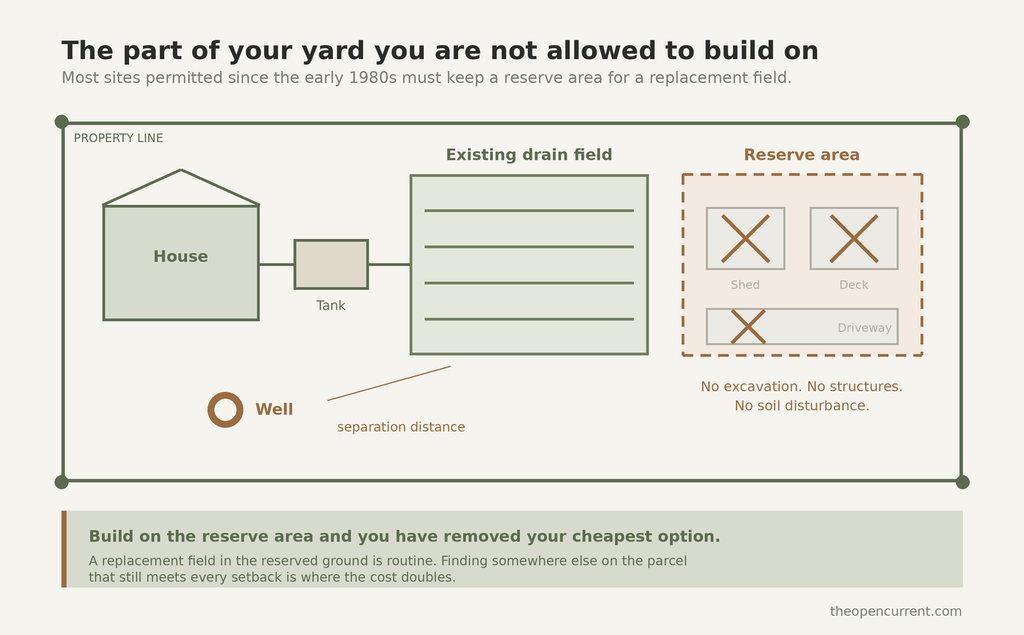
Original diagram. Reuse it with a link to theopencurrent.com.
The mistake is treating it as spare yard. A deck, a patio, a shed, raised garden beds, extending the driveway. It looks like empty space because that’s exactly what it’s supposed to look like. Build on it and you’ve eliminated your only straightforward option, and you’re into relocating the entire system somewhere else on the parcel, assuming somewhere else even exists and meets setbacks.
One county’s rule spells out the test clearly: an addition has to stay outside 10 feet of the drain field, and there must still be room for a complete replacement system meeting all setbacks.
Setbacks measured from property lines. Which means if you don’t actually know where your boundaries are, you don’t know whether your replacement area is usable, and I’ve gone into what it takes to find out in the land survey cost guide.
Go find your septic permit before you do anything else. Your county health department has it if you don’t. It shows the tank, the field and the reserve area, and it turns this entire project from guesswork into arithmetic.
Permits, and the red flags on a quote
Replacing or expanding a field almost always requires a permit. Pumping the tank, cleaning a filter or swapping a lid typically doesn’t.
Three things that should stop you signing:
No permit mentioned. If a contractor tells you one isn’t needed for a full field replacement, or says they’ll handle it without giving you a permit number, that’s serious. You stay ultimately responsible for the work being permitted, inspected at the required stages, and issued a final certificate of compliance. An unpermitted installation that the contractor caused is still your problem when you sell, and improper installation can carry fines up to $25,000.
A replacement quoted with no soil evaluation. Nobody prices a five figure job off a wet patch.
No request for the as-built drawing. That drawing is the first thing any competent person asks for before digging near a septic system. If nobody’s asked, nobody’s planning properly.
How to pay for it, because this is where most people are stuck
Almost nothing written about drain field replacement covers the money side, and for rural property owners there’s real help available.
USDA Section 504 Home Repair is the main federal route, and it’s the one most likely to apply if you’re rural. It provides low-interest loans at a fixed 1 percent to very low income homeowners, plus grants to homeowners aged 62 or over who can’t repay a loan, and the two can be combined. Caps have moved over the years and I’ve seen several different figures quoted, so get the current numbers straight from USDA Rural Development rather than from a blog.
Worth knowing: a failed field that’s triggered a local sanitation violation is the most common qualifying event, and a documented health and safety hazard speeds up the review.
The EPA’s Clean Water State Revolving Fund works through your state. Each state has a CWSRF representative and the fund provides low-interest loans for exactly this kind of work.
The USDA Rural Decentralized Water Systems Grant Program funds nonprofits and tribes, who then lend on to rural homeowners in their area.
There are regional lenders too. Craft3 does environmental lending in Washington and Oregon, and several states run their own septic assistance programs through their department of environmental quality, so that’s the right place to start asking.
Grant amounts and eligibility do change, so treat these as the starting point for a phone call rather than gospel.
If you’re selling, read this part twice
A failed field in the middle of a sale is its own nightmare and the rules are stricter than people assume.
Disclosure is required in every transaction type, including as-is sales. FHA buyers generally can’t finance a home with a failed septic system. Massachusetts requires a Title 5 inspection report within two years of sale, and most jurisdictions there require repair within two years of a failure declaration.
And if you’ve received a health department violation notice, it goes on the disclosure immediately. Failing to disclose a notice you’ve received creates real post-sale liability even if you fully intended to fix it before closing.
Now the other side of that, because it cuts both ways. There’s a seller on a plumbing forum whose buyer walked after an inspector poured roughly 400 gallons into the system and probed for moisture. Two things he noticed afterwards: the buyer’s agent was also acting as the home inspector, and his state doesn’t license home inspectors at all. His frustration is worth repeating, that everyone told him to knock thirty grand off the price when a fix at a tenth of that might have existed.
A failed inspection is a finding, not a verdict. Get an independent septic contractor out before you negotiate against it.
Questions to ask before you sign anything
- What did you actually test? A camera inspection, a soil probe, or the wet patch?
- Is this the field, or could it be the distribution box sending everything to one section?
- Where is my reserve area, and is that where you’re building?
- Is the permit in this price, and what’s the permit number?
- How many linear feet, and is that priced per foot or lump sum?
- Gravel or chambers, and why that one on my soil and with my access?
- Who eats the cost if you hit rock?
- Is removing or abandoning the old field included?
- Is restoration included, meaning backfill, regrade and sod?
- Which inspections are required, and who schedules them?
If a quote comes back as one number with no breakdown, ask for it itemised in writing. Same tell as every other trade.
What to do the week after
Get the as-built drawing and the certificate of compliance, and keep both with your deed and your survey.
Then go find the corners of the new reserve area and mark them, photograph them, drop a GPS pin. That’s the ground you’re protecting for the next twenty years, and the reason you’re reading this page is probably that nobody protected the last one.
Fix whatever killed the first field before you finish celebrating. If roof runoff was saturating the soil, the answer is correcting the drainage, not more gravel. If the tank hadn’t been pumped in fifteen years, put it on a calendar now.
And the boring maintenance is the whole game from here. Pump on schedule, no harsh drain cleaners, spread the laundry out instead of doing five loads on a Sunday, and keep vehicles off it permanently.
Frequently asked questions
How much does a new drain field cost? Most conventional replacements run $5,000 to $15,000 installed. Alternative systems like mounds or aerobic units run $10,000 to $25,000. The spread comes down to soil, size and access.
How much does it cost to replace a leach field? Same thing, same numbers. Leach field is just another name for a drain field, so expect $5,000 to $20,000 for a conventional replacement depending on where you live.
How much is a new septic drain field per foot? Around $40 a linear foot as a working average, with a three bedroom home needing 100 to 300 feet. Rocky ground that requires hand digging can push it past $80 to $100 a foot.
What does a septic bed replacement cost? Septic bed is another regional name for the same system. Budget the same $5,000 to $15,000 for conventional, more if your soil forces an engineered design.
How long does a drain field replacement take? Usually one to seven days depending on scope and weather. It’s faster than most people expect. The permitting beforehand often takes longer than the digging.
How long should a drain field last? Twenty to thirty years for a properly sized and maintained conventional field. Sandy soil and light use can beat that comfortably. If yours failed noticeably early, something caused it and that cause is still there.
Can a drain field be repaired instead of replaced? Sometimes, and it’s always worth checking. Jetting, soil fracturing and bio-remediation run $1,000 to $5,000 and work best when the problem is caught early. Once the soil is fully sealed, replacement is the only option.
Does homeowners insurance cover drain field replacement? Standard policies generally treat it as wear and tear rather than a covered peril, though some carriers sell service line or equipment breakdown riders. Check your policy before assuming either way.
Do I need a permit to replace a drain field? Almost certainly yes. Full field replacement is major work in nearly every county. A contractor who says otherwise is a problem.
Where to go from here
Before you take a quote, do three things. Pull your septic permit and find your reserve area. Ask whoever’s quoting what they actually tested. And get a second opinion on any five figure number, because the gap between a repair and a replacement is the biggest single variable in this whole job.
If the field failed because the tank never got pumped, the new one will go the same way. Fix the cause, not just the symptom.
Next:
- Septic System Cost for what a whole new system runs, if the tank is going too
- Septic Inspection for what a proper inspection covers and what it costs
- Off-Grid Cost Calculator for pricing wastewater alongside water, power and heating
- Off-Grid Water Systems for how the clean water side fits together