
Well Water vs City Water: Which Actually Costs More, and What Nobody Warns You About

TL;DR on well water vs city water: neither one wins. Google’s own AI Overview says it, every honest source says it, and after a couple of days buried in this, I say it too. The real question isn’t which water is better. It’s who owns the failure. On city water you rent the outcome and pay a bill that climbs every year. On a well you own the asset, the electricity, the testing and the 3am pump failure, and in exchange nobody gets to tell you when you’re allowed to water your garden.
That’s the whole thing in a paragraph. But the interesting stuff is in the details, because most comparisons skip what actually bites. Like the fact that on a well, no power means no water, full stop. Or that switching from one to the other runs anywhere from a grand to twenty grand depending on where the pipe in the road happens to sit.
So here’s the honest version of well water vs city water. What each one really costs, what goes wrong with both, and the questions I’d want answered before committing either way.
Well water vs city water: the quick version
| Well water | City water | |
|---|---|---|
| Monthly bill | None for the water, you pay pump electricity | Roughly $40 to $120, and climbing |
| Who tests it | You, voluntarily, if you remember | The utility, by law |
| Upfront cost | Drilling, $5,300 to $16,000+ depending who you ask | Tap fee, $500 to $20,000 depending on the town |
| When it breaks | Your bill, your problem, your weekend | Utility’s problem |
| Power cut | No power, no water | Usually keeps flowing |
| Drought restrictions | Mostly exempt | Whatever the city says |
| Taste | No chlorine, but minerals and sometimes sulphur | Chlorine or chloramine, noticeably |
Now the parts that matter.
The money, honestly
Everyone says well water is free. It isn’t free, it’s unbilled, and those are very different things.
What city water actually costs. Somewhere around $40 to $120 a month, call it $500 to $1,200 a year. The bit that stings is the direction of travel. Bluefield Research, which benchmarks utilities in 50 US cities every year, found combined water and sewer bills rose 5.1 percent in 2025, a five-year high, and 24.2 percent cumulatively over five years. Go back further and it gets brutal: between January 2000 and December 2025 these services went up 207 percent, against 93 percent for general inflation. Portland’s water bureau put rates up 8.1 percent in a single go in July 2025. You don’t get a vote on any of that.
What a well costs to run. Pump electricity, around $200 to $500 a year, or roughly $30 to $60 a month. Annual testing, $100 to $650 depending on the panel. Salt if you’ve got a softener. Then whatever treatment gear your particular water turns out to need.
The break-even math. One contractor analysis lands here over 25 years: a private well at roughly $7,500 upfront plus about $600 a year comes out around $22,500, and city water at about $3,000 upfront plus $720 a year comes out around $21,000 if rates never move. Since rates always move, the realistic city number is closer to $27,000 to $35,000.
So long term the well usually wins, but by way less than well people think. And the two things that decide it are your connection fee and your drilling depth, not the monthly bill.
My favourite version of this came from a forum guy who just did the arithmetic himself. He worked out pumping at about $0.0001 a gallon against $0.0008 for municipal, so roughly an eighth the cost. Then he dropped the line that should honestly be printed on every pressure tank in America: municipal water doesn’t wear out at 3am on a Sunday before Christmas.
Yep. That’s the trade, right there.
Switching costs, both directions
This is missing from basically every comparison I read, and it’s the bit people actually need, because plenty of you aren’t choosing in the abstract. You’re staring at a quote.
Well to city. The tap or connection fee runs $500 to $10,000 by one source and $1,500 to $20,000 by another, with the high end in growing areas where the utility is clawing back capacity costs. Then the line itself, $25 to $200 per linear foot. So the single biggest variable is how far your house sits from the main in the road. Typical all-in hookup lands around $1,000 to $6,000, but a long run up a rural driveway blows straight past that.
City to well. Drilling estimates are all over the shop: $5,300 to $9,200 from Angi, $6,000 to $16,000 from Insurify with deep wells hitting $40,000, and $10,000 to $30,000+ from well contractors for a complete system. I went through why that range is so wide in well drilling cost, and the short answer is geology. Nobody knows what’s under you until they drill it.
FYI if you’re being told you must connect, check whether that’s actually true. Some municipalities require it on new builds, some bill you whether you hook up or not, and some genuinely don’t care. Local question, local answer.
Pitfall one: no power, no water
This is the big one, and it’s what well owners find out during their first proper storm.
Your pressure tank is your entire reserve. A standard residential tank holds 20 to 50 gallons, but only about half is usable before pressure drops too low to be any good. That’s roughly 5 to 10 minutes of normal household use. One flush and a bit of tap.
And it’s worse than that, for a reason a forum owner nailed: the tanks are never completely full, and they’re mostly empty right before the pump kicks on. So if the power drops thirty seconds before a pump cycle, you’ve got almost nothing. The rule of thumb people use is that you want about three times your tank capacity for the water you actually want in reserve, since a 35-gallon tank only gives you about 12 usable gallons.
City water mostly shrugs at outages, because municipal supply usually comes from elevated holding tanks, so your pressure isn’t affected unless the whole supply runs low. Not always true though. During California’s Public Safety Power Shutoffs, rural water districts have had to buy and rent generators and keep storage tanks topped up, and some small systems have no backup power at all because the rates would never cover it.
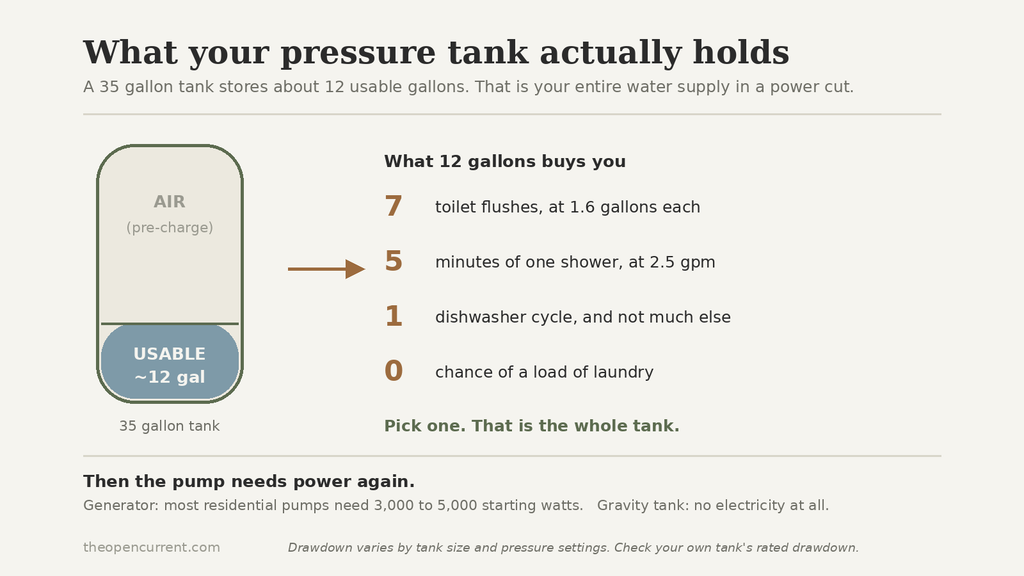
Original diagram. Reuse it with a link to theopencurrent.com.
If you’re on a well, your options:
- A generator. Most residential well pumps need 3,000 to 5,000 starting watts, and you size for starting watts, not running watts. Half-horse pump wants roughly 2,000 to 3,000, three-quarter horse 3,000 to 4,000, one horse 4,000 to 5,000. Go bigger and it gets ugly fast. One forum owner with a 5HP pump 400 feet down needs a 10kW unit, which he describes as pretty pricey. No kidding.
- Battery backup. Roughly 5 to 10 kWh to cover basic daily needs, at $10,000 to $20,000 and up. Expensive, silent, no fuel runs at midnight.
- A gravity tank. Honestly the best answer and nobody suggests it. Pump fills an elevated storage tank, gravity feeds the house, zero electricity involved. One guy in Arizona stuck 1,000 gallons up on an 8 foot stand and called it a day. Old tech, still undefeated.
Pitfall two: both waters have problems, just different ones
What annoys me about most of these comparisons is they treat city water as the safe default and well water as the risky one. That’s lazy.
What goes wrong with well water: hard water scaling up your water heater and dishwasher, iron staining laundry and fixtures that orange-brown colour, sulphur giving you the rotten egg smell, bacteria after flooding, nitrates from farm runoff or a nearby septic system, plus arsenic, radon or PFAS depending on local geology. Treatment for the usual combo runs about $800 to $3,000+ for a whole-house setup. In some regions it’s near-standard kit: acid neutraliser for pH, iron filter if iron is over 0.3 ppm, softener over 7 grains per gallon.
What goes wrong with city water: chlorine and chloramine taste, which every single person who switches notices immediately. Disinfection byproducts, formed when chlorine reacts with organic matter in the water. PFAS from industrial sites, military bases and firefighting foam, affecting hundreds of communities, and standard treatment plants aren’t built to remove them. Lead, where the EPA’s Lead and Copper Rule kicks in above 15 ppb in 10 percent of sampled taps, but a house with old lead service lines or lead solder can sit way above what compliance monitoring picks up. Main breaks and boil-water advisories.
So no, city water isn’t some magic clean answer. It’s a professionally managed average that your own house’s plumbing can undo on the way to the tap.
The real difference isn’t purity. It’s this next bit.
The actual difference: who’s watching
The EPA says it straight out: private well owners are responsible for delivering safe drinking water to their households, and private wells aren’t regulated federally under the Safe Drinking Water Act, or by most state governments either. That’s around 15 percent of the US population, over 43 million people, running their own water utility whether they think of it that way or not.
And the data says most aren’t running it very hard. A USGS study of about 2,100 domestic wells across 48 states found more than one in five, 23 percent, contained at least one contaminant above a human-health benchmark. Microbial contaminants turned up in about a third of the roughly 400 wells tested for them. About half had at least one nuisance contaminant, the stuff that wrecks taste or smell without being dangerous.
Here’s the number that actually matters though, and it depends wildly on where you look. A University of Minnesota Extension survey of 2,600 well owners across Michigan, Wisconsin and Minnesota found about 20 percent had never tested their water. A Florida Well Owner Network programme put it at 65 percent. A randomised study in rural Georgia found only 34 percent had ever tested at all.
The reasons people gave are the interesting part. In the Minnesota survey the top answer for not testing was having been drinking it for years without problems, at 53 percent, followed by not knowing what to test for, at 41 percent, and not knowing how, at 35 percent. So it isn’t complacency exactly. It’s that nobody ever told them.
So the risk on a well isn’t really the water. It’s that nobody’s looking. City water gets tested hundreds of times a year and comes with an annual Consumer Confidence Report telling you what turned up. Your well gets tested when you remember, which for a lot of households is never.
Totally fixable, tbh. Annual bacteria and nitrate test, broader panel every three to five years, done. But only if you actually do it.
Pitfall three: the repair cliff
City water spreads failure across thousands of customers. A well concentrates it onto one household, and that household is you.
Full pump replacement averaged $1,897 nationally in 2026 according to Angi, based on 1,339 verified projects, with most homeowners paying between $974 and $2,821. Add $250 to $1,000 in labour if the old wiring or pipework needs redoing, which is common on an older system where the original wiring was never sized for a modern pump. I broke it all down in well pump replacement cost.
One repair like that eats several years of your savings versus a city bill. Doesn’t make wells a bad deal. It just means the savings are real but lumpy, and what you actually need is a repair fund rather than a smug feeling about not having a water bill.
What well owners genuinely win on: nobody tells you what to do
This barely gets mentioned and it matters enormously if you’ve got land.
During drought, city customers get mandatory restrictions. Watering schedules, outdoor bans, the lot. Well owners mostly aren’t subject to any of that, though some areas do regulate groundwater.
If you’ve got a garden, an orchard, livestock or anything else that drinks, that’s not a small thing. One forum owner reckoned his rural water bill would’ve hit $300 or more in summer just for plants and turf. On a well that’s a slightly bigger electricity bill and nothing else.
Flip side, and I’m not going to pretend otherwise: shallow wells drawing from unconfined aquifers drop when the water table drops. Deep bedrock wells in confined aquifers are much more resilient. So “wells are drought-proof” is only true for some wells.
The thing nobody tells you: it’s rarely just about water
Best point I found in all this, and it came from a forum, obviously.
A guy in a well-versus-city thread argued that having city sewer available matters more than city water. His reasoning was simple. He’d rebuilt a septic system when the leach field gave out, a pressure-dosed mound job, roughly $15,000.
He’s right, and it reframes the whole question. In practice you’re usually not choosing between well and city water. You’re choosing between well plus septic and city water plus sewer. And the septic side carries the bigger numbers, which I’ve been through in septic system cost.
Worth noticing too that your monthly city bill usually bundles sewer in. So when someone compares their $70 city bill against a well owner’s electricity, they’re not comparing the same thing at all.
If you’re buying a place, your loan has opinions
Quick but important, because this one catches people at the worst possible moment.
A property on a well comes with lending rules a city water property simply doesn’t have. FHA and VA both require water testing and enforce minimum distances between the well and the septic system, and a failed test that can’t be sorted before closing can stop the loan funding. Conventional loans don’t carry those distance requirements at all.
Same house, different loan, different answer. I went through the whole lot, including the distances and the traps hiding in the testing itself, in well inspection cost.
The off-grid version, where the maths changes
If there’s no grid, this stops being a comparison and turns into a design problem.
Your pump is almost certainly the biggest surge load on the property, which means it sizes your inverter, not just your battery bank. Every gallon costs you watt-hours. And the pressure tank stops being a convenience and becomes the buffer between having water and not having water.
Which is why gravity storage keeps coming up out here. Fill a tank when the sun’s up, feed the house by gravity the rest of the time, and your water supply stops caring about your state of charge. It’s the most robust thing you can do to a small off-grid water system, and it costs less than a battery upgrade.
One more thing worth knowing: solar-powered wells are the fastest-growing segment of new installs, and private well use overall is rising about 2.5 percent a year with roughly 500,000 new wells drilled annually. This isn’t a shrinking way to live.
Questions to answer before you decide
If you’re actually choosing, these are what I’d want answered. Most have specific local answers and none of them are guesswork.
- Is the water main even in the road, and how far from the house? That’s the tap fee plus $25 to $200 a foot.
- What’s the tap fee in this exact jurisdiction? Anywhere from a few hundred to twenty grand.
- How deep do wells go around here, and what does the local geology put in the water? Arsenic, iron, nitrates?
- Shallow or deep aquifer? That decides how the well behaves in a drought.
- What’s the pump horsepower and starting wattage? That decides what backup costs.
- Is sewer available, or are you buying a septic system either way?
- How much water goes outdoors? Garden, livestock, orchard?
- Is there treatment gear already installed, and what problem was it bought to fix?
- What does the local Consumer Confidence Report say, if city water is on the table?
- Which loan are you using, if you’re buying?
Number six is the one people skip and regret, IMO.
So which one?
If you’re on city water and happy, a carbon filter fixes the chlorine taste and you’re done. Not everything needs to become a project.
If you’re on a well, the honest answer is you’re running a small water utility. The job isn’t hard, it’s just yours. Test annually. Know where your pump’s spec sheet is. Have a plan for when the power goes out that isn’t “hope it comes back on.” Keep a repair fund, because pumps don’t fail politely.
And if you’re genuinely choosing, choose on the things you can’t change later: how far the main is, how deep the water is, whether sewer exists, and how much water your land needs. The monthly bill is the least interesting number in this entire article.
FAQ
Well water vs city water: which is actually better?
Neither, and anyone claiming otherwise is selling something. City water is tested for you and keeps running in a power cut. Well water has no monthly bill, no drought restrictions and no rate rises. Choose on what you can’t change later: how far the main is, how deep the water is, and whether sewer exists.
Is well water safe to drink?
Often, but nobody checks it for you. The EPA doesn’t regulate private wells, and a USGS study of about 2,100 domestic wells found more than one in five contained a contaminant above a human-health benchmark. Test annually for bacteria and nitrates, broader panel every three to five years.
Does well water work during a power outage?
No. Once the pressure tank empties, usually 5 to 10 minutes of normal use, you have no water until the power comes back. A generator, battery backup or a gravity-fed storage tank fixes it.
How much does it cost to connect to city water?
The tap fee alone runs $500 to $20,000 depending on the municipality, plus $25 to $200 per linear foot for the line. Most hookups land between $1,000 and $6,000, but distance from the main drives everything.
Does a well add value to a house?
In rural markets generally yes, with estimates around $10,000 to $30,000 against a comparable property. Worth knowing it can raise your assessed value too: one owner reported a tax review board valuing his well at the $14,000 he paid for it, while assigning nothing at all to a rural water connection.
Why does city water taste like chlorine?
Because it is chlorine, or chloramine, added to keep the water safe through miles of pipe. It’s the first thing people notice after switching off a well, and a whole-house or under-sink carbon filter sorts it.
Do well owners avoid drought restrictions?
Mostly. Municipal customers face mandatory outdoor watering limits during drought, while well owners generally don’t, though some areas regulate groundwater. Shallow wells can still lose yield as the water table drops.