Well Drilling Cost: How Much It Really Costs to Drill a Well

Well drilling cost is quoted per foot, but what you’re really buying is a working well, and for most people that lands somewhere between $5,500 and $15,000. Deep wells in hard rock can blow well past that. And if you’ve started getting quotes, you’ve probably noticed nobody talks in totals. Everybody talks per foot.
That’s where the confusion starts. Search for this and you’ll find per foot prices anywhere from single digits to over $100. A lot of what ranks is junk, cost tables that contradict themselves in the same article. Even the big home sites don’t add up. HomeAdvisor’s 2024 guide says drilling alone runs about $9,180 for a 150 foot well, then says drilling costs $15 to $25 a foot. I did the math. 150 feet at $25 is $3,750. Something in there isn’t a per foot number.
Here’s the thing most guides blur: the cost per foot is the price of the hole. The cost of a well is the hole plus the casing, the pump, the pressure tank, the wiring, the permit, the water test, and sometimes a second hole when the first one comes up dry. That’s the number that actually leaves your bank account.
So this guide covers what the whole bill breaks into, a worked example for a 300 foot well, the pain points that blow budgets (dry holes are the big one), and the questions to ask before you sign anything.
What a well drilling cost actually includes
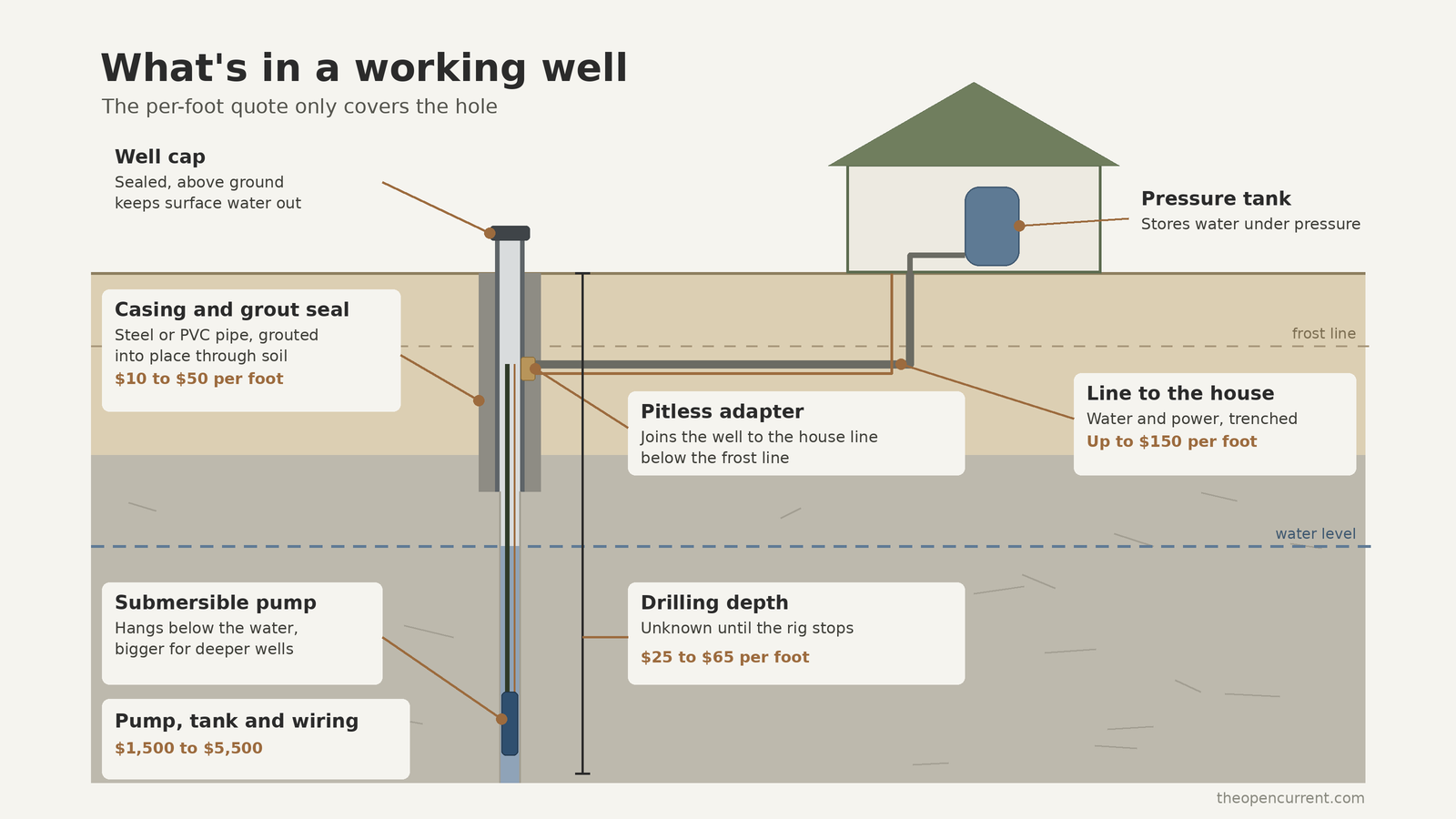
Original diagram. Reuse it with a link to theopencurrent.com.
Here’s the full bill, line by line. These are national ranges, so your county will land somewhere inside them, not on the average.
| Item | Typical cost | How it’s priced | Watch for |
|---|---|---|---|
| Drilling | $25 to $65 per foot | Per foot of depth | Depth is unknown until you drill |
| Casing and grout | $10 to $50 per foot | Per foot of cased hole | Geology and code set the length |
| Pump, tank and wiring | $1,500 to $5,500 | Rises with depth | Deeper wells need bigger pumps |
| Permits and water testing | $300 to $1,500 | Flat fees | Varies a lot by state |
| Lines to the house | Up to $150 per foot | Per foot of trench | Drill closer to the house |
| Dry holes and plugging | Varies | Per foot plus sealing | Get the policy in writing |
A few notes on what’s in there.
Casing isn’t an upsell. It’s the steel or PVC pipe that stops the hole collapsing and keeps surface water from contaminating your water. How much of the hole needs casing depends on your geology and your local code, not on how much the driller wants to sell you.
The pump line comes straight from my well pump replacement cost guide. A submersible in a 100 to 200 foot well runs about $1,500 to $3,000 installed, and a deep one in a 300 to 400 foot well runs $2,800 to $5,500. A new well needs exactly the same pump, so the numbers match.
Distance to the house is a sneaky one. Water line and electrical both have to reach the well, and each can cost up to $150 a foot. A well at the far end of the property can quietly add thousands before anybody drills anything.
How much is a 300 foot well?
This is one of the most searched questions about well drilling, so let’s actually run it.
- Drilling: 300 feet × $25 to $65 = $7,500 to $19,500
- Casing: say 50 feet cased × $10 to $50 = $500 to $2,500 (this is an assumption, your geology decides the real length)
- Pump, tank and wiring for a deep well: $2,800 to $5,500
- Permits and water testing: $300 to $1,500
Total: roughly $11,100 to $29,000, before trenching to the house and before any dry holes.
Two things jump out. First, drilling is the biggest line but not the only big one. Second, look how wide that range is. A 300 foot well in soft ground near a busy driller and a 300 foot well in hard rock in the middle of nowhere are not the same job, even though both are “300 feet.”
Heads up if you’ve used my off-grid cost calculator. It puts a drilled well at $8,000 to $25,000, which covers most wells. A deep well in hard rock can run past the top of that, and I’d rather tell you that here than pretend otherwise.
What drives the price up
Depth, and you don’t know it until you drill
Depth is the multiplier, and here’s the uncomfortable part: nobody knows your final depth until the rig stops. A driller can estimate from what they’ve seen nearby, but the ground doesn’t do quotes.
One forum poster who works for a county health department described his own well going bone dry at 400 feet, with his neighbor’s well at 705 feet. At 415 feet they hit water flowing at 40 gallons a minute. His driller’s rule of thumb was that around 600 feet you start thinking about a new hole, because pulling water from that deep takes a seriously big pump.
That’s one guy’s story, but it shows the risk perfectly. The difference between a good day and a bad day at the rig can be hundreds of feet.
The free research before you call anyone: your neighbors’ well logs
Licensed drillers have to file a well log with the state when they finish a well. It records the depth, what they drilled through, and how much water it produced. Many states have searchable well records online, and if yours doesn’t, your county office may have copies.
Pulling the logs for wells near your land is the closest thing to a crystal ball you’ll get. Just don’t treat it as a promise. One state geological survey points out that log quality depends on the driller’s knowledge and experience, and older logs are often very general. Use them as a rough guide to how deep people around you went, not a guarantee of what you’ll hit.
Geology
Soft soil and sand drill fast and cheap. Hard rock is slower, wears out bits and pushes the per foot rate up. That’s most of the reason two quotes for the same depth in different counties can be wildly different, and neither driller is ripping you off.
Where you are, and when
This one surprised me. Timing and access are real costs.
Backlogs can be brutal. In a 2022 public comment to Idaho’s water regulator, someone reported lead times of 10 to 24 months for drilling in southwestern Idaho. That’s one busy region at one moment, but if you’re building somewhere popular, the well can be the longest wait in the whole project.
Spring is the expensive season to get a rig in. A drilling trade publication notes some states put road weight limits on during spring thaw that make most rigs overweight, so some drillers have to haul their drill pipe on a separate trip. Muddy sites can also need matting or a dozer just to get the rig in. Ask whether any of that is in the bid.
Once drilling actually starts, it’s quick. One Minnesota driller puts active drilling and casing at one to three days for most homes.
Pain point #1: you pay for dry holes
This is the one that blindsides people. Drillers get paid for drilling, not for finding water. If the hole comes up dry, you still owe for the footage.
One homeowner shared that their driller came up dry at three spots before finding water on the fourth, and the bill landed about $4,000 over a roughly $4,800 estimate. That was back in 2008, so the numbers are old, but the mechanism hasn’t changed one bit.
Dry holes aren’t free to walk away from either. South Carolina’s health department notes that any abandoned boreholes have to be properly grouted to protect the groundwater, which means a plugging cost on top.
The fix is in the contract. The same South Carolina guidance says to agree in writing what the driller takes responsibility for if the well is dry, and notes some drillers will drill another well in a different spot at half price. If your quote doesn’t mention dry holes at all, that’s the first question to ask.
Pain point #2: low yield
Hitting water isn’t the same as hitting enough water. How much a well produces is measured in gallons per minute.
For a single family home, 5 gallons a minute is good and 3 is livable, and some health or building departments won’t approve a well for new construction below 3. Household wells are typically designed to pump 10 gallons a minute or less, which is plenty for most homes.
If your well comes in low, you’ll hear about hydrofracking, where water is pumped in under high pressure to open up cracks in the rock. It can help, but it isn’t magic. One New Jersey owner paid around $2,000 to hydrofrack a weak well and got about a year before running dry again.
Here’s the part most guides skip, and it matters if you’re off grid. A slow well isn’t necessarily a failed well. One veteran driller designs systems for wells producing as little as a quarter gallon a minute, which still adds up to 360 gallons a day. The trick is storage: the well trickles into a tank, and a second pump runs the house from the tank. I cover how storage fits into the bigger picture in my off-grid water systems hub.
Where to drill (and whether water witching works)
Plenty of rural buyers still pay a water witch to pick the spot with a forked stick. I get it, it’s tradition, and sometimes it seems to work.
The U.S. Geological Survey doesn’t mince words. Its advice is not to spend money on a water witch, or on any gadget sold for finding underground water. Geologists put dowsers’ apparent success down to water simply being hard to miss in a lot of places, and a UC Davis groundwater professor points out that many dowsers work in areas with plenty of groundwater to begin with.
So what actually decides the spot? Geology, the well logs around you, and the rules. Penn State Extension recommends a well sit at least 50 feet from a septic tank and at least 100 feet from a septic absorption field. Which means if you’re building on raw land, plan the well and the septic together, not one after the other. My septic system cost guide covers the other half of that plan.
Can you legally drill your own well?
It depends entirely on your state, and the rules swing from “go for it” to “absolutely not.”
- Montana offers an exemption permit for a $100 fee, but only on land used for farming, ranching or your own residence, and you have to do the drilling yourself.
- Washington lets you drill on your own property for your own use no more than once every two years, as long as it meets all construction standards. Sealing up an old well still requires a licensed driller.
- Florida exempts homeowners from the license requirement for wells two inches or less in diameter, but construction still has to meet the standards.
- California is the strict end. In a 2011 case, a court ruled that building a water well requires a C-57 license, and rejected property owners’ argument that the owner-builder exemption covered them.
- Iowa doesn’t let a landowner drill a new well without a permit first.
Even where it’s legal, a proper drilled well needs a rig. The DIY route is mostly realistic for shallow driven wells in soft ground, not a 300 foot hole in rock.
Is drilling a well worth it?
Here’s where I argue against the obvious purchase.
For most rural homes, a drilled well is the right answer. But it’s not automatically the right answer, and at $11,000 to $29,000 for a deep one, it’s worth a hard look at the alternatives first.
My off-grid cost calculator puts a rainwater catchment and cistern system at roughly $6,000 to $20,000, and hauled water with a storage tank at $2,000 to $6,000. Neither is as convenient as a well, and catchment depends on your rainfall. But if your neighbors’ logs show deep, low-yield wells, or you’re in an area with a two year drilling backlog, those options stop sounding crazy.
The other honest scenario is buying land that already has a weak well. That low yield can drop further seasonally or permanently. If you’re buying a place with a well that barely produces, assume you’ll spend money getting more or better water, and negotiate like it.
Off grid? The pump is where the hidden cost sits
A deeper well needs a bigger pump, and a bigger pump is a bigger electrical problem when your power comes from panels and batteries.
Pumps pull several times their running watts for a second or two on startup. A 2-wire submersible surges around 4 to 5 times its running watts and a 3-wire around 3 to 4 times. Specifying a 3-wire pump for a new well can be the difference between your inverter coping or not. I break down that difference properly in my submersible well pump guide.
The low yield plus storage setup from earlier helps here too. A small pump filling a tank slowly is a much gentler load on a battery bank than a big pump hammering away every time somebody showers.
Paying for it
If you already have a home in a rural area, there’s cheap financing most people never hear about. USDA funds nonprofits that lend to rural homeowners for well and septic systems, with loans up to $15,000 per household at a fixed 1 percent over 20 years. Grants have also been offered to homeowners earning under 60 percent of the area median income.
The catch: the well has to serve an existing home, in a rural area with 50,000 people or fewer. If you’re drilling on raw land before building, you won’t qualify. Those terms are from recent program rounds, so check the current rules with USDA Rural Development before counting on it.
Questions to ask before you hire a driller
Penn State Extension’s checklist is the best one I found. Your contract should include:
- Compliance with state and local regulations.
- The driller’s liability insurance.
- Casing specs, including how deep the casing goes.
- A sanitary well cap and grout seal.
- Development of the well to maximum yield.
- Disinfection after drilling and after the pump goes in.
- An itemized cost estimate.
- An estimated yield.
- Delivery of the well log and pump test results.
Add these on top:
- What’s your dry hole policy, in writing? Do you drill a second hole at a discount, and who pays to plug the first?
- What’s the per foot rate, the estimated depth, and a not-to-exceed price? That last one stops a deep hole from becoming an open ended bill.
- Can I have references? A Rhode Island tip sheet suggests asking for at least five from well projects in the past three years, and actually calling them.
- Is site access and mobilization in the price? Especially in spring.
What to do after the well is drilled
Test the water, and time it right. Nebraska’s state guidance says to wait two weeks after the pump is installed before testing, because opening the well can let bacteria in. Some states make testing mandatory: North Carolina requires new wells to be tested for bacteria and chemical contaminants within 30 days of completion.
Keep testing every year. The EPA recommends testing private wells annually for coliform bacteria, nitrates, total dissolved solids and pH. Nobody regulates your well except you.
Keep the paperwork forever. Get a copy of the well log and the pump warranty and file them with your house records. The next time something goes wrong, whoever shows up to fix it will want that log.
Mistakes that cost real money
- Budgeting the per foot rate as if it’s the total. It’s the hole, not the well.
- Signing a quote with no dry hole policy. You’ll pay for every dry foot either way, so know the terms first.
- Skipping the neighbors’ well logs. It’s free and it’s the best depth estimate you’ll get before drilling.
- Putting the well far from the house without pricing the trench and lines.
- Paying a water witch instead of checking the logs and setbacks.
- Drilling the well and planning septic later, then discovering the setbacks don’t fit.
- Buying land with a weak well and not negotiating the cost of fixing it.
FAQ
How much does it cost to drill a well?
For a complete, working well, most people pay somewhere between $5,500 and $15,000. Drilling alone usually runs $25 to $65 a foot, with casing, the pump, permits and testing on top. Deep wells in hard rock can cost much more.
How much does a 300 foot well cost?
Roughly $11,000 to $29,000 all in, based on drilling at $25 to $65 a foot, some casing, a deep well pump system, and permits and testing. Trenching to the house and any dry holes are extra.
Can I legally drill my own well?
It depends on your state. Montana and Washington allow homeowners to drill their own wells under certain conditions, Florida exempts small diameter wells, and California requires a licensed contractor. Check with your state water agency before you start.
Is drilling a well worth it?
For most rural homes, yes. But compare it against rainwater catchment or hauled water if nearby wells are very deep or low yield, or if local drillers have long backlogs.
Does water witching work?
The U.S. Geological Survey advises against spending money on it. Geologists say dowsers mostly seem successful because water is hard to miss in many areas.
How long does it take to drill a well?
The drilling itself usually takes one to three days for a home well. The wait for a driller can be much longer, over a year in some busy regions.
What’s the cheapest way to get a well?
Check your neighbors’ well logs so you know roughly what you’re in for, put the well as close to the house as the setbacks allow, avoid spring mobilization, get several itemized quotes with a dry hole policy, and check whether you qualify for USDA’s low interest well loans.
Where to go next
Once the well’s in, the pressure tank is what keeps your pump alive. My well pressure tank replacement cost guide covers how to tell if yours is failing and what a new one really costs.
If you’re buying raw land, the well is only one of the tests that decide what you can build. Start with my perc test guide.
And before you drill anywhere near a property line, it’s worth knowing exactly where that line is. My land survey cost guide covers what that costs.