Septic Inspection: What It Costs, What They Check, and What Happens If It Fails

Here’s the thing that got me when I started digging into this. Most people who pay for a septic inspection don’t actually get one.
They get a guy who walks the yard, runs a few taps, asks when the tank was last pumped, and writes something up. Forty minutes, a few hundred bucks, a piece of paper. Everyone goes home happy and nobody has any idea whether the system is fine or three months from a $20,000 problem.
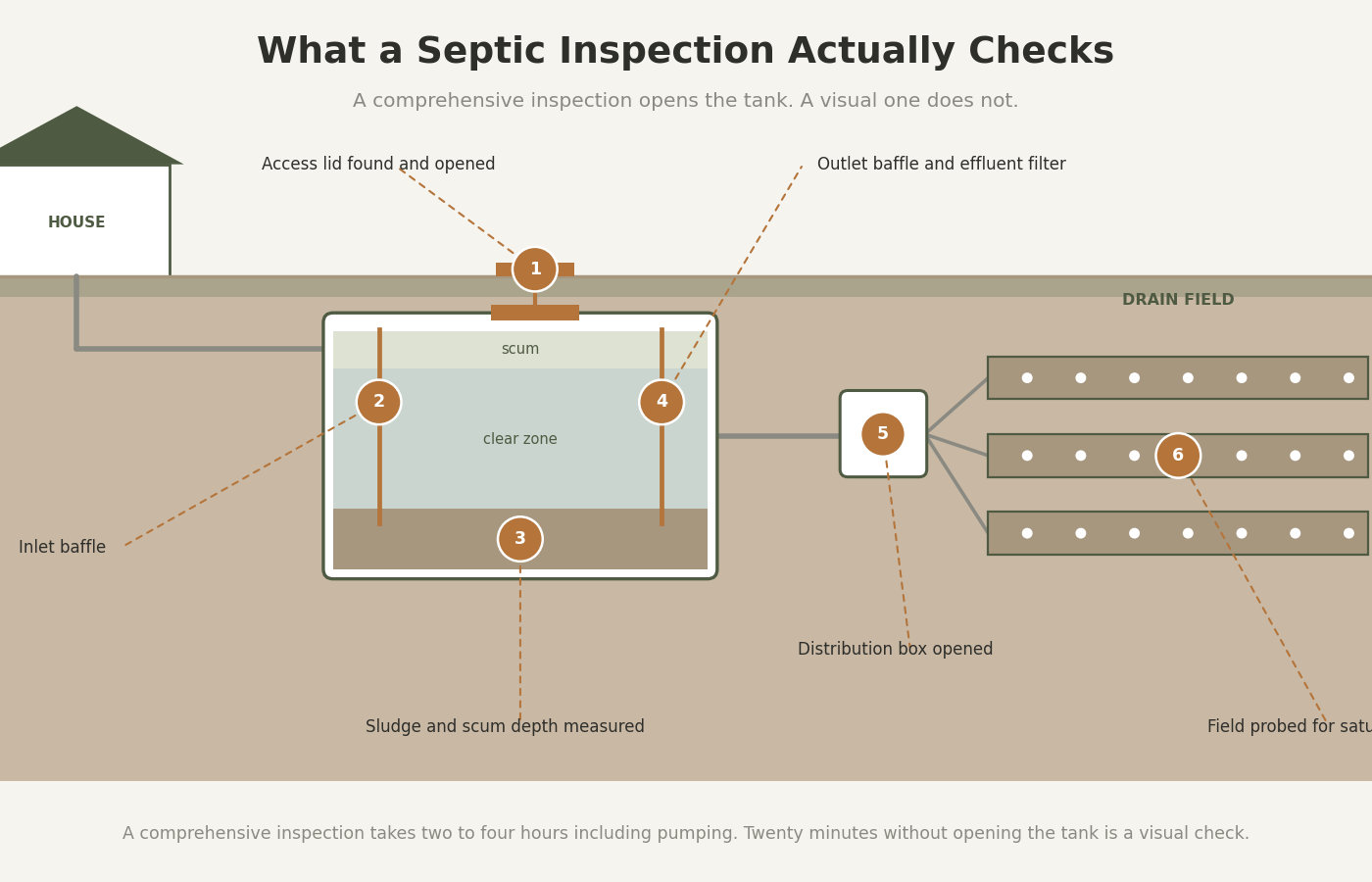
A real septic inspection takes two to four hours and it involves opening the tank. That’s not me being fussy. If nobody opened the tank, nobody inspected the system. They inspected your lawn.
So that’s mostly what this guide is about. Knowing which one you’re buying, and what to do when the answer comes back bad.
The two kinds, and why it matters so much
The visual one is what you get by default, especially when a general home inspector folds it into a wider survey. I don’t want to trash it entirely. It’ll catch obvious surface failure, and if you’re just curious about a place you already own, it’s fine.
But it cannot tell you whether your drain field has five years left or five months. It isn’t capable of it. And if you’re about to hand over money for a property, that’s the only question that actually matters.
The comprehensive one is what you want when there’s real money on the line. Buying, selling, or trying to work out whether the system you inherited with the land is a ticking bill.
What they actually check
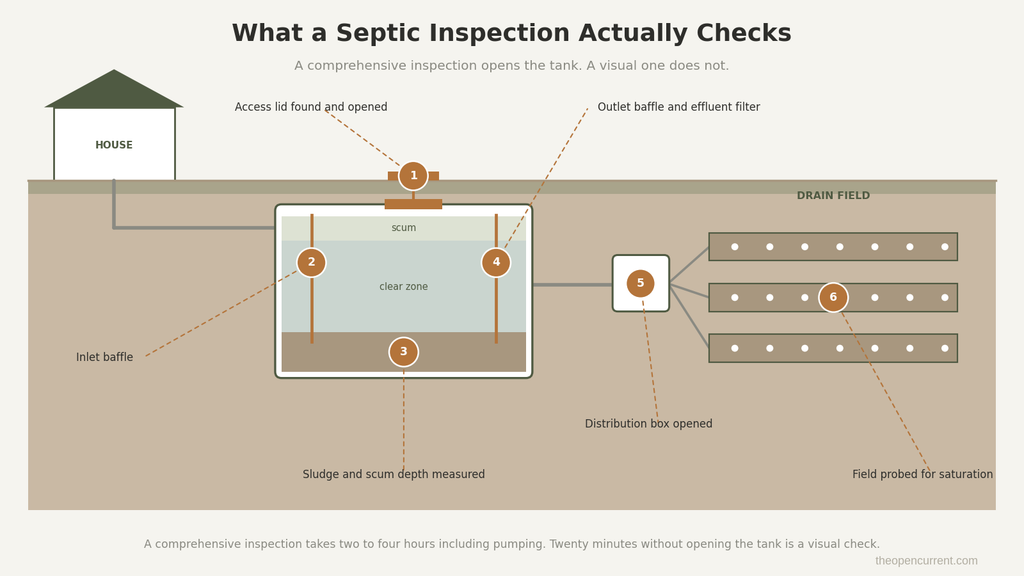
Original diagram. Reuse it with a link to theopencurrent.com.
Six things, roughly in this order.
They find and open the access lid. Sounds trivial, isn’t. Loads of tanks are buried with no riser, and locating one can add a couple hundred to your bill. If you know where yours is, tell them before they start charging you to go looking.
They measure sludge and scum depth. This is the good stuff. Sludge settles on the bottom, scum floats on top, and the clear zone in between is where the system does its actual work. Squeeze that zone and solids start heading out into your drain field, which is how a cheap problem turns into an expensive one. This number tells an inspector how the system has really been running, rather than how the seller described it.
They check the inlet and outlet baffles. These stop scum washing out into the field. A cracked baffle is a common failure and a cheap fix, assuming somebody actually looks.
They pull the effluent filter, if there is one.
They open the distribution box. This splits flow between your drain lines. If effluent backs up into it while they’re testing, that’s your field saying it’s had enough.
They probe the drain field. Not glance at it. Probe it, in several places, to see how saturated the soil is. They’re also watching for soggy ground, standing water, weirdly lush grass, and smell at the surface.
The EPA’s guidance on inspecting and maintaining a septic system covers the maintenance side of this, though it won’t tell you which tier of inspection you’re being sold.
Do not let anyone pump the tank beforehand
This is the one I’d tattoo on a buyer’s hand.
If the seller has the tank pumped a few days before your inspection, the inspector can’t measure sludge levels, can’t read the waterline staining on the tank walls, and can’t watch for backflow from the field. The most useful parts of the test are just gone.
The tank gets pumped during the inspection. That’s the whole point of it. When it’s emptied and effluent comes straight back in from the field, that’s a failing drain field announcing itself in the clearest way you’ll ever see. Pump it a week early and that signal leaves with the contents.
Now, a tank pumped just before an inspection might be completely innocent. Somebody tidying up before they sell. It might also be the oldest trick in the trade, and honestly I don’t think you’re being unfair to wonder which. Either way you’ve paid for information you’re not going to get.
Ask when it was last pumped. Get the date in writing.
What it costs
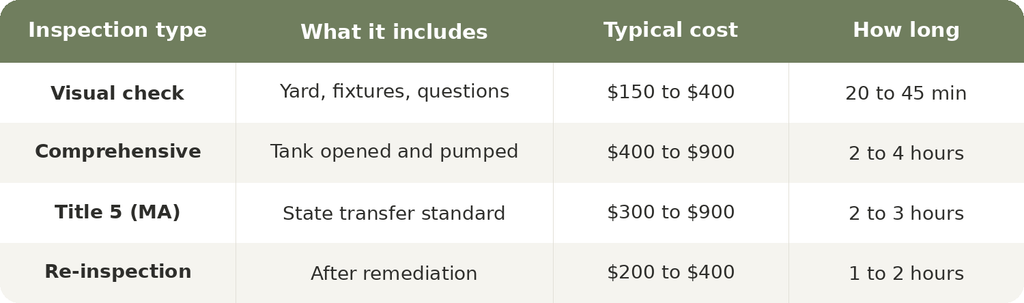
A basic visual runs somewhere around $150 to $400, depending on where you are and whether it’s bundled into a general home inspection.
A comprehensive one with pumping runs $400 to $900 for most properties. Massachusetts has the most standardised version of this, the Title 5 inspection required when a property changes hands, and that averages around $500. Standard ones land between $400 and $700, advanced ones on big or unusual systems can hit $1,200, and re-inspections after you’ve fixed something run $200 to $400.
Add money for a tank nobody can find, awkward access, an oversized system, or an aerobic unit with mechanical parts to test.
Now set that against what it’s buying you. A failing drain field is $3,000 to $10,000 to replace, and a good deal more if your soil won’t take a conventional system. I’ve broken that whole range down in the septic system cost guide if you want the detail.
Same argument I made about the perc test, really. Six hundred dollars buying information about a twenty thousand dollar decision is a bargain, right up until you decide to skip it.
If you’re off grid, two things change
They’ll test the aerator. If you’ve got an aerobic treatment unit, the inspection covers the mechanical side, and I’d pay close attention to that for a reason no local inspector is going to mention. An ATU runs its air compressor continuously. On the grid that’s a line on a bill nobody reads. Off grid it’s a 24 hour parasitic draw on your battery bank, and an aerator that’s struggling is quietly eating your storage as well as failing to treat anything. The off grid cost calculator will show you what that load does to a system.
Access costs more. Remote property means fewer contractors willing to drive out, and the ones who will price it accordingly. Get local quotes before you assume the national range applies to you, because it often doesn’t.
And if you’re on a well as well as a septic system, get both done on the same visit. Partly that’s convenience, but mostly it’s because the two are connected in a way people don’t think about until it’s a problem. A failing drain field close to your wellhead isn’t a plumbing issue, it’s a drinking water issue. The submersible well pump guide covers that side of it.
When it fails
First thing, and I know this is hard when you’ve just been handed bad news: ask what specifically failed.
The answer you’ll usually get first is “you need a new drain field, about ten grand.” Sometimes that’s genuinely true. Plenty of times it isn’t, or isn’t yet. A failure can be a cracked baffle, a tank that’s simply too old for current code, a field undersized for the number of bedrooms, a distribution box tipped out of level, or not enough electrical supply to a lift pump. That’s a range from a few hundred dollars to twenty thousand, all wearing the same word.
Reading through forum threads on this, the thing that stuck with me was how often the first number quoted was the expensive one. One guy was told he needed a whole new field. Another in the same thread had extended his existing field alongside the old one for about $2,500 and been fine for years afterwards.
If the inspection comes back with a failed field, that’s the expensive finding rather than the tank, and it’s worth knowing the range before you negotiate. Drain field replacement cost covers what it runs and what to check before accepting a quote.
Get three quotes. In one case I came across, quotes for the same remediation varied by nearly two thousand dollars. Same job, same property.
Call the health department yourself. They set the rules, they decide what’s acceptable, and in most counties theirs is the only opinion that counts in the end. An inspector’s recommendation is not a permit decision, and the difference is worth knowing before you spend anything.
Arizona’s cooperative extension has a good plain-English breakdown of what inspection involves and why it matters, if you want a second read that isn’t trying to sell you anything.
And know that a fail can come out of nowhere. One owner sold a 50 year old system that two people had used for 27 years without a single problem. It failed on a dye test, because effluent was surfacing somewhere he’d never had reason to look. You can be failing for years and have no idea, because nothing inside the house ever misbehaves.
Mistakes that cost people real money
Accepting a visual check when you paid for an inspection. Twenty minutes and nobody opened the tank means you got a look, not a test. Ask up front which one you’re getting and what’s in it.
Not being there. An inspector who’d rather you didn’t watch is a red flag. Stand there. Ask what they’re looking at and why. You’ll learn more about your own system in those two hours than you will from the report afterwards.
Planting trees near the system. One failure I read about traced back to a crepe myrtle planted ten feet from the tank. Roots go looking for water and pipes are full of it. Keep anything woody well clear, twenty feet or more from the drip line.
Assuming a pass means healthy. It means it passed on that day, against your county’s thresholds, and those vary enormously. A system that sails through in Texas might fail in Michigan without anything about it changing.
Skipping it because the seller has a recent report. Recent according to who, done by who, and which tier? Get your own, with your own inspector, written into the contract as a contingency.
Questions worth asking
Before you book:
- Is this a visual inspection or a comprehensive one, and what’s included?
- Will the tank be opened and pumped as part of it?
- Do you do a dye test or a hydraulic load test?
- Will you open the distribution box?
- Will you probe the drain field or just look at it?
- How long will it take, and can I be there?
- Are you licensed for septic specifically, or is this part of a general home inspection?
Before the inspector shows up, if you’re buying:
- When was the tank last pumped? Get a date, in writing.
- Where is the tank, and is there a riser?
- Is there an original permit and a system diagram?
- How many bedrooms was the system designed for, and how many does the house have now?
- Has there ever been standing water, backups, or a smell outside?
- What repairs have been done, and when?
Afterwards, if something failed:
- What exactly failed, and which component?
- Is this a repair or a replacement?
- What would the county actually accept as a fix?
- Is there a cheaper compliant option you haven’t mentioned?
- If I get a second opinion, what should they be looking at?
That last one is worth asking even when you trust the answer. Costs you nothing and it occasionally changes everything.
Frequently asked questions
How much does a septic inspection cost? A basic visual runs $150 to $400. A comprehensive one with pumping runs $400 to $900, and a Massachusetts Title 5 averages around $500. Advanced inspections on large or unusual systems can reach $1,200.
How long does a septic inspection take? Two to four hours for a comprehensive one, including pumping. If it took twenty minutes, you got a visual check.
How often should a septic system be inspected? Every three to five years for most households, which lines up neatly with pumping. Aerobic systems usually need annual or quarterly service under contract.
What is a septic dye test? Dye goes into a drain inside the house and the inspector watches for it appearing outside at the surface. It catches effluent breakout that a homeowner would walk past every day without noticing.
Who pays for a septic inspection when buying a house? Usually the buyer, as due diligence. In some states, Massachusetts among them, the seller handles the transfer inspection. Either way, get your own rather than trusting a report you didn’t commission.
Can a septic system fail without any symptoms? Yes, and it happens all the time. Surface breakout, a squeezed clear zone, or a saturated field can all exist for years before anything backs up indoors.
Should I get the tank pumped before the inspection? No. It should be pumped during, because what flows back in afterwards is what tells the inspector how the drain field is doing.
Where to go from here
Book the comprehensive one, not the visual one, and be there while it happens.
If you’re buying, put it in the contract as a contingency, same as a perc test. A failed inspection you can walk away from costs you a few hundred dollars. One you find out about afterwards costs you whatever the county decides it costs.
And if it does fail, don’t take the first number as gospel. Ask what failed, get three quotes, and ring the health department yourself.
Next:
- Septic System Cost for what a replacement actually runs
- Perc Test Guide for the test that decides your options if the field has to be rebuilt
- Perc Test Results Explained if you already have numbers you don’t understand
- Submersible Well Pump Buying Guide for the water side of the same property
- Off-Grid Cost Calculator to see what an aerobic system draws from your power
| Inspection type | What it includes | Typical cost | How long | Tank opened? |
|---|---|---|---|---|
| Visual check | Yard walked, fixtures run, questions asked | $150 to $400 | 20 to 45 min | No |
| Comprehensive | Tank opened and pumped, baffles and D-box checked, field probed | $400 to $900 | 2 to 4 hours | Yes |
| Title 5 (Massachusetts) | State standard required on property transfer | $300 to $900 | 2 to 3 hours | Yes |
| Advanced | Large, unusual or engineered systems | $700 to $1,200 | 3 to 4 hours | Yes |
| Re-inspection | Follow-up after remediation | $200 to $400 | 1 to 2 hours | Usually |