Well Pump Replacement Cost: What You’ll Actually Pay in 2026

Well pump replacement cost lands somewhere between $800 and $4,000 installed for most people, and every cost guide on the internet will tell you the average is around $1,800. That number is close to useless.
It’s useless because the average lumps together a shallow jet pump sitting in a pit house with a submersible hanging 400 feet down a casing, and those are not the same job. It’s also useless because if you’re off grid, there’s a line item nobody on those pages counts, and it can be bigger than the pump.
I’ll walk through what the bill actually breaks into, why depth is the multiplier that matters, and the off-grid cost that only shows up after the pump is already in the ground.
What a well pump replacement actually costs
Here’s the range you’re working with. These are full installed costs, pump plus labor plus the bits that go with it.
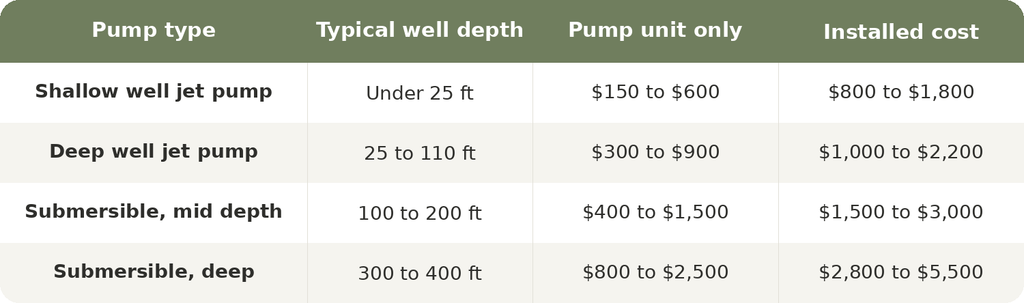
Most residential jobs land in that $1,500 to $4,000 band, and the national average sits right around $1,800 to $1,900 for a standard deep well submersible. Beyond 300 feet it climbs fast, and some replacements past that clear $8,000 once you’re into specialized pulling equipment and longer crew hours.
The job itself usually takes three to six hours for a crew that knows what they’re doing. Shallow jet pumps are quicker because the pump lives above ground. A submersible that has to come up from a few hundred feet needs a hoist and takes a good while longer.
Depth is the multiplier, not the pump
If you remember one number from this whole guide, make it this one: every additional 100 feet of well depth adds roughly $500 to $1,000 to the total.
That’s not just a bigger pump. It’s more drop pipe, more wire, a longer pull, and more time on a truck that charges by the hour. A 150 foot well and a 450 foot well can use a pump of similar horsepower and still differ by two grand on the invoice.
This is also why quotes vary so wildly between neighbors. Somebody three miles down the road with a 90 foot well is genuinely paying half what you are, and neither of you is being ripped off. Depth hits even harder if you’re drilling a new well rather than replacing a pump, which I break down in my well drilling cost guide.
If your well is deeper than about 25 feet, a shallow jet pump is physically incapable of pulling water that far, so you’re looking at a submersible or a deep jet setup. That’s not an upsell, that’s just suction physics.
What’s actually in the bill
A typical submersible replacement breaks down roughly like this:
- Pump and motor: $400 to $1,500 depending on horsepower and brand
- Drop pipe and fittings: $300 to $800, scaling with depth
- Wire: $200 to $500
- Control box, if you’ve got a 3 wire pump: $150 to $400
- Labor: $800 to $1,500 for a standard 200 foot well, covering the truck, the crew and the pulling rig
Add a pressure tank if yours is also shot. That’s a few hundred for a box-store tank, and well over a thousand for a premium one, which I break down in the well pressure tank replacement cost guide. That’s often worth doing, and I’ll come back to why.
One thing worth knowing before you take a quote: some outfits quote the pump only and then add labor and parts separately once they’re on site. If a number looks suspiciously low against everything above, that’s usually what’s going on.
The off-grid cost nobody counts
Here’s where every other cost guide leaves you hanging, because they’re all written for somebody with a power company.
A well pump doesn’t sip power. It slams it. Motors pull three to five times their running wattage for the first second or two of startup, before the rotor gets spinning and starts generating back EMF to limit the current. A half horse pump drawing 700 watts running can spike to around 3,000 watts on start. A one horse pump can hit 5,000.
On grid, nobody notices. Off grid, that surge is the single most common reason inverters trip or shut down. People size for running watts, forget surge, and then spend two winters manually cycling a pressure tank wondering what’s wrong with their system.
The DIY Solar Forum inverter sizing threads are full of people working through exactly this, with real nameplate numbers.
So when you’re replacing a pump off grid, the real question isn’t just what the pump costs. It’s whether the pump you pick will start on the inverter you already own.
Get that wrong and your $1,800 pump replacement quietly becomes a $1,800 pump replacement plus a new inverter. That’s the line item nobody counts.
The off grid cost calculator does this arithmetic across your whole setup, so you can see what a pump choice costs you in panels and batteries rather than just in pump.
Two things change this math, and both are decisions you make at replacement time, which is exactly why this belongs in a cost article.
2 wire versus 3 wire changes your surge
This one is almost never mentioned and it’s free money if you catch it.
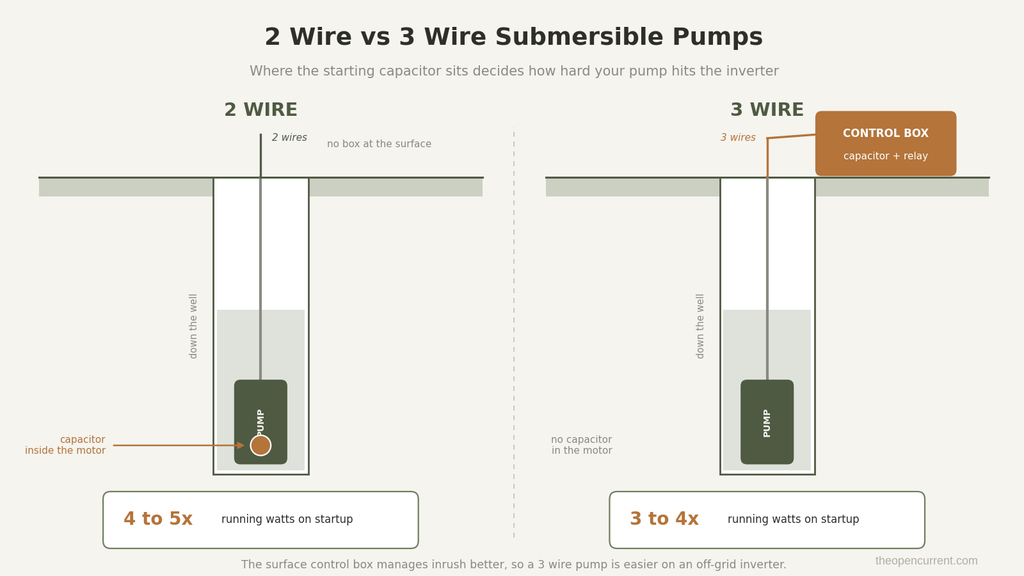
A 2 wire pump keeps its starting capacitor down in the motor, at the bottom of the well. A 3 wire pump puts it in a control box up at the surface, and I’ve explained the full difference in the submersible well pump guide. What matters here is the money: the surface box manages the inrush better, so a 3 wire pump typically surges around three to four times running watts where a 2 wire surges four to five times.
Original diagram. Reuse it with a link to theopencurrent.com.
That difference can be the whole reason your existing inverter copes or doesn’t. If you’re already replacing the pump and you’ve got a marginal inverter, specifying 3 wire is a decision that costs you a control box and might save you a four figure inverter upgrade.
The tradeoff is that a 3 wire pump has more parts, and the control box is one more thing that can fail. But it’s at the surface where you can actually get to it, rather than 300 feet down a hole.
The soft start question
A soft starter ramps voltage to the motor over a couple of seconds instead of hitting it with everything at once, and it can knock startup surge down by 40 to 50 percent. Parts run roughly $200 to $400.
The pitch writes itself: a couple hundred bucks of soft starter instead of a couple thousand of inverter.
I’ve covered the soft starter argument in more depth in the submersible well pump guide, including why the forum veterans are a lot less enthusiastic about them than the product pages are. Worth reading that section before you buy one, because the results people report in the field are messier than the spec sheets suggest.
There’s also a third route. Some pumps have soft start built into the motor. The Grundfos SQ series is the one that comes up constantly in off-grid conversations, and it’s a more efficient motor on top of that. Costs more up front than a budget pump. Might mean you don’t need a bigger inverter or a bolt on soft starter at all.
The cheap pump is usually the expensive one
This is the part where I argue against the obvious move.
Budget pumps from brands like Flotec, Red Lion and Wayne run about $200 to $400 for a three quarter horse unit. Premium pumps from Grundfos, Franklin Electric or Goulds land around $600 to $1,000 for the same horsepower.
The budget pump lasts five to ten years. The premium pump lasts fifteen to twenty five. Right there, before anything else, the expensive pump is cheaper per year.
But here’s the bit that matters specifically if you’re off grid: premium pumps run 15 to 30 percent more efficient. Those lifespan and efficiency figures come from DrillerDB’s well pump cost breakdown.
On grid that’s a slightly smaller power bill and most people ignore it. Off grid, that’s panels and battery you never have to buy. A pump is one of the biggest loads on a homestead system, and shaving 20 percent off it compounds through your entire array sizing.
Add in the labor. Pulling a pump from 300 feet costs the same whether the pump was $300 or $900. If the cheap one dies at year seven, you’re paying that labor bill twice in the time the good one is still going.
I don’t say “buy the expensive one” often. On well pumps, off grid, the math is not close.
Before you spend anything, check these
Plenty of people pay for a full replacement when the actual failure was a $40 part. Run these first.
The capacitor. A failed start capacitor mimics a dead pump almost exactly. Motor hums, nothing happens, or it trips the breaker. It’s a cheap part and on a jet pump it’s right there at the surface.
The pressure switch. Another surface level part, another cheap fix, another thing that presents as “no water.” If the contacts are pitted or the switch is stuck, the pump never gets the signal to run.
The check valve. If the pump runs but pressure drops off, a failed check valve can be the culprit rather than the pump itself.
The breaker and the wiring. Sounds obvious. It gets missed constantly, especially off grid where the fault might be upstream in the inverter or a tripped breaker in a panel nobody looks at.
You can also test a submersible without pulling it, using an insulation resistance test and a resistance check across the leads. A competent well tech will do this before recommending a replacement. If someone wants to pull your pump without testing it first, get somebody else.
Repair or replace
Rough guide, and there’s judgment in it.
If the pump is under about eight years old and the failure is a surface component, repair it. If it’s over twelve to fifteen and the motor itself is dead, replace it, because you’re paying the pulling labor either way and a patched old pump means paying it again soon.
Submersibles generally last eight to fifteen years, jet pumps four to ten. Water quality, how well the pump was sized, and how often it cycles all move that a lot.
That last one matters more than people think. A pump that short cycles because the pressure tank is waterlogged or undersized wears out dramatically faster. If your pump died young, the tank is a genuine suspect, and replacing the pump without fixing the tank just starts the clock again. That’s covered properly in the well pressure tank guide.
It’s also why bundling the tank into the same job is often smart. The crew is already there, the system is already drained, and the marginal cost is a lot lower than a separate call.
Mistakes that cost people real money
Skipping the second quote. One homeowner got told their pump had failed and the job would be $3,500 for the pump plus $800 for electrical work down the well. The next company replaced the pump in about forty minutes and saved them over two grand. A $60 service call fee is cheap insurance against a four figure mistake.
Accepting a bill that won’t itemize. There’s a well documented case of somebody charged $645 for a $44 part and thirty minutes of work, and when they asked for a breakdown of parts versus labor the tech refused to give one. Refusing to itemize is the tell. Ask up front, in writing.
Paying the emergency premium unnecessarily. Weekend and after hours service adds 25 to 50 percent. If you’ve got water storage or a cistern and can wait until Monday, that’s a few hundred dollars for doing nothing.
Replacing the pump and reusing tired drop pipe and wire. If the pump is ten years or older, the pipe and wire are the same age and have been sitting in water the whole time. The labor is already being paid for. Doing it now costs a few hundred. Doing it in two years costs the whole pull again.
Sizing the new pump by copying the old one. Common, understandable, and often wrong. The old pump may have been oversized by whoever installed it, and oversized pumps short cycle, which is what killed it. Off grid, an oversized pump is also burning power you don’t have.
Frequently asked questions
How much does it cost to replace a well pump? For most homes, $1,500 to $4,000 installed. Shallow jet pumps can come in around $800 to $1,800. Deep submersibles in wells past 300 feet run $2,800 to $5,500, and past that it climbs.
How long does a well pump last? Submersibles typically eight to fifteen years, jet pumps four to ten. Premium pumps at the top of that range or beyond. Frequent cycling shortens it significantly.
How do I tell if my well pump is bad? No water at all, air spitting from taps, pressure that won’t build, a motor that hums without starting, or a breaker that trips repeatedly. Note that most of those can also be a pressure switch, a capacitor or a waterlogged tank, which is why you test before you pull.
How many watts does a well pump use? A half to three quarter horse submersible draws roughly 400 to 900 watts running, and spikes to three to five times that on startup. Size your inverter for the surge, not the running figure.
Can I replace a well pump myself? On a shallow jet pump at the surface, plenty of people do. On a submersible, I’d say no. A 100 foot pull can exceed 200 pounds once you add pump, wire and a pipe full of water, and if you lose your grip the whole assembly drops to the bottom of the casing. That turns a routine job into a fishing operation or a dead well. Add 240 volts in standing water and it’s not worth it.
Is it worth replacing the pressure tank at the same time? Usually yes, if the tank is more than about ten years old. The crew is already there and the system is already down, so the marginal cost is much lower than a second visit.
Where to go from here
If you’re pricing a replacement right now, the two numbers that move your quote most are well depth and pump type, so have both ready before you call anyone. Get three quotes and insist on itemized breakdowns.
If you’re off grid, work out your surge before you pick a pump, not after. A pump that won’t start on your inverter is a much more expensive problem than a pump that costs a bit more up front.
And if the pump you’re replacing died early, go look at your pressure tank before you blame the pump.
Next:
- Submersible Well Pump Buying Guide for choosing the actual unit
- Well Pressure Tank Sizing and Buying Guide for the thing that probably killed your last pump
| Pump type | Typical well depth | Pump unit only | Installed cost | Typical lifespan |
|---|---|---|---|---|
| Shallow well jet pump | Under 25 ft | $150 to $600 | $800 to $1,800 | 4 to 10 years |
| Deep well jet pump | 25 to 110 ft | $300 to $900 | $1,000 to $2,200 | 4 to 10 years |
| Submersible, mid depth | 100 to 200 ft | $400 to $1,500 | $1,500 to $3,000 | 8 to 15 years |
| Submersible, deep | 300 to 400 ft | $800 to $2,500 | $2,800 to $5,500 | 8 to 15 years |