
Tankless vs Tank Water Heater: The Off-Grid Answer Is Different

The tankless vs tank water heater argument has been settled online for about fifteen years now, and the answer everyone lands on is the same. Tankless costs more up front, saves energy, lasts twice as long, buy tankless if you plan to stay put.
That’s a reasonable answer. It’s also written for somebody with a gas meter on the side of the house and a power company they’ve never had to think about.
I went through the actual numbers for this one and the off-grid version of the decision turns on things those pages never mention. Not efficiency. Not payback period. Whether the thing will physically run on what you’ve got.
The mainstream numbers, quickly, because they do matter
Let me give you the normal comparison first, because half of it still applies.
A tank water heater runs $600 to $3,100 installed depending on size and fuel. A tankless runs $1,400 to $5,600. Tanks last 8 to 12 years, tankless 15 to 20 and sometimes past that. The Department of Energy puts tankless at 24 to 34 percent more efficient for a household using 41 gallons a day or less, which is one or two people, dropping to 8 to 14 percent once you’re at 86 gallons a day.
Run it out twenty years and a gas tankless lands around $12,000 to $18,000 all in, against $14,800 to $20,800 for a tank once you’ve bought the tank twice.
Two things to know before that sways you. Real world payback on a gas to gas swap comes out at 22 to 27 years, which is longer than the unit lasts. And the federal credit that used to knock $600 off a qualifying high efficiency gas unit expired on December 31, 2025, same date the solar credit went away, so any cost guide still showing it is out of date.
Tankless vs tank water heater, off grid
Here’s where the standard advice falls apart.
An electric tankless water heater is not an option off grid. Not expensive, not inefficient. Impossible.
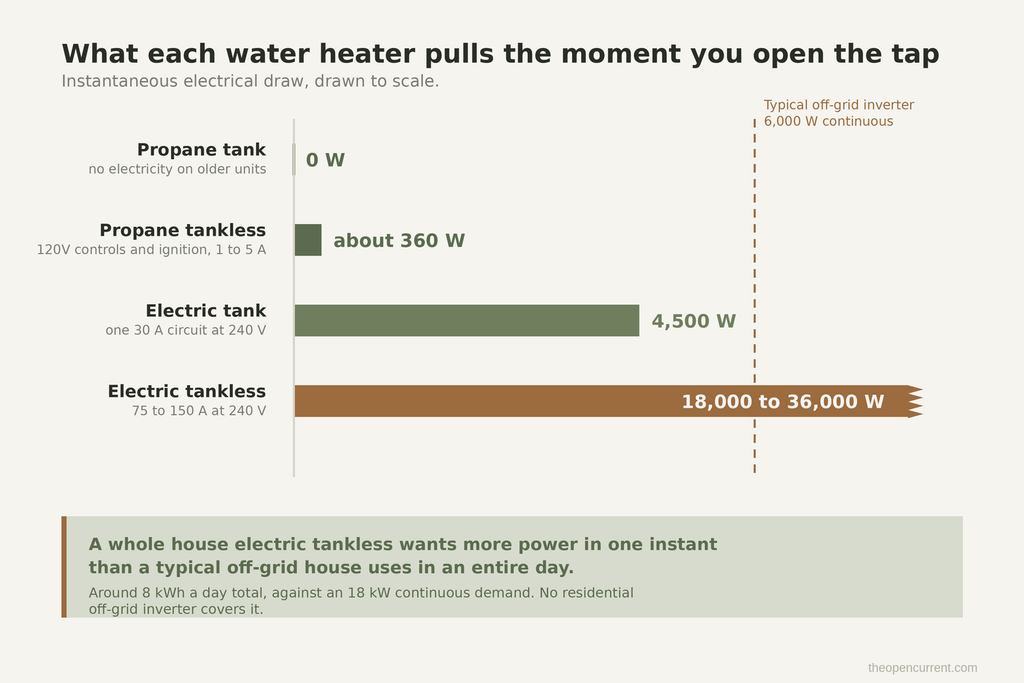
A whole house electric tankless draws 18 to 36 kilowatts. That’s 75 to 150 amps at 240 volts. A 27 kW unit pulls 112 amps continuously and eats more than half the capacity of an entire 200 amp house panel. The bigger ones need four separate 40 amp double pole breakers.
Put that next to a real off-grid system. A typical whole house build runs somewhere around 8 kWh across an entire day. An 18 kW instantaneous draw is more than twice your whole day’s electricity, demanded in one continuous hit, and no residential inverter on the market covers it. You could stand in front of a full battery bank and still not start it.
Worth saying that an electric tank isn’t much better. A 4,500 watt element pulling 6.5 to 15 kWh a day is the single largest line in the off-grid cost calculator, and running one continuously would flatten a large battery bank in about an hour.
So if you’re off grid, the real question isn’t tankless or tank. It’s propane tankless or propane tank, and that’s a completely different comparison with completely different tradeoffs.
| Propane tank | Propane tankless | Electric tank | Electric tankless | |
|---|---|---|---|---|
| Installed cost | $900 to $2,500 | $2,000 to $4,500 | $600 to $1,800 | $1,400 to $5,600 plus panel work |
| Lifespan | 8 to 12 yrs, 25+ with anode changes | 15 to 20 yrs with annual descaling | 8 to 12 yrs, 25+ with anode changes | 15 to 20 yrs |
| Power to run | None on older units | 120V at 1 to 5A, or two D cells | 4,500W, 18.8A at 240V | 18,000 to 36,000W, 75 to 150A |
| Full fire fuel draw | 30,000 to 40,000 BTU/hr | 150,000 to 199,000 BTU/hr | n/a | n/a |
| Off-grid verdict | Works, and keeps working in an outage | Works if propane and flow keep up | Your single biggest load | Impossible |
Original diagram. Reuse it with a link to theopencurrent.com.
Propane tankless still needs electricity, and the detail matters
This trips up more people than anything else, partly because both extreme answers get repeated as gospel.
A full size propane tankless needs 120V power for the ignition, the control board, the display and often a powered vent fan. Even ENERGY STAR’s own guidance tells installers to check whether electricity is available near the heater for forced ventilation models, which tells you how routinely it gets overlooked. It’s a small load, somewhere around 1 to 5 amps, but it’s permanent and it means no power equals no hot water. That matters a lot more on a battery bank in February than it does on a grid connection.
Then there’s a second class of unit that ignites off two D cell batteries at 3 volts DC with no household connection at all. The Eccotemp L10 comes up constantly in off-grid conversations, 2.65 GPM and about 68,000 BTU. Camplux and Gasland make similar units. Marey does a 4.2 GPM at 100,000 BTU on battery ignition.
The owner reports on these are genuinely good. One guy has run an L10 at an off-grid house for over eight years and says he can’t remember changing the batteries. Another reckons the D cells corrode out before they ever go flat.
The catch is that battery ignition units run lower flow rates and usually have no powered vent, so you’re looking at an outdoor mount or a very deliberate venting job. You’re trading capacity for independence, and for a cabin that’s often the right trade.
Flow rate is where people get it wrong
Tankless units are not sized in gallons. They’re sized in gallons per minute at a given temperature rise, and the temperature rise is the bit everyone skips.
Your rise is your target temperature minus whatever comes out of the ground. Target 120, incoming 50 in January, that’s 70 degrees of work. It takes roughly 40,000 BTU an hour to hold 1 GPM at a 70 degree rise.
So the headline number on the box is close to meaningless. A unit that cheerfully does 8 GPM on warm water might only manage 6 on cold. Winter groundwater can be 42 degrees where summer is 65, and that’s the same house.
Size for January, never for August. That lovely 2.65 GPM cabin unit is plenty in July and marginal in February, and that’s when people decide tankless doesn’t work rather than admitting they bought the wrong size.
If your water is coming from a well, the numbers you need are in the submersible well pump guide, because flow rate at the tap is a pump and pressure tank question before it’s ever a water heater question.
The failure mode nobody writes about
Tankless heaters need a minimum flow to fire the burner, usually around 0.5 GPM. Below that, the industry actually calls it the dead zone. The burner never lights.
Off grid this is not theoretical. If you’re on a 12 volt pump, or gravity feed from a cistern, or a well with a tired pressure tank, there’s a real chance you don’t make 0.5 GPM at the tap. You open it, you get cold, and nothing is broken. Some units start as low as 3.6 PSI, which helps on weak sources, and that’s a spec worth hunting down before you buy rather than after.
The reverse problem is just as annoying. Open a tap to rinse a plate and a whole house unit fires at close to 100,000 BTU to warm a gallon of water. That’s not a rounding error on propane you’re hauling in yourself.
Your propane supply might not keep up
Short version here because this one deserves its own article, and I’ve written it.
Propane has to boil out of the liquid before it reaches the burner, and how fast it can do that depends on how cold it is outside and how much liquid is left in the tank. A full 100 lb cylinder delivers around 167,000 BTU an hour at 20 degrees, and only about 113,000 at zero.
Now look at what a whole house tankless wants. 150,000 to 199,000 BTU an hour at full fire, against 30,000 to 40,000 for a tank.
You can see the collision coming. The unit runs fine in September and starves in January, and it doesn’t look broken, it just goes lukewarm. In cold climates the guidance is a propane tank rated for at least 150 percent of the heater’s full fire BTU, which for a 199,000 BTU unit means 500 gallons minimum.
The full version, including the vaporization numbers by temperature and how to size your tank properly, is in how much propane a tankless water heater uses.
The bill is not the unit
Worth knowing even if somebody else is doing the install.
A tank runs on a half inch gas line sized for about 40,000 BTU. A tankless at 199,000 needs three quarter inch minimum, and upsizing costs $350 to $1,500 depending on the run and whether it goes through finished walls.
You also can’t reuse the old flue. Non condensing units need Category III stainless because the exhaust runs hot, at $15 to $60 a linear foot plus $300 to $1,000 for the run and the wall penetration. Condensing units use cheap PVC instead but then make acidic condensate that needs a neutralizer cartridge before it touches your plumbing.
One contractor put it well: only about one in five tankless installs is genuinely plug and play. The rest need at least one upgrade the marketing never mentions.
Handy tell for reading a quote. If more than about 60 percent of the total is the unit itself, somebody has left the expensive parts off. I break down every line item, with three real world quote scenarios, in my tankless water heater cost guide.
What the trades actually say
This is the section that surprised me, and I think it’s the most useful thing on the page.
The plumbing forums are full of contractors who have stopped installing these. One says he can buy and fit whatever he likes and picks a tank every single time, because tankless units carry a lot of electronics and when those fail the repair is brutal. Another says he runs the pipes out of the wall and lets the homeowner make the final connection, because he doesn’t want the callback. A third had two units go back to the factory under warranty, which meant a long stretch with no hot water.
That last one hits different when you’re forty miles from town. A tank has a burner, a thermostat and an anode rod. A tankless has a control board, and when the board dies in February you’re waiting on a part.
The septic angle, which nobody else will tell you
Best thing I read while researching this, from a homesteader on a tractor forum.
A tankless heater makes hot water forever, which is roughly how long teenagers and houseguests will stay in a shower. All that water goes straight into your septic system. A tank runs out, and people get out.
If you’re on a conventional gravity drain field, your water heater is a wastewater decision as much as a hot water one. That’s not something a plumbing blog in the suburbs is ever going to raise, and it’s real. I’ve gone through what the system underneath costs in the septic system cost guide.
The tank’s secret weapon
Everyone quotes 8 to 12 years for a tank like it’s physics. It isn’t. That’s a corrosion clock, and the anode rod is what runs it.
The rod is a sacrificial piece of metal that corrodes so the tank doesn’t. When it’s gone, the tank starts rusting from the inside. Almost nobody replaces one.
The forum guys who do report getting close to thirty years out of a tank. One changed his every five years and his was 29 years old when the house burned down, and he figures it had plenty left. A rod runs about $40, and there are powered versions that never need changing, which also sorts out smelly water if your well gives you that.
That flips the headline argument. Tankless supposedly wins on lifespan, but a maintained tank can comfortably outlive a neglected tankless. And the maintenance is a forty dollar part every few years instead of a descaling service at $200 to $300 a visit.
Which is the honest way to frame this whole decision. Both of these need maintenance. The question is which one you’ll actually do. Forty miles from a plumber, that’s a real question.
So which one
Here’s my actual read, and it depends less on the technology than on how you live.
Propane tankless makes sense if you’re seasonal or intermittent, because a tank sitting hot in an empty cabin is pure waste and a tankless sitting idle costs nothing. Also if space is genuinely tight, if you can feed it properly on propane, and if your water system reliably makes decent flow.
A propane tank makes sense if you’re full time, if your water pressure is marginal or you’re on gravity feed, if you’re somewhere cold with limited propane storage, if you’re on a septic field you’re protective of, and honestly if you’re the kind of person who would rather change a $40 rod every few years than schedule an annual descale.
And if you’re already burning wood all winter, it’s tempting to get your hot water from the stove too. It can work, but there’s a real explosion risk if it’s done wrong. I cover the safe way to do it in my wood stove water heater guide.
Neither is the answer more often than you’d think. On a big enough system with real summer surplus, a heat pump water heater cuts electric water heating by 60 to 70 percent and lands at 1.5 to 3 kWh a day against 6.5 to 15 for resistance. That’s a tank, by the way. The most efficient water heater sold today isn’t tankless at all, and not one page in this whole debate seems to mention it.
Frequently asked questions
Is a tankless vs tank water heater decision different off grid? For a grid connected house where you’ll stay ten years or more, usually yes on total cost. Off grid the answer flips more often than not, because electric tankless is impossible, propane tankless needs a serious propane supply and a minimum water flow, and a maintained tank can last decades.
Can you run a tankless water heater off grid? A propane one, yes, and plenty of people do. An electric one, no. Whole house electric tankless draws 18 to 36 kW, which is far beyond any residential off-grid inverter.
Do propane tankless water heaters need electricity? Most full size units do, for ignition, controls and often a vent fan, typically 1 to 5 amps. Smaller units like the Eccotemp L10 run ignition off two D cell batteries and need no household power at all.
How long do tank and tankless water heaters actually last? Tanks are quoted at 8 to 12 years and tankless at 15 to 20. But tank lifespan is really anode rod lifespan, and owners who replace the rod every few years report getting 25 to 30 years.
What size tankless water heater do I need? Work out your peak simultaneous flow in GPM, then your temperature rise, which is 120 minus your coldest incoming water temperature. Size on the January number, not the annual average.
Why does my tankless run cold on low flow? Most need around 0.5 GPM before the burner fires. Below that, it never lights. On a 12 volt pump or gravity feed this is a common and confusing problem.
Does a tankless water heater save money? Some, but less than advertised. The 24 to 34 percent figure applies to households using 41 gallons a day or less. Real world payback on a gas to gas swap runs 22 to 27 years, which often exceeds the life of the unit.
Where to go from here
If you’re grid tied and staying put, the usual advice holds and you don’t need me.
If you’re off grid, do this in order. Check what your propane supply can actually vaporize on your coldest day. Check what flow rate your water system genuinely delivers at the tap. Then pick the heater, because both of those numbers will narrow your options a lot faster than any efficiency chart.
And whichever way you go, budget the maintenance honestly. The unit that fails early is almost never the one that was wrong on paper. It’s the one nobody looked after. The tankless vs tank water heater choice is really a question about which maintenance you’ll keep up.
Next:
- How Much Propane a Tankless Water Heater Uses for the tank sizing and vaporization math
- Off-Grid Cost Calculator for what water heating does to your whole build
- Propane Refrigerator Buying Guide for the other big propane appliance decision
- Off-Grid Water Systems for how the water gets there in the first place