Well Pressure Tank Replacement Cost: What You’ll Pay and Why Quotes Vary So Much

A well pressure tank replacement can cost you $450 or it can cost you $2,000, and the annoying part is that both quotes might be completely fair.
I went through the price guides that rank for this, and the Reddit threads where people post the quotes they actually got. On one of those threads, people were quoted $1,800 and $2,000 for the same basic job that a big home site says averages a few hundred bucks. Somebody’s wrong, right?
Not exactly. After pricing the tanks themselves at real retailers, I found the thing most cost guides skip: they’re pricing the cheap tank. A box-store 44-gallon well tank runs around $400. The industry-standard Amtrol Well-X-Trol costs well over that, often double, and some suppliers list the 44-gallon at more than $1,000. When a contractor quotes you, the tank in that quote is doing most of the work on the number.
So this guide covers what the job really costs with each kind of tank, how to tell if your tank is actually dead (and one piece of common advice that the manufacturer calls an explosion hazard), the cheap part that catches people out when they upsize, and the questions that stop you overpaying.
What a well pressure tank replacement actually costs
Here’s the honest range for a well pressure tank replacement, built from current tank prices plus typical labor. Labor for this job usually runs two to six hours at roughly $75 to $150 an hour, and a tank in a crawlspace or tight utility closet lands at the top of that.
| Job | Tank price | Typical total | Watch for |
|---|---|---|---|
| DIY, box-store tank | $150 to $500 | $250 to $650 | Old tee and switch |
| Pro, box-store tank | $150 to $500 | $450 to $1,200 | Which tank is quoted |
| Pro, Well-X-Trol 20 gal | About $320 | $600 to $1,100 | Small drawdown |
| Pro, Well-X-Trol 44 gal | $700 to $1,450 | $950 to $2,200 | Tee size change |
The first thing that jumps out is the gap between a pro installing a box-store tank and a pro installing a 44-gallon Well-X-Trol. Same job, same plumber, same afternoon. The only thing that changed is the tank.
A few reference prices so you can sanity check a quote yourself. The Well-X-Trol WX-202, a 20-gallon tank, sells for about $323. The 32-gallon WX-203 sells for around $556, and suppliers list the 44-gallon WX-250 anywhere from about $1,000 to $1,400, so shop around if you’re buying one yourself. The Water Worker 44-gallon at Home Depot was showing at $398 when I checked.
Big home sites put the whole job much lower. Angi says $300 to $700 on average. That’s a reasonable number if you’re getting a box-store bladder tank in an easy spot. It’s not a reasonable number for a premium 44-gallon tank, because the tank alone costs more than that.
Why quotes for the same job vary so much
The tank is most of the gap
If you’ve got two quotes $800 apart, the first question isn’t “who’s ripping me off.” It’s “which tank is each of them putting in?”
A contractor who installs Well-X-Trol on every job isn’t overcharging you just because the other guy quoted a box-store tank. They’re selling a different product. Whether that product is worth the extra is a real question, and I’ll get to it.
Is a box-store tank the same as a Well-X-Trol?
Sort of, and this one surprised me. Several owners report that Water Worker, the Home Depot brand, is made by Amtrol, the same company behind Well-X-Trol. So you’re not buying some mystery import.
The differences that are on paper: Well-X-Trol carries a 7-year warranty and Water Worker carries 5. Amtrol also claims the Well-X-Trol has a 150 PSIG working pressure, its thickest butyl diaphragm, a stainless steel system connection and a welded air stem.
The differences that aren’t on paper come from owners. One Home Depot reviewer who clearly knew his stuff said the Water Worker uses thinner steel, a black iron elbow at the bottom instead of brass, and no brass bushing to fit your tank tee. That’s one guy’s review, not a spec sheet, but it’s specific enough to be worth checking in the box before you install.
My take: a box-store bladder tank is a legit choice, especially if yours failed on a Saturday and the family wants a shower. Just know which one you’re paying for.
A “44-gallon” tank doesn’t hold 44 gallons
This is the one that gets everybody. The number on the tank is its total volume, air included. The water it actually delivers between pump starts is called drawdown, and it’s way smaller.
The WX-250 is sold as a 44-gallon tank. Its drawdown at a 40/60 pressure setting is 12.9 gallons. A 20-gallon tank gives you about 6 gallons. It’s the plumbing version of a family-size bag of chips.
That matters because drawdown, not the gallon number, decides how often your pump starts. If you’re comparing two tanks, compare drawdown at your pressure setting. If you’re not sure what size you need in the first place, my well pressure tank sizing guide walks through it.
Access, labor and the parts nobody mentions
The WX-250 is 36 inches tall, 22 inches wide and weighs 69 pounds empty. That’s fine in a basement. In a crawlspace it’s a two-person job, and a waterlogged tank is a whole different animal because 44 gallons of water alone weighs over 360 pounds. Nobody’s idea of a good Tuesday.
The other swing factor is the stuff around the tank: the pressure switch, the gauge, the tank tee. More on that below, because it’s where a lot of quote padding and a lot of genuine value both live.
Do you actually need a new tank?
Before you pay anyone, spend two minutes confirming the tank is the problem. A bad pressure switch or a leak can look a lot like a dead tank.
The two-minute check
The classic symptoms. Amtrol lists the signs of a tank that needs replacing as rapid pump cycling or low pressure in the system. If your pump kicks on every time someone washes their hands, that’s the tell.
The air valve test. On top of the tank there’s a valve that looks exactly like the one on a car tire. Press it. If water comes out instead of air, the bladder has ruptured and the tank needs replacing. That’s the definitive answer. No repair, no workaround.
The air charge check. If air comes out, check the pressure with a tire gauge. Amtrol’s instructions are to shut off the pump and drain the system of water pressure first, then read it. The correct precharge is 2 PSI below your pressure switch cut-in. On a 40/60 switch, that’s 38 PSI. If the tank has low or no air, Amtrol says it may need replacing.
Why “just add air” is bad advice for an old tank
Here’s the part I really want you to read.
If you post a cycling pump on any plumbing forum, somebody will tell you to top up the tank with a bike pump or compressor. On one pro forum, a plumber told a reader to add about 35 PSI through the valve stem and call it done. It’s everywhere, and it sounds harmless.
Amtrol’s own installation manual says the opposite, under a “DANGER! EXPLOSION HAZARD” warning. It says do not adjust or add pressure if there has been a loss of air, and do not adjust the precharge if there is visible exterior corrosion. A newer version of the manual goes further: only adjust the precharge when the tank is new, or when you’ve confirmed the tank’s integrity and that there’s no internal or external corrosion.
So think about who’s actually doing the topping up. It’s almost always someone with an old, rusty tank that keeps losing air. That’s exactly the tank the manufacturer is telling you not to pump up. A pressurized steel tank that lets go is not a mess you clean up with a mop.
Setting the precharge on a brand new tank before you fill it? Totally normal, and I cover it in the DIY section. Repeatedly refilling a corroded one to squeeze out another season? That’s the one to stop.
How long does a well tank last?
The honest answer is that sources don’t agree, and I’m not going to pretend they do.
One home inspector’s summary of InterNACHI, NAHB and Fannie Mae data puts a well pressure tank at 10 to 25 years, averaging 15. HomeAdvisor’s own FAQ says 7 to 10 years. One water treatment retailer says cheap hardware-store tanks often last 5 to 7 years before the bladder fails.
My read is that the spread is mostly tank quality and where the tank sits. Which brings me to the cheapest longevity tip I found. A Home Depot reviewer replaced an 18-year-old Well-X-Trol because the bottom had rusted out from sitting straight on a concrete floor with uninsulated pipes sweating onto it. He put the new one on a 4-inch platform. A few bucks of lumber or a couple of pavers for years of extra life is a pretty good trade.
The tank tee: the cheap part that trips people up
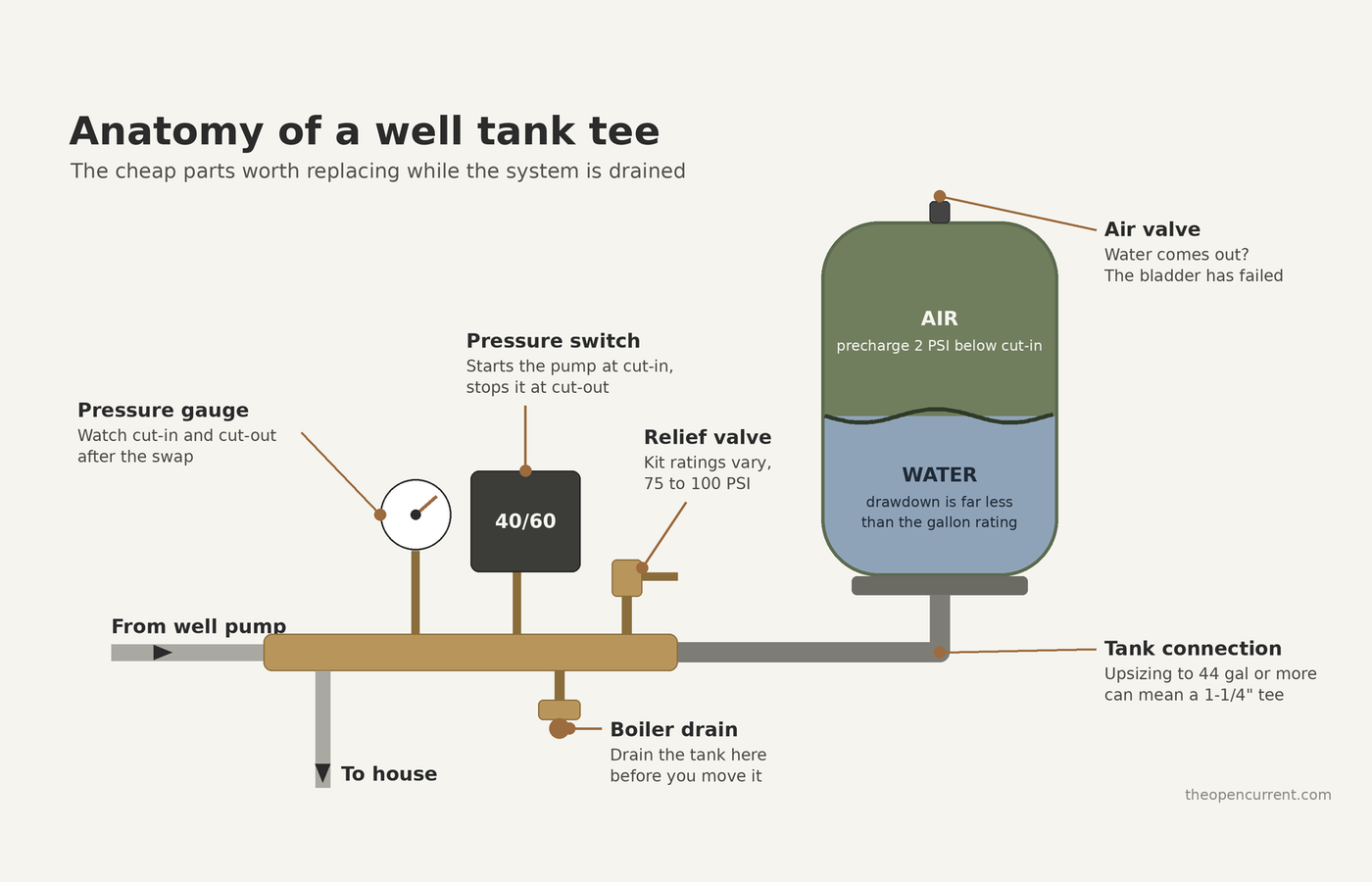
The tank tee is the brass or stainless fitting that screws into the bottom of the water pressure tank and carries everything else. A typical kit includes the tee, a pressure relief valve, a boiler drain, a brass nipple, thread tape, a 100 PSI gauge and a 40/60 pressure switch.
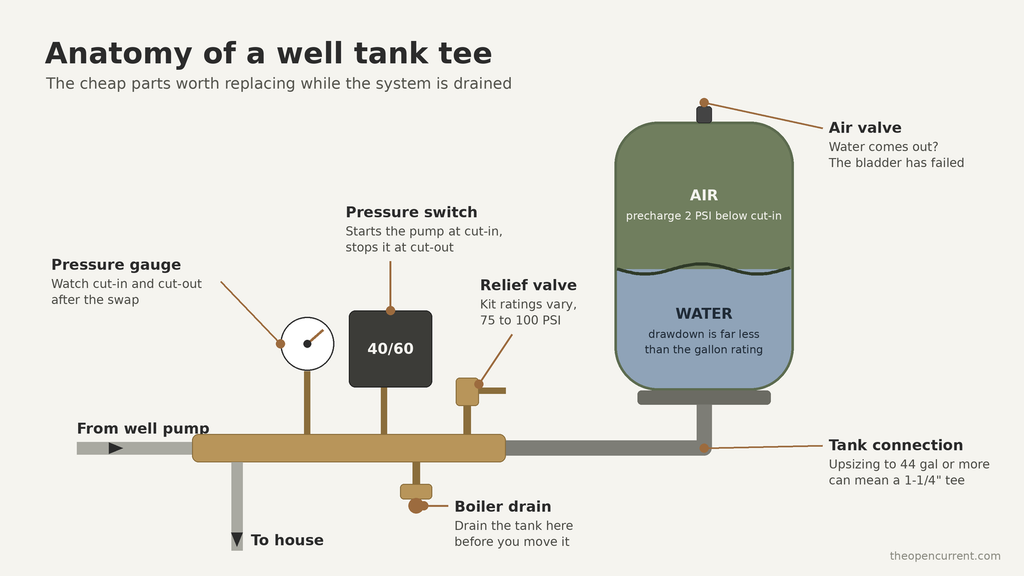
Original diagram. Reuse it with a link to theopencurrent.com.
Two things to know.
These parts are cheap, so replace them while the system is drained. When a reader on a DIY forum was quoted $750 to swap a 20-gallon tank, a regular pointed out the switch runs $20 to $30 and the gauge $10 to $20. Prices have crept up since, but they’re still small money. The expensive part of a pressure switch is the second call-out when the old one dies three months after your new tank went in.
If you upsize, the tee might not fit. This is the gotcha nobody mentions. A standard 1-inch tee kit is sold for the Well-X-Trol WX-201 through WX-203 and the Goulds V60 to V100. The bigger Amtrol tanks, the 44, 62 and 119-gallon models, take a 1-1/4″ × 14″ tee. So going from a 20-gallon to a 44-gallon bladder tank can mean a new tee, not just a new tank. And remember the Home Depot reviewer who said his Water Worker came without the bushing to step down to a 1-inch tee? Check the box before the store closes.
One more: relief valve ratings vary between kits. I’ve seen 75 PSI in one kit and 100 PSI in another. I couldn’t find a code source that settles which is right for every system, so I’m not going to give you a rule. Ask your installer why they chose the one they did.
How to replace a well pressure tank yourself
Is this DIY-able? For someone comfortable with threaded plumbing and turning off a breaker, yes. If the pressure switch needs rewiring and you’ve never worked on a live 240V circuit, that’s the part to hand to a pro.
Also check your warranty before you start. HomeAdvisor says many manufacturers specify professional installation to keep the warranty valid, and I’d rather you find that out now than after the bladder fails.
The basic sequence, following Amtrol’s instructions where they give them:
- Kill the pump at the breaker. Not the switch on the wall. The breaker.
- Drain the pressure. Open a faucet or drain until the gauge reads 0 PSI.
- Drain the old well water tank through the boiler drain on the tee. Don’t try to move it full. See the 360 pounds above.
- Disconnect and remove the old tank. Corroded fittings are where this goes from an hour to an afternoon.
- Set the precharge on the new tank before any water goes in. Amtrol’s steps are to check the precharge and release or add air until it’s 2 PSI below the pump cut-in. New tanks usually ship at 38 PSI, which suits a 40/60 switch, but check it anyway.
- Put it on something other than bare concrete. Your future self says thanks.
- Tape the threads, connect the tee, restore power and watch the gauge. The pump should shut off at your cut-out pressure and start at your cut-in.
- Check every joint for leaks before you walk away.
Amtrol’s manual also recommends a water test before installation and suggests asking your local plumbing official about disinfecting your home’s plumbing. Opening up the system is a good excuse to do both.
Before you upsize: bigger tank or a cycle stop valve?
Here’s the section where I argue against the obvious purchase.
The usual advice when replacing a tank is to go bigger. More drawdown means fewer pump starts, and fewer starts is easier on the pump. That’s true, and it’s why so many installers upsell a 44 or 86-gallon tank.
But there’s a genuine argument among pros that a bigger tank isn’t the only fix. A cycle stop valve holds the pressure steady while water is being used, so the pump keeps running at reduced flow instead of stopping and starting. On Terry Love’s plumbing forum, the pitch is that a cycle stop valve plus a tiny 4.5-gallon tank does the job better, costs less and fits where a big tank won’t.
The pushback is just as real. One pro on PlumbingZone says switching to a cycle stop valve costs more and needs more maintenance. A homesteader on another forum put it more simply: it’s another thing to break, so spend the money on a bigger tank.
One thing worth knowing. The loudest advocate for cycle stop valves on the forums sells them, and one forum regular openly accused him of shilling. That doesn’t make him wrong. It’s just context you’d want.
My honest opinion: for a normal household well where the old tank simply wore out, replace it with a well tank sized properly for your pump and move on. A cycle stop valve starts to make sense when you’ve got big variable demand, like irrigation on top of the house, or when there’s no room for a big tank. Either way, don’t let anyone sell you a giant tank as the only option without mentioning the other one exists.
Off grid? Your well tank is also a power decision
If your well pump runs off solar and batteries, the tank does a second job most guides ignore. Every pump start is a surge your inverter has to carry.
A submersible pump pulls several times its running current for a moment every time it starts. As a rough guide, a 2-wire pump surges around 4 to 5 times its running current and a 3-wire pump around 3 to 4 times. I break that difference down in my submersible well pump guide. Franklin Electric’s own motor manual says 2-wire motors need a generator rated 50% bigger than 3-wire ones for the best starting. That’s how big a deal starting current is.
Now look at it through the tank. Franklin allows 100 starts in 24 hours for a 1 to 5.5 hp single-phase motor, and says motors should run at least one minute each time to get rid of the starting heat. A small, tired tank with a few gallons of drawdown blows through starts fast. On the grid that wears your pump. Off grid it also hammers your inverter with surge after surge and leaves less margin for anything else that starts at the same time.
You’ll see service companies claim short cycling cuts pump life from 10 to 15 years down to 1 or 2. That’s a marketing claim, not data, so don’t take it as gospel. Franklin’s start limits are the number I’d trust.
A cycle stop valve changes the shape of the load too. Fewer surges, but longer runs at partial flow. I haven’t found solid data on how that nets out on a battery bank, so I’m not going to pretend I have.
If you’re planning a whole system and want to see how the well pump’s surge stacks up against everything else, the off-grid cost calculator shows your peak surge alongside the costs.
Mistakes that cost real money
- Topping up air on a tank that keeps losing it. Covered above. The manufacturer says don’t.
- Filling the new tank before setting the precharge. The air charge needs setting while the tank is empty. Do it after and you’re draining it again.
- Comparing tanks by gallon size instead of drawdown. A 44-gallon tank gives you about 13.
- Upsizing without checking the tee. The bigger tank may need a 1-1/4″ tee.
- Leaving the old switch and gauge on. They’re cheap now and a second visit isn’t.
- Setting the tank on bare concrete next to pipes that sweat.
- Living with short cycling for months. Whatever the real pump damage number is, it isn’t zero. If a new tank comes in the same year as a new pump, my well pump replacement cost guide covers the bigger bill.
Questions to ask before you hire anyone
- Which exact brand and model is in this quote? This alone explains most price gaps.
- What’s the drawdown at my pressure setting? Not the gallon size.
- Are you replacing the tee, switch and gauge, or reusing mine?
- If the tank’s bigger, does the tee size change?
- Will you set the air charge to 2 PSI below cut-in before filling it? If they look at you funny, that’s your answer.
- Is my pump old enough that it’s worth checking while you’re here?
A good installer will answer all six without blinking. A bad one gets vague on the first question, and that’s usually where the markup is hiding.
FAQ
How often should a well pressure tank be replaced?
There’s no fixed schedule. Replace it when the bladder fails (water from the air valve) or the tank is corroding. Estimates range from 5 to 7 years for cheap tanks up to 10 to 25 years for good ones.
How difficult is it to replace a well pressure tank?
Moderate. The plumbing is threaded, not soldered, and the steps are straightforward. The hard parts are draining and moving the old tank, stubborn corroded fittings, and any pressure switch wiring. If the tank is in a crawlspace, get help.
How do I know if my well tank is bad?
Your pump turns on and off rapidly, pressure drops fast when you run water, or water comes out of the air valve on top. That last one is a guaranteed failed bladder.
What is the average lifespan of a well pressure tank?
Around 15 years is a common estimate from home inspection data, with a range of roughly 10 to 25. Budget tanks can fail much sooner.
Can I just recharge the air in my tank?
On a new tank, or one you’ve confirmed is sound with no corrosion, yes. Set it to 2 PSI below your cut-in with the system drained. On an old tank that’s been losing air or is rusty, Amtrol warns against it because of the explosion risk.
Is a bigger well pressure tank worth it?
Often, because more drawdown means fewer pump starts. But check that your tee fits, and know that a cycle stop valve with a small tank is a legitimate alternative some pros prefer.
Where to go next
If you’re buying a property with a well, the well is only half the story. My septic inspection guide covers what a proper inspection looks like and what to ask before you sign anything.
And if the property doesn’t have a well yet, my well drilling cost guide covers what a new one really costs.
If you’re working out how your water setup fits the bigger picture, start with my off-grid water systems hub.
And if your well pump runs on solar, how to go off-grid with solar covers the power side of all this.