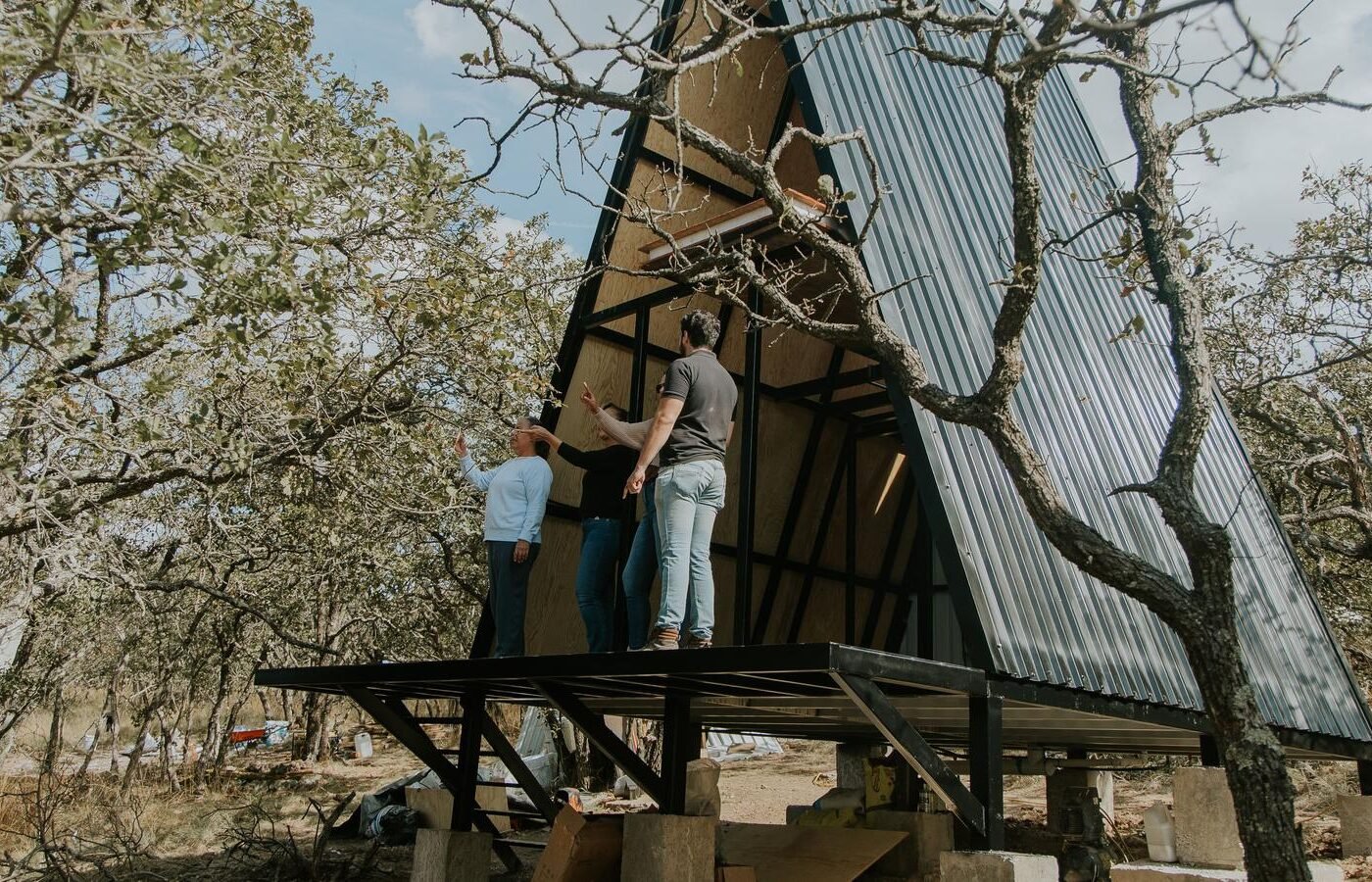
Off Grid Cabin: What Actually Decides Whether You Can Build One

There’s a guy on a homesteading forum who couldn’t get a mortgage on his off grid cabin. He’d worked through the usual problems. No grid power, no municipal water, he knew all that was going to make it harder.
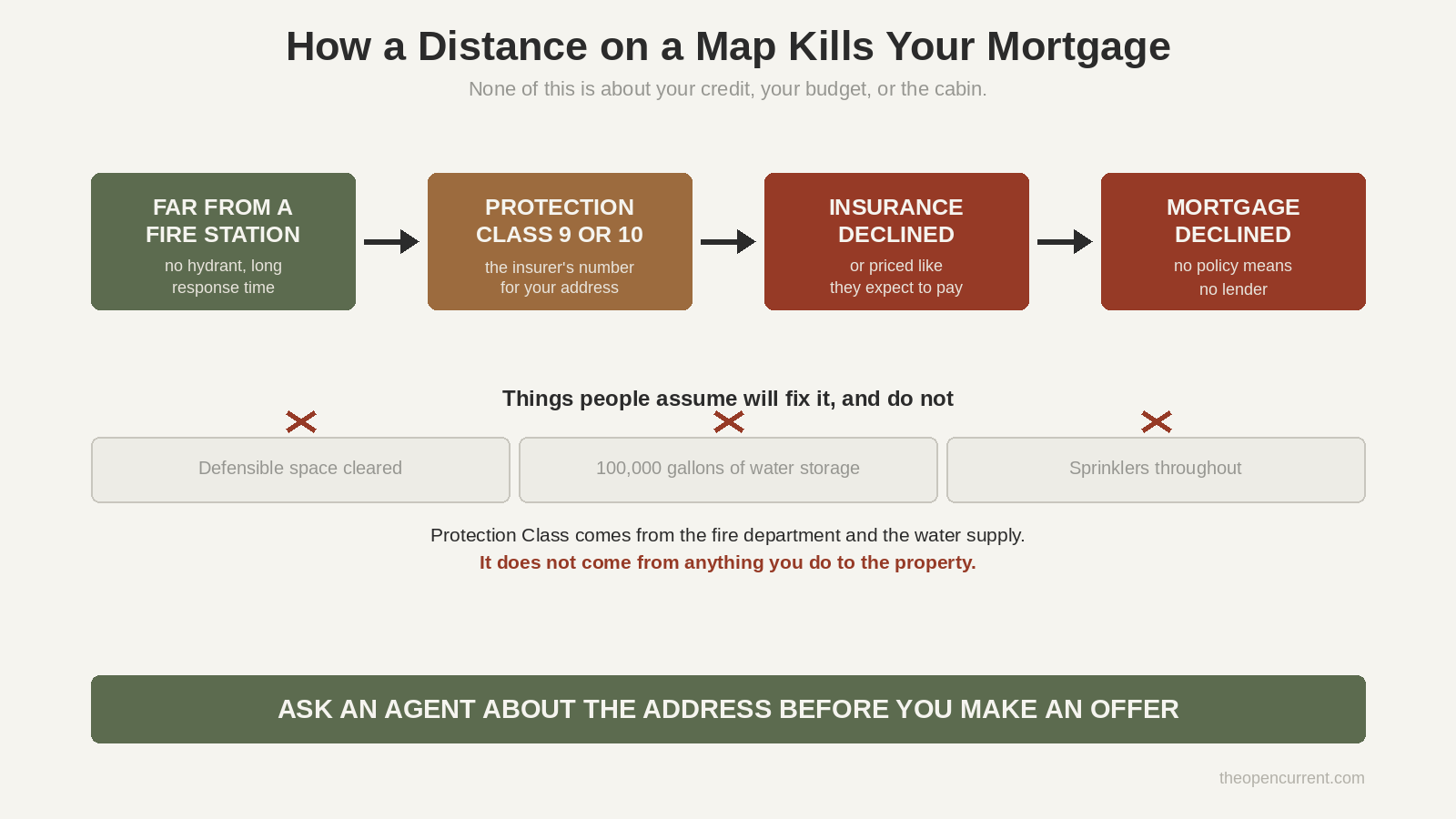
What actually killed it was none of those. His place sat more than 500 feet from a fire hydrant, which meant he couldn’t buy insurance. And no insurance means no lender, because a bank isn’t lending against something that might burn flat with nothing standing behind it.
So the financing died over a distance on a map. Not a design choice. Not a budget. A distance.
That’s the thing about building an off grid cabin that almost nobody writes about. The building itself is usually about a third of what you spend, and it’s the last piece to fall into place. What decides whether you can actually live out there gets settled long before you pick a floor plan, and it gets settled by three gates that have nothing to do with carpentry.
Sewage. Insurance. Access.
Miss any one of them and you’ve got a very expensive shed.
Gate one: the toilet decides whether you’re allowed to live there
Here’s the sentence that reframed this whole thing for me, from a legal write-up on off grid living: the biggest hurdle for an off grid home isn’t the walls, it’s the waste.
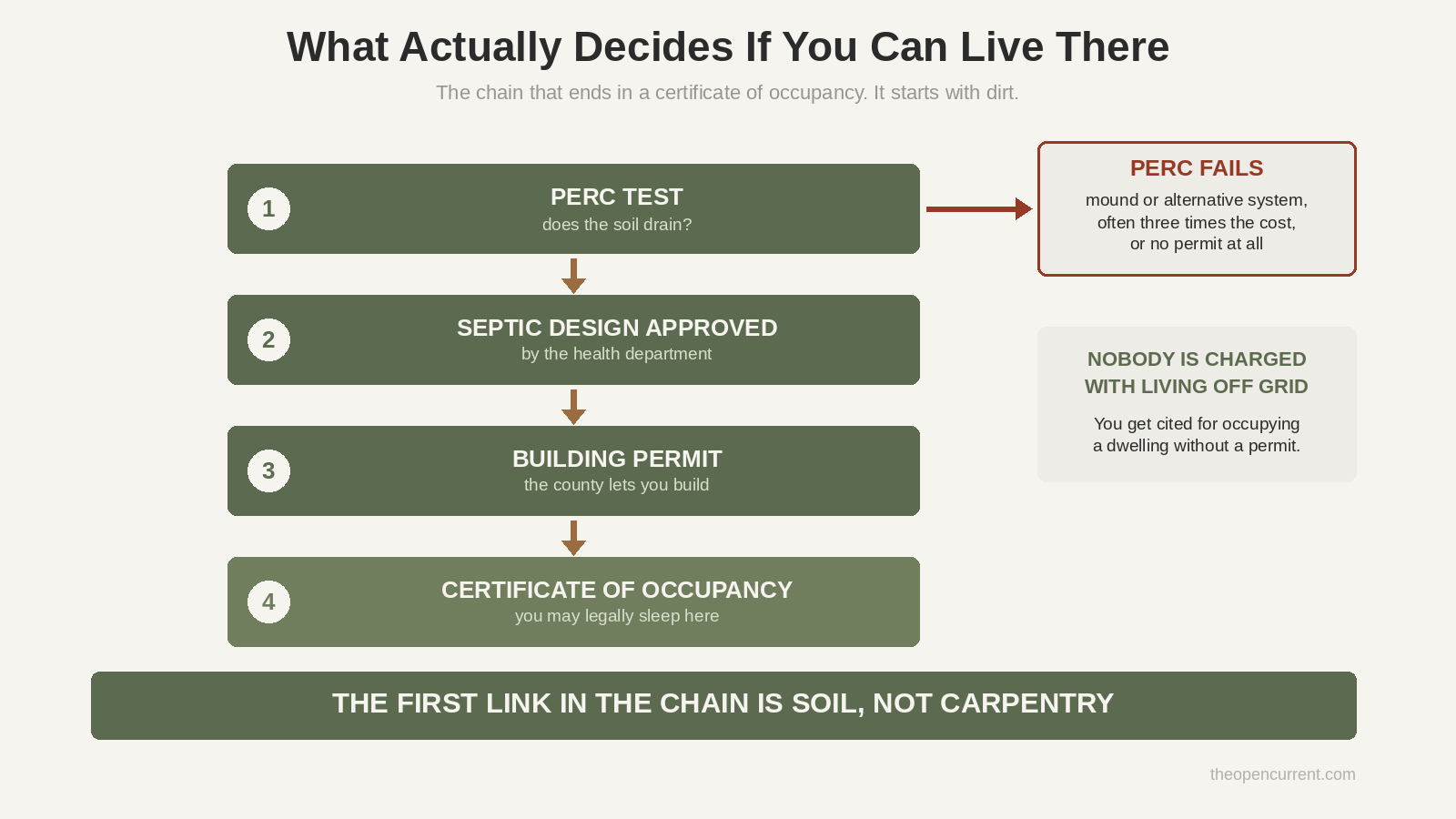
Most counties require a certificate of occupancy before anyone can legally live in a dwelling. To get one, you need a state approved way of dealing with sewage. No approved waste system, no certificate. No certificate, and the building you just spent a year on is legally a structure you’re not allowed to sleep in.
And notice how the enforcement actually works, because this part is sneaky. Nobody gets charged with living off grid. That’s not a crime anywhere in the US. What happens is you get cited for occupying a dwelling without a valid occupancy permit. Same outcome, different paperwork.
So the real chain is:
Perc test → septic approval → certificate of occupancy → you’re legally allowed to sleep in your own cabin.
Which means the single most important thing on your property isn’t the view. It’s whether the dirt drains. I wrote up what a perc test actually involves separately, and if you take one thing from this article, let it be this: never buy land without a perc contingency in the contract. Never. That’s the whole ballgame and people skip it constantly because they fell in love with a creek.
And composting toilets are not the escape hatch you think they are. Loads of people assume they can dodge the septic cost with a composter and some greywater. Sometimes true. Often not. Plenty of health departments simply don’t accept composting toilets as a primary waste method for a permitted residence, and “approved” is doing enormous work in that sentence. Ask before you buy, not after.
Original diagram. Reuse it with a link to theopencurrent.com.
Gate two: a map decides your insurance, and insurance decides your mortgage
This is the one that blindsides people, and it’s the section I’d read twice if I were you.
Every insurer rates your property on something called a Protection Class, numbered 1 to 10. It’s based on how far you are from a fire department, how long they’d take to get there, whether they’re full time or volunteer, and whether there’s a reliable water source nearby. City house next to a hydrant with a staffed station down the road? Low number. Cabin at the end of a logging road? High number.
Most off grid homes land at Class 9 or 10.
The thresholds get quoted as something like under 15 minutes or 7.5 miles from a professionally staffed 24/7 fire house to land at Class 9, with Class 9 being the highest a lot of insurance companies will write at all. Past that you’re Class 10, which in insurer language means they’re assuming total loss. I’d treat those exact numbers as a rough guide rather than gospel, because ISO has revised how it scores this more than once and individual carriers set their own cutoffs. The shape of it holds though, and the shape is what matters: far from a station plus no water source equals a number most insurers don’t like.
Now the brutal part, and I want to be really clear about this because it’s counterintuitive.
You cannot improve your way out of your Protection Class. One insurance discussion put it bluntly: it doesn’t matter if you’ve cleared defensible space, installed a hundred thousand gallons of water storage, or fitted sprinklers throughout. The class is based on the fire department and the hydrant, not on you. You can do everything right and still be uninsurable.
And that’s how our forum guy lost his mortgage. No policy, no loan.
What financing actually looks like
Assuming you can get insured, here’s what people report when they go looking for money.
Chase, Bank of America and Wells Fargo mostly won’t touch off grid property. Not out of spite, just that it doesn’t fit the box their underwriting was built around.
What you’ll run into instead:
- 30 to 35% down is common, meaning the bank lends 65 to 70% of value
- One couple who documented their search ran into lenders stacking it: 5% more down for being off grid on power, another 5% for water, another 5% for sewage. Off grid on all three and that’s 15 extra points before you start
- Roughly a one percentage point rate penalty on top
Where it actually works is local credit unions and community banks. One write-up explained why better than I could: when you live in the backwoods, the person at the credit union mortgage desk also lives in the backwoods. They’ve seen a hundred properties like yours and they’re not scared of the word “solar.” Practical Self Reliance has a good breakdown of their own experience getting financed if you want somebody who’s actually been through it.
And here’s the genuinely weird one. A conventional mortgage typically requires utilities to be available at the property. Not connected. Available. Which means you can buy a normal financed house with power at the road and then go off grid afterwards by choice, no problem. But you generally can’t get a conventional mortgage on something that’s already off grid.
Same house. Same systems. Different order. Completely different answer from the bank. Oof.
Two more insurance things worth knowing
Wood stoves make insurers twitchy. They’re a leading cause of residential fires, so expect to need a certified inspection, proof of clearance to combustibles, and possibly a separate rider on the policy. Worth budgeting for if you’re planning wood heat, which most off grid builds are. Same goes double if you’re doing anything clever with it, like the wood stove water heater setup where you’re now running a pressure vessel off a firebox.
Your solar might not be covered the way you assume. Roof mounted panels usually sit under dwelling coverage. A ground mount array may land under “Other Structures” instead, which typically carries a much lower limit. Off grid systems generally need to be declared and evaluated individually rather than quietly assumed. Read the policy, don’t skim it.
Original diagram. Reuse it with a link to theopencurrent.com.
Gate three: if a truck can’t get there, nothing else matters
Every single thing that makes a property livable arrives on wheels.
The well drilling rig. The concrete truck. The septic excavator. The lumber delivery. The propane tank. Every one of them needs a road that exists and holds weight in the rain.
Building a road to a remote site runs somewhere around $3,000 to $30,000 depending on terrain and distance, which is a spread wide enough to eat an entire cabin budget. And access isn’t just about whether you can get there in a truck on a dry day in July. It’s whether a loaded concrete mixer can get there in April.
This is also why water needs confirming before you buy rather than after. Drilling rigs need road access, water quality testing takes weeks, and a dry hole is a thing that genuinely happens. I put together what well drilling actually costs including the dry hole risk, because “we’ll sort water out later” is one of the more expensive sentences in this hobby.
The most repeated lesson across cabin forums is that clearing land and putting in the foundation take longer than building the walls. The walls are the fun part and the fast part. Everything before them is mud.
So what does an off grid cabin actually cost?
The honest answer is that the structure is usually the smallest line item, and I know that sounds like something someone says to be contrarian, but look at the numbers.
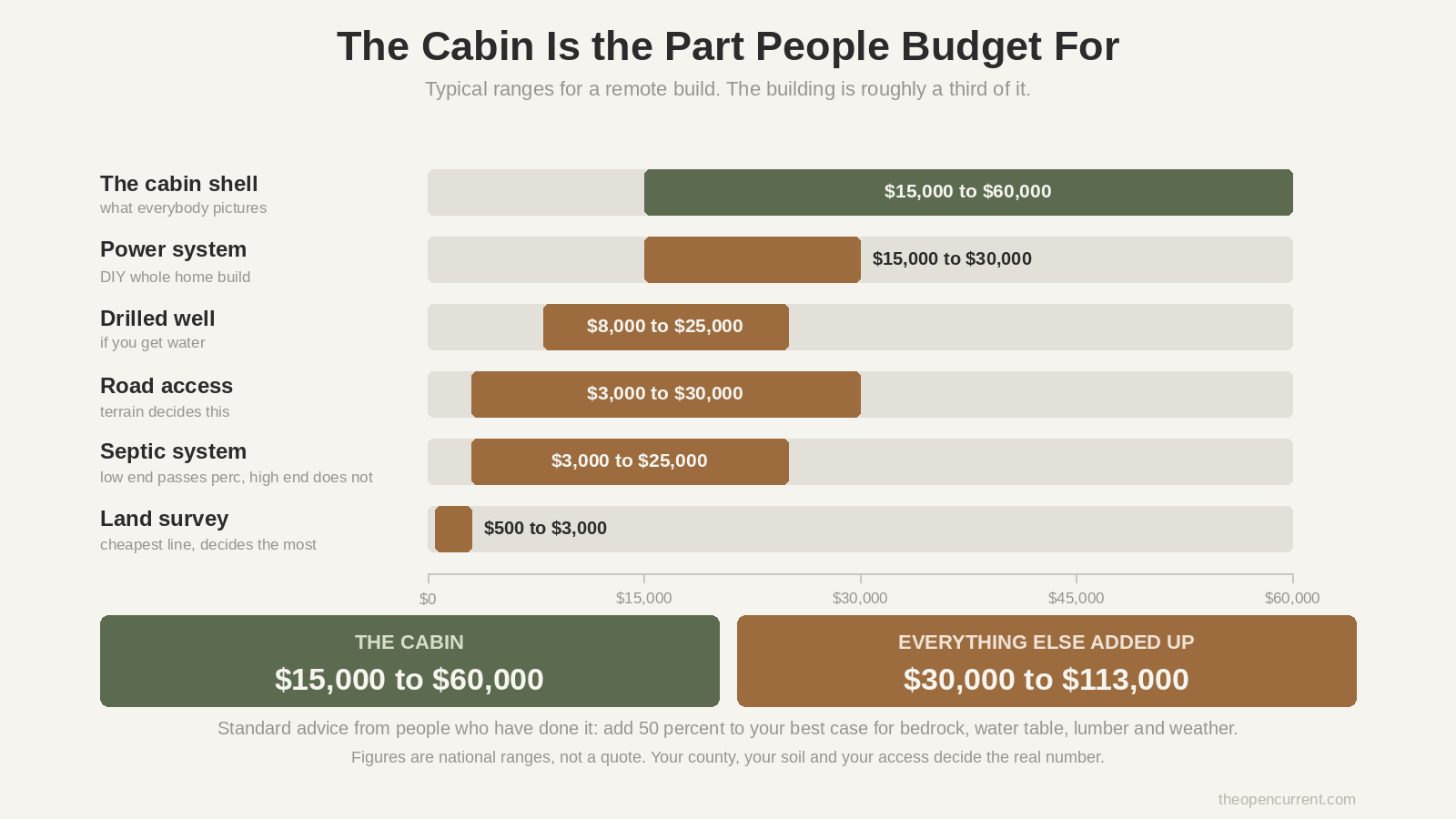
Published shell figures are all over the place, which tells you something on its own. I’ve seen $30 a square foot quoted for a simple DIY build, which puts a 500 square foot cabin around $15,000. I’ve also seen $35,000 to $80,000 and up for something you’d want to overwinter in. Call it $20,000 to $60,000 for most people and accept that the range is wide because “cabin” covers a lot of ground.
Meanwhile:
- Road access: $3,000 to $30,000
- Drilled well: often $8,000 to $25,000
- Septic system: $3,000 to $8,000 conventional, $10,000 to $25,000 if your perc test comes back bad and you need a mound
- Land survey: a few hundred to a few thousand, and worth every penny because every setback and separation distance on your property is measured from a line you can’t see
- Power system: $15,000 to $30,000 for a DIY whole home build, more if you pay someone
Add it up. Even on generous assumptions the cabin is about a third of your spend, and on a remote parcel with a bad perc test it drops well under that.
Standard advice from people who’ve done this is to add a 50% buffer to your best case. That’s not pessimism, that’s bedrock you didn’t know about, a water table higher than expected, lumber prices doing lumber price things, and weather. Always weather.
If you want to play with real numbers rather than read mine, the off-grid cost calculator lets you pick your water, waste, heating and appliances and spits out both a cost range and a daily power draw, which are more connected than most people expect.
Original diagram. Reuse it with a link to theopencurrent.com.
The off grid cabin build order, and why getting it wrong is expensive
Nearly every mistake in an off grid cabin build is a sequencing mistake. People design the cabin first because that’s the fun bit, then try to bolt the systems on afterward.
Roughly the order that works:
- Call the county. Planning, building and health departments. Before you buy. Questions are further down.
- Perc test, with a contingency in the purchase contract. This decides your septic, which decides your occupancy.
- Confirm water. Well viability, spring flow, or whether catchment is even legal where you are.
- Confirm access. Can the rigs and trucks get in, year round?
- Survey. Find your actual boundaries before you site anything.
- Site everything together. Cabin, septic field, well, array, propane. They all have separation distances from each other and setbacks from the lines.
- Then design the cabin around what the site will actually support.
Step 6 is the one that gets underrated. Your well has to sit a legal distance from the drain field. Your array wants south facing sky with nothing shading it. Your propane tank has clearance requirements. Your septic needs the soil that passed the perc, which may not be where you wanted the house. These things fight each other, and solving it on paper is free while solving it with an excavator is not.
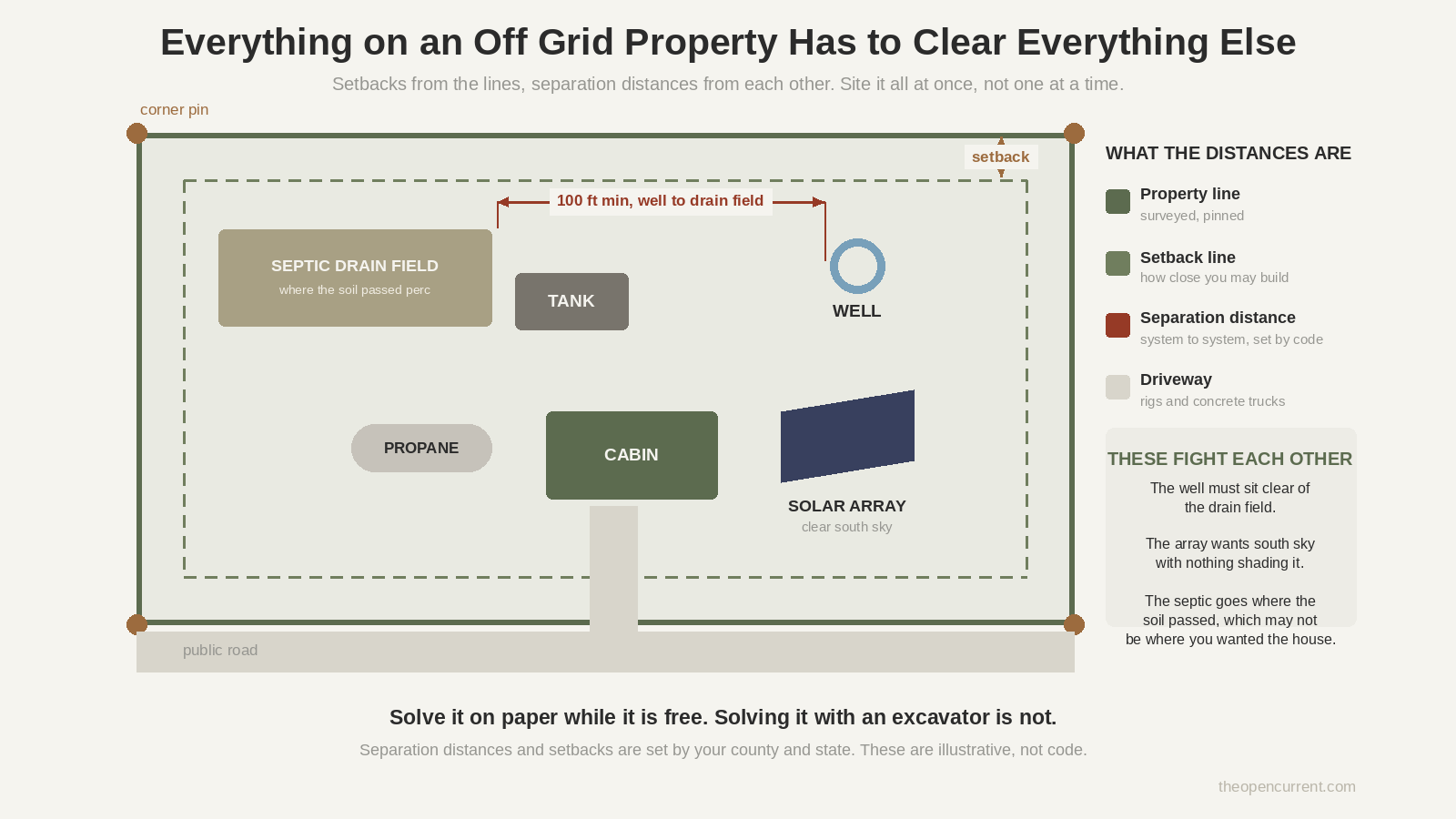
Original diagram. Reuse it with a link to theopencurrent.com.
Mistakes that keep showing up
The 14 day camping trap. You buy land, plan to live in an RV or a trailer while you build. Makes total sense. Except most jurisdictions cap how long you can camp on your own property, often around 14 days, after which you need a permitted dwelling. Some counties do temporary occupancy permits while you’re actively building, but they can be tough to get. So you can own the land and be legally unable to stay on it while you build the thing that would let you stay on it. Catch 22 with a property tax bill.
Assuming your cabin is big enough to be legal. Loads of counties set a minimum square footage for a primary residence, often somewhere between 500 and 1,000 square feet. Your lovely efficient 400 square foot cabin may simply not be permittable as a dwelling. There’s usually an exemption around 120 to 200 square feet for sheds and storage buildings, and this is where half the internet stops reading. The second half of that rule is that you still can’t legally live in the shed.
Believing the listing. “Buildable.” “Great for a cabin.” “Recreational land.” None of those phrases mean you can legally live there year round. Recreational or agricultural zoning might let you put up a structure and still prohibit it being your primary residence. Realtors are not lying to you exactly, they’re just using words that mean less than you assume.
Forgetting the electrical permit. People expect building and septic permits. What surprises them is that a fully off grid solar and battery system usually still needs an electrical permit and an inspection to NEC standards. You’re not connected to anything, and it’s still inspected.
Going unpermitted and shrugging. Enforcement genuinely varies, and plenty of rural counties with tiny code budgets will never darken your door. But the tail is long: insurance may not pay out on an unpermitted structure, banks generally won’t mortgage it for a buyer, and selling gets hard. You’re not just betting on today, you’re betting on your exit.
Building one of everything. A thing I keep seeing from people who’ve lived this a while: off grid usually means two sources for most things, heat especially. One heat source is a single point of failure in January, and January is when you find out. Redundancy isn’t paranoia out here, it’s the design.
Questions to ask before you buy anything
Call three places: county planning, the building department, and the health department. This is a free phone call that can save you a five figure mistake, and it staggers me how many people skip it.
- What’s the minimum square footage for a primary residence in this zoning district?
- Does this parcel allow full time residential occupancy, or only seasonal and recreational use?
- What exactly is required to get a certificate of occupancy?
- Are composting toilets accepted as a primary waste method, or is a permitted septic system mandatory?
- Is rainwater catchment legal here, and can it be a primary household water source?
- What’s the largest structure I can build with no permit, and can I legally sleep in it?
- How long can I camp or park an RV on my own land while I’m building?
- Does my off grid electrical system need a permit and an NEC inspection?
- Is there any requirement to connect to municipal utilities on this parcel?
- Has a perc test ever been done here, and would you accept an old one?
And two more for people who aren’t the county:
- Insurance agent: what’s this address’s Protection Class, and will you write a policy on it?
- Local credit union: do you lend on off grid property, and what’s your down payment requirement?
Ask 11 and 12 before you make an offer. Not after.
FAQ
Is it legal to live in an off grid cabin? Yes, everywhere in the US in the broad sense. Off grid living itself isn’t illegal anywhere. What trips people up is local compliance: zoning, minimum dwelling size, an approved waste system, and a certificate of occupancy. You don’t get cited for living off grid, you get cited for occupying a dwelling without a permit.
How much does it cost to build an off grid cabin? Shell figures range from about $15,000 for a small DIY build up past $80,000, but the shell is usually the smallest piece. Road access, well, septic, survey and power system routinely add up to more than the building. Budget the infrastructure first and add 50% to your best case.
Do I need a permit for an off grid cabin? Almost certainly, and probably several. Building, septic, plumbing, and electrical, even though you’re not connected to a grid. Some counties exempt structures under roughly 120 to 200 square feet, but those exemptions cover sheds you can’t legally live in.
Can I get a mortgage on an off grid cabin? Sometimes, but not from the big banks. Expect 30 to 35% down and about a point of extra interest, and try local credit unions and community banks. A conventional mortgage usually requires utilities to be available at the property, so buying a grid connected house and going off grid later is a much easier financing path than buying something already off grid.
Can I insure an off grid cabin? Depends almost entirely on your Protection Class, which comes from your distance and response time from a fire department and whether there’s a water source. Most off grid homes are Class 9 or 10, and Class 10 is where a lot of insurers stop writing. Ask an agent about the specific address before you buy.
Can I use a composting toilet instead of a septic system? Legally, only if your health department accepts it as a primary waste method, and plenty don’t. Check before you plan around it, because your occupancy permit may depend on it.
Can I live in an RV on my land while I build? Often only for about two weeks. Most jurisdictions cap camping on your own property, and some offer temporary occupancy permits during construction. Ask the county, because this one quietly wrecks build timelines.
Where to go next
- Off-grid water systems. Wells, catchment, hauling, and what each one actually costs to run.
- How to go off grid with solar. The full power picture, including why you size for December and not for July.
- Septic system cost. What each system type runs, and what happens when your perc test comes back bad.