Are Solar Gate Openers Any Good? Battery Life, Winter and What Actually Fails

TL;DR: yes, solar gate openers are legit, and a decent solar gate opener battery setup can run a remote gate for years. The catch is that you have to size it for December, not June, and sort out a handful of gate problems before the opener ever goes on. Get those right and the thing just works. Get them wrong and you’re out there in sleet, shoving a 16 foot pipe gate open by hand and questioning your life choices.
I went deep on this one. I read the manufacturer manuals, a pile of forum threads, the safety standards and even a couple of county road codes. Some of what turned up was stuff I never would’ve thought to check. The biggest surprise? On a lot of these setups, the thing draining your battery isn’t the motor. It’s the electronics sitting there all day waiting for you to press the remote.
Quick PSA before I get into it: I’m not ranking models here. I haven’t tested any of them, and I’m not gonna pretend I have. What I can give you is the stuff that decides whether any opener works at your gate, which honestly matters more than the brand anyway.
Every gate opener is really a battery opener
This clicked for me reading the Ghost Controls docs. On their systems the 12V battery is the main power source, and the control board has its own charging circuit built in. The AC transformer, if you use one, doesn’t run the motor at all. It just recharges the battery. Mighty Mule works the same way. The stock battery is a 12V, 7 amp-hour sealed lead-acid unit, and the solar panel’s whole job is keeping it topped up.
So “solar vs hardwired” isn’t really a choice between two kinds of opener. It’s a choice about what charges the battery. That flips the whole question around. A solar gate opener is only as good as the charging it gets on the worst day of the year.
What drains a solar gate opener battery
There are two kinds of drain, and most people only ever think about one.
The motor
The arm pulls a few amps while it moves. One owner on the DIY Solar Power Forum, planning out a Ghost Controls install, figured 3 to 5 amps per movement, plus about 4 amps for five seconds if you add an electric lock. A typical swing takes somewhere around 15 to 30 seconds. So it’s heavy amps, but only for seconds at a time.
Standby (the sneaky one)
The control board, the receiver listening for your remote, a keypad, photo eyes, a WiFi or cellular module. Every single one of these sips power 24/7. That same forum owner listed a continuous draw of about 25 milliamps for the board alone.
Twenty-five milliamps sounds like nothing, right? Multiply it out: 25 mA × 24 hours = 0.6 amp-hours a day, every day, whether the gate moves or not.
Now the motor. Say 4 amps for 15 seconds open and 15 seconds closed. That’s 30 seconds, about 0.0083 hours, times 4 amps, so roughly 0.033 amp-hours per full cycle. Ten cycles a day works out to about 0.33 amp-hours.
So on a gate that cycles ten times a day, standby uses nearly double what the motor does. No joke. In a sizing thread on the Northern Arizona Wind & Sun solar forum, the moderator’s worked example came out even more lopsided: the receiver used about four times as much power per day as the gate actuator.
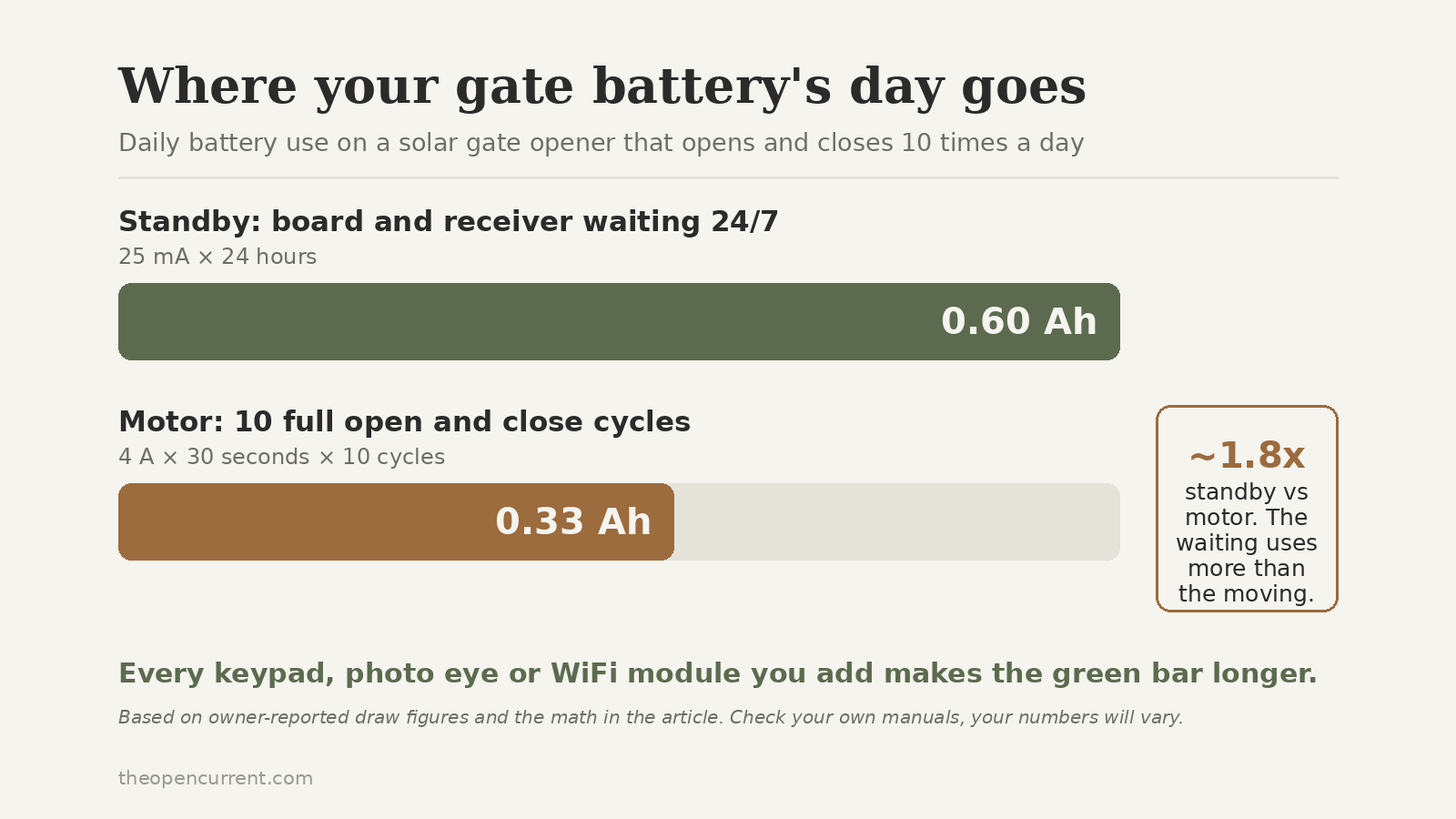
Original diagram. Reuse it with a link to theopencurrent.com.
That’s why adding “just one more accessory” can tip a setup that was fine into one that goes flat every winter. Every accessory is another tiny load that never, ever switches off.
How long does a solar gate opener battery last?
The number you’ll see everywhere is three to five years for a standard sealed lead-acid battery. Fair enough as an average. The more useful question is what pushes yours toward the short end, because most of those things are in your hands.
Heat
This is the big one, and it’s the one nobody expects from a gate. Battery University’s rule of thumb for sealed lead-acid is that every 8°C (15°F) rise above 25°C (77°F) cuts battery life in half. Their example: a battery rated for 10 years at 77°F lasts about 5 at a steady 92°F, and roughly two and a half years at a constant 106°F.
Now picture where a gate battery lives. In a plastic box, bolted to a post, usually in full sun. On a July afternoon in Texas or Arizona that box runs way hotter than the air around it. Your battery is basically slow-cooking itself.
And heat damage doesn’t come back. Once that capacity’s gone, it’s gone for good. If you can put the box on the shady side of the post, or rig a little cover over it, do it. Cheapest battery upgrade you’ll ever make, IMO.
Winter undercharging
This is the cold weather killer. A lead-acid battery that spends weeks sitting part charged builds up sulfation on its plates. Battery University notes sulfation can be reversed if you catch it in time, but the other aging process, grid corrosion, is permanent.
An undersized panel in winter means the battery never gets back to full. It limps along at 60 or 70 percent, quietly sulfating, and by spring it’s lost real capacity. That’s the story behind a ton of “my gate battery died after two years” posts.
Deep discharges
Lead-acid hates being run flat. Battery University puts deep cycle lead-acid at roughly 200 to 300 full discharge and charge cycles. So decent sizing keeps a lead-acid battery above about half charge. A battery that gets drained to empty a few times over one gloomy week just burned a big chunk of its life.
The quick version
| What kills it | What happens | What fixes it |
|---|---|---|
| Heat in the battery box | Life halves for every 15°F above 77°F | Shade the box, mount it on the shady side |
| Winter undercharging | Battery sits part charged and sulfates | Size the panel for December, not June |
| Standby draw from accessories | A constant load that never stops | Do the math before adding accessories |
| Deep discharges on cloudy runs | Each one costs real cycle life | Bigger battery, so you only use the top half |
| Charging lithium below freezing | Permanent internal damage | A battery with a low temp charge cutoff or heater |
Why the cycle ratings don’t match your winter
OK, this is the part I’d want every buyer to see before ordering. The big DIY brands base their solar cycle numbers on 8 hours of sunlight a day.
Mighty Mule’s 10W panel is rated for 8 to 26 cycles a day depending on your zone, and the chart says right on it that it assumes 8 hours of sun and a fully charged battery. The Ghost Controls manual tells you to read its chart assuming 8 hours of direct sunlight too.
Now compare that with winter. Solar gets designed around December, and on NREL’s December solar maps much of the country averages 4 peak sun hours a day or less. The Pacific Northwest and the Great Lakes sit lower still. A peak sun hour is one hour of full strength sun, so 8 hours of winter daylight might only give you 2 or 3 hours’ worth of charging. YMMV depending on where you live, but that’s the ballpark.
That’s the gap right there. A rating built on 8 good hours doesn’t tell you much about a 2 hour December. Nobody’s hiding it, it’s printed on the chart. It’s just super easy to read “26 cycles” and stop reading.
Ghost Controls gives a really handy rule of thumb on their battery selection page. If your panel gets more than 4 hours of direct sun, their standard 7Ah batteries are fine. If it gets less than 4, they strongly recommend a deep cycle battery. That’s the whole winter question in one line, and I’d take it seriously.
How to size a solar gate opener battery and panel
Nobody puts this on the product page, so here’s the math I’d run. Five minutes and your phone calculator, that’s it.
Step 1: Work out your daily amp-hours
Standby: take the standby draw in milliamps for the board plus every accessory (it’s in the manuals), multiply by 24, divide by 1,000.
Cycles: amps while moving × seconds per full open and close × cycles per day, divided by 3,600.
Add them up. That’s your daily use.
Step 2: Size the battery
Decide how many sunless days you want to ride out. Three is a sensible floor IMO. The Northern Arizona Wind & Sun moderator suggests lead-acid should generally get a full charge every 2 to 3 days, 5 at the very outside, if you want decent life out of it.
Battery Ah = daily Ah × days of backup ÷ 0.5
The ÷ 0.5 is because you only want to use the top half of a lead-acid battery.
Step 3: Size the panel for December
Panel watts = daily Ah × 12 ÷ (your December peak sun hours × 0.65)
The 0.65 covers charging losses, dirt, a so-so angle, and the fact that small gate chargers aren’t super efficient. I’d rather be pleasantly surprised than stranded at the gate at 7am.
A worked example
Say you’ve got a single swing gate with a board and receiver pulling 25 mA, plus a keypad adding another 15 mA (that keypad number is just for the example, so check your own manual). You open and close it 8 times a day at 4 amps for 30 seconds per cycle.
- Standby: 40 mA × 24 ÷ 1,000 = 0.96 Ah
- Cycles: 4 × 30 × 8 ÷ 3,600 = 0.27 Ah
- Daily total: about 1.2 Ah
Battery for 3 days: 1.2 × 3 ÷ 0.5 = 7.2 Ah. The stock 7Ah battery is sitting right on the line with zero margin.
Panel for a December with 2.5 peak sun hours: 1.2 × 12 ÷ (2.5 × 0.65) = about 9 watts. The stock 10W panel squeaks by on paper, and one shady morning or a snowy panel wipes that out.
Throw on a cellular module, or live somewhere with 1.5 peak sun hours in December, and that exact kit falls over. That’s pretty much the story of every dead gate battery, in one example.
If you’d rather not do the battery side by hand, my free solar battery calculator runs the same capacity math for any 12V load.
Don’t just bolt on more panels
Heads up, there’s a catch. Ghost Controls says their board limits the current it sends to the battery once you connect more than 30 watts of panel, to protect the battery. So past a certain point, more panel on the stock board does literally nothing.
If your math says you need more than the board will take, the fix people on the solar forums usually land on is a separate small charge controller feeding a bigger battery. Check your manual before you try it though, because boards have their own rules. Mighty Mule, for example, warns never to run the transformer and solar at the same time or it’ll damage the control board. And never, ever wire a panel straight to a battery with nothing in between. Ghost Controls puts that one in all caps, and fair enough.
Panel placement beats panel size
Before you buy a bigger panel, sort these out:
- Face it south (in the US) and tilt it steep, since the winter sun sits low.
- Check for winter shade. A tree that’s totally fine in June can shade the panel all morning in December.
- Keep it clear of snow and dust. A snow-covered panel makes basically zilch.
- Split it up. Ghost Controls makes a smart point: a few small panels can be angled a bit differently, one grabbing morning sun and one grabbing afternoon, which often beats one big panel.
Lithium vs sealed lead-acid for a gate opener
Lithium iron phosphate (LiFePO4) batteries get sold as drop-in gate opener replacements now, and on paper they look amazing. Way lighter, and rated for thousands of cycles instead of hundreds. Two catches before you swap, though.
The charger on your board was built for lead-acid
A typical gate opener board charges on a sealed lead-acid profile. Gate Openers Unlimited’s compatibility guidance says not to change battery chemistry unless your opener’s documentation allows it, because lithium needs its own charge profile and low temperature protection. Even the lithium replacement sellers tell you to use a compatible lithium charger. Check with your opener’s maker first, or you could void your warranty on a battery that never charges right.
Lithium can’t take a charge below freezing
This is the big one for cold places. Battery makers are clear that the operating range printed on a LiFePO4 battery covers discharging only. Charging one below 32°F (0°C) causes lithium plating, which damages it permanently. A gate battery lives outside, so on a sunny 20°F morning your panel is trying to charge a frozen battery. Big yikes.
Good lithium batteries have a battery management system that blocks charging below freezing, and some have built-in heaters that warm the cells first. Without one of those, lithium’s a bad bet at a northern gate. Even with one, a battery that refuses to charge on cold sunny mornings is losing you winter charge time, which is exactly what you’re short on.
Lead-acid in the cold
Sealed lead-acid will take a charge in freezing weather, which is a big reason it’s still the default. It does lose usable capacity in the cold, and a flat lead-acid battery can freeze at temps a fully charged one shrugs off. One more reason to keep it topped up all winter.
My take: in a hot climate, lithium’s cycle life makes it worth a hard look, if your opener officially supports it. In a cold one, a good deep cycle AGM battery with a properly sized panel is the simpler, safer bet. For the bigger picture on how both chemistries age, I broke that down in how long solar batteries actually last.
Solar vs hardwired
If you’ve got power within reach, “hardwired” usually means running low-voltage wire from a transformer near the house out to the gate. Ghost Controls allows up to 1,000 feet of 16 gauge stranded wire for that run. The battery still does the work, and the transformer just keeps it full.
That setup wins on reliability, straight up. A small daily trickle charge is exactly what little lead-acid batteries like, and Ghost Controls says their 7Ah batteries do best with a constant trickle keeping the voltage up.
Solar wins when the gate is a long way from anything, when trenching means crossing a field or a driveway, or when you’re off grid anyway. At a remote property it’s often the only sensible option.
And if you’re already running a house battery bank, there’s a third route. Treat the gate as one more small load in your main system and feed it from there. If you’re still planning that main system, my guide to going off grid with solar covers the whole setup.
What fails besides the battery
OK so here’s where the forum deep dive paid off. Batteries get all the attention, but owners describe a whole second set of problems that have nothing to do with sizing.
Wind
This came up more than anything except batteries. A gust shoves the gate, the opener reads it as an obstruction or trips a limit, and now your gate’s stuck halfway. An experienced installer on TractorByNet said the usual trouble isn’t the accessories at all, it’s tripping a limit switch, and he recommends an electric latch because it takes the wind load off the operator. Another owner said the automatic lock is a big help anywhere windy.
Solid panel gates are the worst for this, since they act like a sail. Ghost Controls straight up doesn’t recommend its openers on full panel gates, because a gust can wreck both the gate and the opener, and they won’t cover the arm under warranty on those.
Lightning
Gate electronics sit out in the open at the end of long wire runs, and lightning is a known board killer. An installer who’s put in several openers said the solar side worked great, and the one problem he kept hitting was lightning frying a control board. If you’re in storm country, surge protection and decent grounding are worth thinking about. I covered that side of things in grounding solar panels.
Ants, wasps, spiders and slugs
This one surprised me ngl. Gate control boxes are warm, dry and sheltered, so bugs love them. One owner on TractorByNet described ants ruining a neighbor’s gate controller, and the tech’s explanation was formic acid from the ant trails etching and shorting the board. Gate repair companies also report spiders spinning webs across photo eyes so the gate won’t close, wasps nesting in the housing, and slug trails bridging contacts on the board.
The fix is boring but it works. Seal every gap and conduit entry, drop ant bait in the box when you service it, and open the box up once or twice a year to take a look.
Random opening and false triggers
A Rokslide owner’s biggest complaints were a flaky remote and the gate opening at random, which is a real problem when it means chasing cows back into the yard. Gate Openers Unlimited lists the usual suspects: humidity, ants and wet conduit can create stray current paths across terminals, and a surge-damaged board can still power up while one input goes haywire.
Exit sensors cause their own drama. One owner with a driveway on a highway had passing trucks setting off his exit wands, over and over. If your gate is close to a busy road, think hard about where any exit sensor goes.
Snow
A long-time owner of a heavy 16 foot gate said the only trouble he’d had in 12 years was blowing a couple of fuses when he tried to open it against heavy snow. If your gate swings into a spot where snow drifts or the plow piles it up, that’s a real winter headache.
An opener that’s too small
Some of the worst stories I read came down to a light-duty opener on a heavy steel gate. One horse owner’s double gate opener was slow, balky and needed repair after repair before the board finally died. Check the weight and length ratings and leave yourself real margin. Don’t buy the one that’s rated right at your gate’s limit.
FWIW, not everyone has a bad time. Plenty of owners report years of zero drama, and one mentions a neighbor’s 12 foot cattle gate running on solar for around 20 years. The difference usually comes down to the stuff in this article.
The gate has to work by hand first
This sounds obvious, but it’s the step people skip. An opener moves a gate, it doesn’t fix one. If the gate binds, drags or sags, the opener works harder, trips its obstruction sensing, and wears out early.
Ghost Controls says the gate has to swing level, plumb and freely through its full range before you install. A gate that isn’t plumb can surge or hesitate, and one that isn’t level can drag or bind. They also set minimum post sizes: 6×6 for wood, 3 inch diameter for round metal, 4×4 for square metal, all set in concrete. If the gate weighs over 200 lbs, you need bearing hinges.
Two more things. Put physical gate stops in for both the open and closed positions, or the motor can crash into the post or over-extend the arm. And in cold climates, frost heave can shift a post over one winter, so set footings below the frost line.
The safety stuff you can’t skip
Real talk for a sec, because this part isn’t optional.
Entrapment
According to Consumer Product Safety Commission figures, 32 deaths were linked to automated gates between 1985 and 2000, and 20 of them were children. The CPSC also estimates around 25,000 people were injured in automated gate incidents between 1990 and 2000. That’s why the UL 325 safety standard exists. For swing gates, it calls for two external entrapment protection devices, such as photo eyes or safety edges, unless there’s no entrapment risk in one direction.
If kids, pedestrians or animals are ever near your gate, budget for photo eyes. And only run the gate when you can actually see it. Ghost Controls says the same thing, because a moving gate can hit people, livestock or vehicles in its path.
Livestock
If animals graze near the gate, your accessory choices change. Ghost Controls says its vehicle sensors aren’t recommended on properties with livestock, and suggests a keypad instead.
Fire department access
Most people never think about this one. If there’s an emergency and your gate’s closed, how does a fire engine get in? Some areas require a specific device. Sonoma Valley Fire, for example, requires new or modified gates to have a Knox key switch or Knox padlock, partly so fire engines don’t get trapped inside a property once they start fighting a fire. In other rural areas it’s as simple as giving the fire department your keypad code. Rules vary a lot, so call your local fire department before you buy anything.
Setback from the road
If the gate sits right on the road, you’re stuck waiting on the road every time it opens. Some counties set a minimum. Baker County, Oregon, for example, requires gates on private driveways over 150 feet long to sit at least 30 feet back from the road, with at least 14 feet between the posts. If you tow a trailer, go further. One gate builder recommends up to 75 feet so a truck and trailer can drive straight through without hanging off the road.
Remote control, WiFi and security
WiFi probably doesn’t reach your gate
Ghost Controls points out that most gate openers sit beyond the range of home WiFi, so any smart setup has to solve the signal problem first. There are options: Mighty Mule sells a wireless bridge rated up to half a mile, and there are cellular controllers that skip WiFi entirely but need a monthly subscription. Just remember every one of these modules is more standby draw. Put it in your math.
Security is limited
One owner on a cattle forum put it perfectly: an opener keeps honest people out. A determined thief can pull a couple of cotter pins or the post bolts and walk the gate off. If security’s the main reason you want a gate, look at anti-lift hinges and tamper-resistant hardware too.
When the battery dies anyway
Every opener has a manual release, usually a keyed lever, pull pin or release bolt that disconnects the motor so you can swing the gate by hand. Find yours now, not in the middle of an ice storm. And keep the release key somewhere that isn’t behind the gate, because locking the key on the wrong side of your own gate is a lowkey classic.
Signs your gate battery is on its way out
- The gate moves slower than it used to, especially first thing in the morning.
- It’s fine in the afternoon but struggles or stops halfway in the morning.
- It quits in the first cold snap of the year.
- The board beeps or flags a low battery (lots of them do, so check your manual).
- A cheap multimeter reads well under 12.6 volts after a full sunny afternoon.
A healthy, fully charged 12V sealed lead-acid battery rests at roughly 12.6 to 12.8 volts. If yours sits noticeably lower after a sunny day, either the battery’s worn out or it isn’t getting enough charge. Ghost Controls says low batteries are their most common support call, and names not enough charging time and not enough panel as the usual causes. So before you buy a new battery, make sure the panel is clean, unshaded and actually charging.
Oh, and if your kit uses two batteries, replace them as a matched pair.
Questions to answer before you buy
Here’s the checklist I’d run before spending a cent:
- Does the gate swing freely by hand, level and plumb, on posts big enough and set in concrete?
- What does it weigh and how long is it? Is the opener rated comfortably above both, not right at the limit?
- Is it a solid panel gate somewhere windy? Plan for an electric lock, or rethink it.
- Will livestock, kids or pedestrians ever be near it? That decides your sensors and safety devices.
- How many times a day will it cycle IRL, counting deliveries and visitors?
- How much December sun reaches the exact spot where the panel goes?
- How far is it from the house? That decides power, WiFi and remote range.
- What’s the standby draw of the board plus every accessory you want?
- Can a truck and trailer pull fully off the road while the gate opens?
- What does your fire department require?
- Which way should it swing, given the slope, snow drifts and traffic?
- Where will the battery box sit, and can you shade it?
- When it fails, what’s the plan? Know the manual release, keep a spare battery, and check whether replacement parts are sold locally.
So, are solar gate openers any good?
Yep. It’s solid, proven tech, and at a remote gate it’s often the best option going. When they fail, they fail for predictable reasons: panels sized for summer, batteries cooked in hot boxes, accessories stacked on until standby eats the budget, lithium charged in the cold, wind on solid gates, and gates that never swung right to begin with.
Every one of those is fixable before you buy. Do the December math, shade the battery, treat every accessory as a permanent load, and get the gate swinging sweet by hand first. Do that and your gate will just work, which is all you ever wanted from it tbh.
FAQ
How long does a solar gate opener battery last?
Usually three to five years for a standard sealed lead-acid battery. Heat, winter undercharging and deep discharges all shorten that. A shaded battery that stays well charged lasts longest.
Do solar gate openers work in winter?
Yes, as long as the panel is sized for December sun rather than the 8 hours most cycle charts assume, and it’s kept clear of snow and shade.
How many watts of solar does a gate opener need?
Lots of kits ship with 10 watts, which covers light use in sunny spots. To size your own, take daily amp-hours × 12 and divide by (December peak sun hours × 0.65). Then check the max your board accepts.
Can I put a lithium battery in my gate opener?
Only if your opener’s maker supports it, since most boards charge for lead-acid. In cold climates, pick one with a low temperature charge cutoff or a heater, because charging below 32°F damages it.
Why does my solar gate opener battery keep dying?
Most often the panel isn’t putting back what the system uses, especially in winter, or accessories are drawing more standby power than the panel can replace. Heat damage is the other usual suspect.
Why does my gate stop halfway?
Common causes are a weak battery, wind pushing on the gate, a gate that binds or drags, or snow in the swing path. Check that the gate moves freely by hand before blaming the opener.
Do I need photo eyes on my gate opener?
If there’s any chance of people, kids or animals in the gate’s path, yes. The UL 325 standard calls for two external entrapment protection devices on swing gates unless there’s no entrapment risk in one direction.
What battery does a solar gate opener use?
Most DIY residential openers use a 12V, 7 amp-hour sealed lead-acid battery. For solar with limited sun, Ghost Controls recommends a 12V deep cycle battery instead.