How Long Do Solar Batteries Last? What Actually Decides It

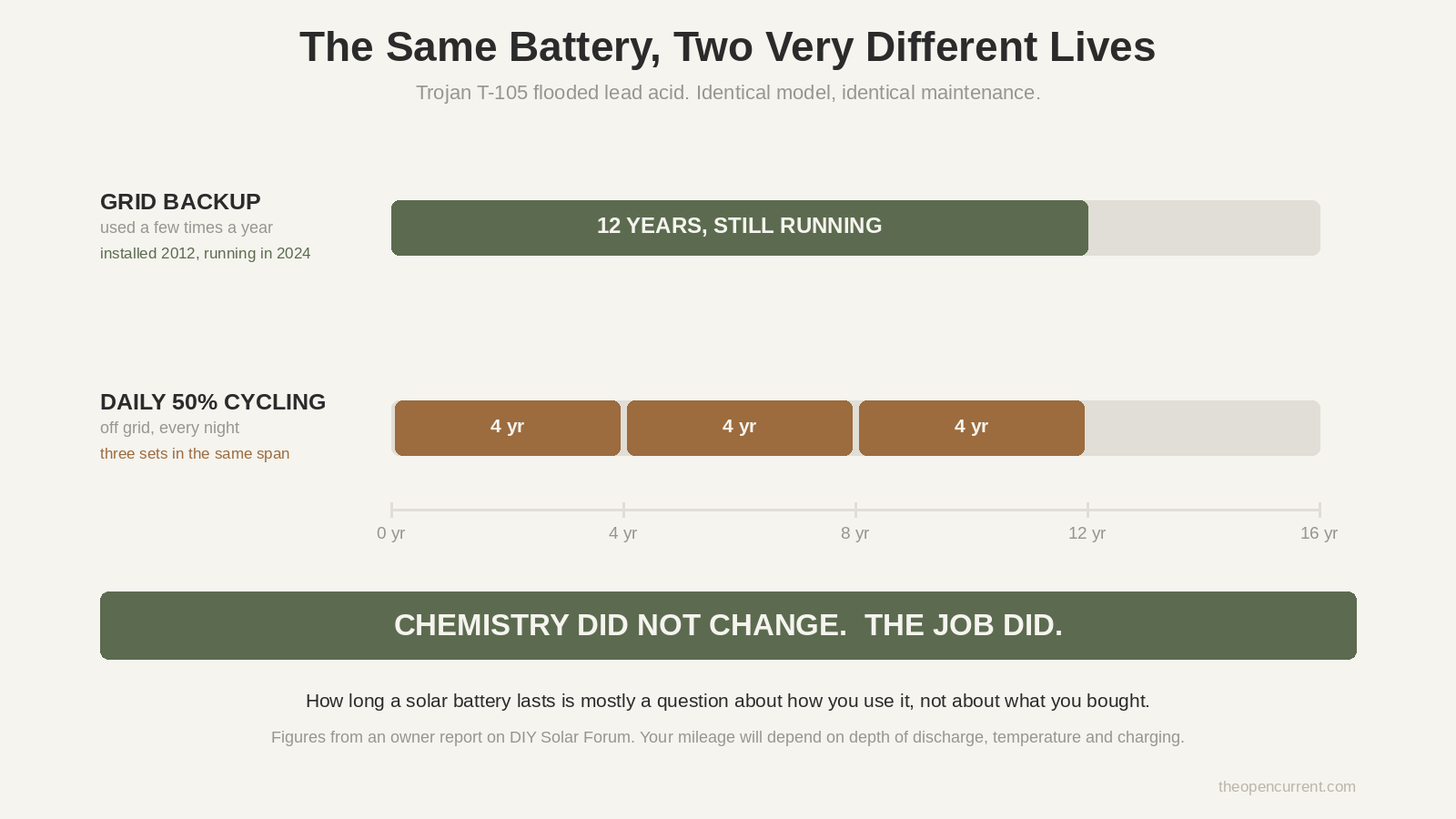
A set of Trojan T-105s went into a house in western Maine back in 2012. They’re still running.
Twelve years out of lead acid is excellent. But that system is grid backup, fired up a handful of times a year when the power drops. Somebody on the forum ran the numbers for him: cycle those exact same batteries to 50% every day and he’d be on his third set by now.
Twelve years or four. Same model, same maintenance, completely different answer.
So how long do solar batteries last? Lead acid will give you anywhere from two to fifteen years, and LiFePO4 eight to fifteen. Those ranges are wide because the chemistry you buy matters a lot less than what you do with it afterwards.
Heat is brutal on small batteries that live outdoors in a sealed box. A gate opener battery bolted to a post in full sun is the classic example, and it’s a big reason those batteries so often die years early. I dug into that in what actually kills a solar gate opener battery.
Which is good news, because nearly all of that is in your hands. This is what the people at the long end are doing.
Original diagram. Reuse it with a link to theopencurrent.com.
The thing that surprised me: you can’t cheat it by cycling shallow
I went in assuming shallow cycling was free money. It’s not, and the numbers are pretty clear about it.
The claim I kept seeing on forums is that anywhere from 10% to 80% depth of discharge gives you roughly the same total amp hours over the battery’s whole life. So I checked it against spec sheet figures published for a Renogy deep cycle battery: 500 cycles at 50% DoD, 230 cycles at 100%.
Multiply it out. 500 × 0.5 = 250. 230 × 1.0 = 230. Near enough identical.
So the battery has a total amount of energy in it, and how you slice that up is mostly your choice. Cycle it hard and you get the energy out fast and replace it sooner. Cycle it gently and you spread the same energy over more years.
The catch is calendar life. Cycle too gently and the battery simply dies of old age before you’ve used the cycles you paid for. A forum veteran makes exactly this argument against big banks: size for three days of autonomy and the thing will age out before you get your money’s worth. His preference is to oversize the array instead, which he puts at around 2.5 cents per kWh over twenty years.
I’ll be honest, that’s slightly awkward for me, because my own cost calculator sizes storage at roughly two days. I still think two days is right for a place you actually live in, where a four day gray stretch in January isn’t hypothetical. But it’s a real trade rather than a free win, and it’s worth knowing you’re making it.
Either way, the argument for oversizing the array over oversizing the bank lines up with everything I’ve written about winter sun hours being the number that matters.
What the fifteen year people actually do
Right, the useful part.
1. They cycle shallow. Genuinely shallow.
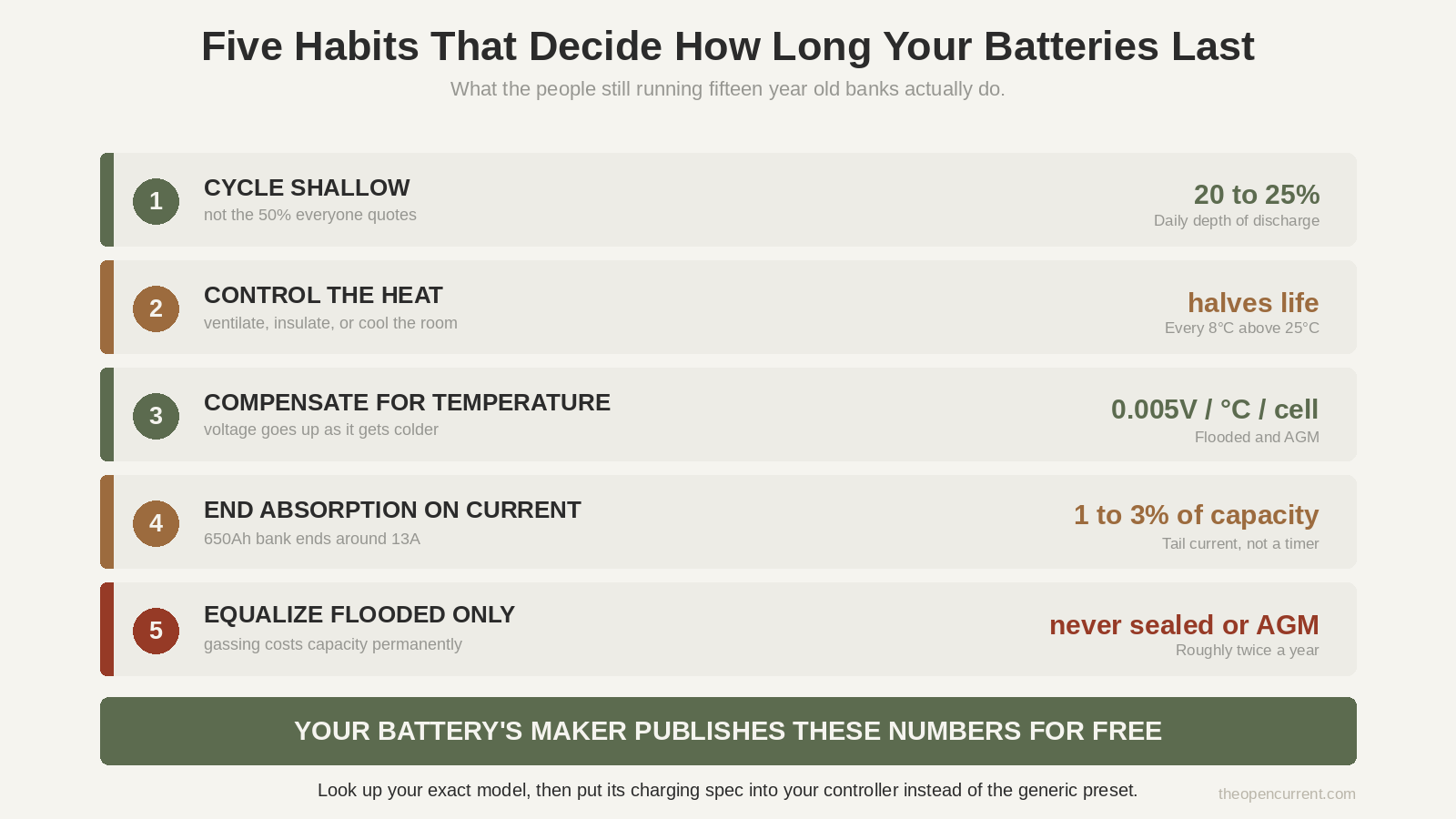
Our Surrette guy discharges to 75 to 80% state of charge daily. That’s 20 to 25% depth of discharge.
Not 50%. Twenty five.
Another person in that thread, who’s set up a lot of these for clients, puts it as: always recharge at 50%, hardly ever go below 30%, keep a charge source running 360 days a year, and be able to shed loads during a bad stretch.
That last clause is doing a lot of work, by the way. Being able to reduce loads is a design decision you make years earlier.
2. They control the temperature, properly
Not “keep it somewhere cool.” Actively managed, like a thing that matters.
Our guy runs air conditioning in both power rooms through spring, summer and fall. Others use insulated plywood boxes with the lid cracked for airflow, or fan ventilated enclosures.
For scale on why: one person’s bank sits at 87°F on a summer morning and hits 106°F by the end of absorption, and that’s in a ventilated box. Another has his in a storage container with 30°F daily swings that regularly tops 100°F. And there’s a guy who stuck a marine battery in a cabin loft that hits 115°F, purely to keep the wire run to the panel short. Dead in two years.
Renogy’s figure is that every 8°C above 25°C can halve battery life. Take that seriously before you tuck your bank into the warmest corner of the building.
3. They charge with temperature compensation
This is the most concrete fixable thing in this whole article, and a lot of systems simply don’t have it set up.
Charging voltage needs to go UP as the battery gets colder, and down as it gets warmer. The standard figure for flooded and AGM is 0.005 volts per degree C per cell, which on a six cell 12V battery works out at 0.03V for every degree. In practice: a 12V AGM that wants 14.8V at 25°C needs about 15.25V at 10°C to actually reach a full charge.
As one forum post puts it, if you’re not charging at exactly 25°C and you haven’t got compensation running, you’re either undercharging or overcharging. Every single day.
It needs a battery temperature probe wired back to the charge controller or inverter charger. Cheap part. One afternoon. Genuinely might be worth years.
4. They know when absorption is actually done
Most systems run absorption on a timer. That’s a guess wearing a lab coat.
The real measure is tail current, sometimes called absorption termination current. Trojan’s guidance allows terminating when charge current drops to 1 to 3% of capacity. On a 650Ah bank that’s about 13 amps.
Cut absorption short and you’re chronically undercharging, which is the leading way lead acid batteries die. Run it too long and you’re cooking off water and heating the battery. Tail current is how you stop guessing.
5. They equalize, but only the right batteries
Flooded lead acid wants an equalization charge roughly twice a year, and the seasonal changeovers are a decent trigger to remember it by.
Sealed and AGM batteries should not be equalized. Manufacturers say so explicitly. Sealed doesn’t mean they won’t gas, and if they gas, that electrolyte is gone for good and so is the capacity. If you take one thing from this section, take that one, because plenty of people apply flooded advice to AGM and quietly wreck them.
Original diagram. Reuse it with a link to theopencurrent.com.
Your battery has its own spec sheet, and it’s free
Here’s the line from a permies thread that reframed this for me more than anything else.
You can go to Trojan’s site, find your exact battery model, and get the precise charging specification for every stage. Bulk, absorption, float, equalization, per cell. Program those numbers into your charge controller and you’re basically done. The batteries will last a long time.
The poster’s own follow up is that about 80% of people have no idea that’s possible.
And that’s not a dig at anybody. Nothing in the buying process tells you this exists. You get a battery, you get a charge controller with a “lead acid” preset, and the preset is a generic compromise for every lead acid battery ever made. Your specific battery has actual numbers, published free, by the people who built it.
Twenty minutes in the settings menu. It’s the highest return thing on this entire page and it costs nothing.
Working out where you currently stand
If your bank is already in service, you probably want to know how it’s doing. There’s one thing to get straight first.
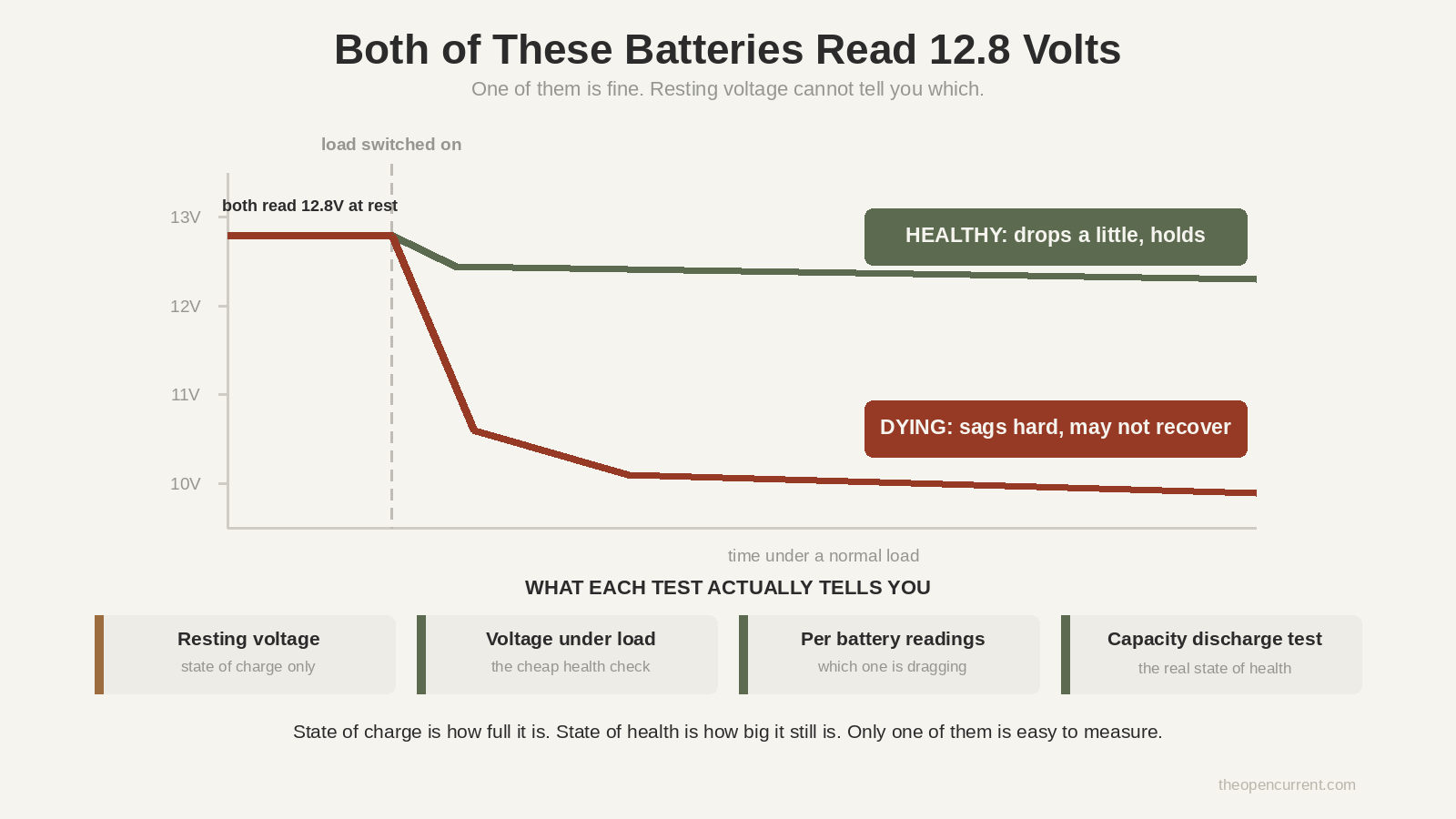
Voltage tells you state of charge. It tells you almost nothing about health.
My favorite quote from the whole research pile, from a solar forum veteran: he can hand you a battery whose specific gravity and voltage read perfectly balanced at 100%, and it’ll die within minutes under load.
So here’s the ladder, cheapest first.
Voltage sag under load. Put a normal load on and watch the terminal voltage. A healthy battery drops a bit and holds steady. A dying one sags hard, something like 12.8V down to 10V on a modest load, and may not bounce back when you remove it.
Measure each battery individually. In a bank, averages hide the problem. One user found a pair reading 14.06V and 9.45V, against 13.39 and 13.20 on another pair. The good batteries were overcharging the bad one and it was getting hot. That’s how you find the specific unit that’s dragging everything down.
For lithium, check cell voltages. One cell at 2.5V while the rest are at 3.2V means the BMS will lock out charging and the pack looks dead. Sometimes a manual balance on the low group recovers a surprising chunk of capacity, so don’t write it off before you’ve looked.
A capacity discharge test is the only real answer, and it takes anywhere from 2 to 20 hours. Fully charge, apply a known load, measure what actually comes out.
For ongoing monitoring, get a shunt based battery monitor. Voltage based state of charge readings are described on the forums as useless in an operating system, and having read enough threads where people chased a phantom problem for months, I believe it. A shunt counts amp hours in and out. That’s the real number.
End of life is conventionally 80% of original capacity. In practice most people pull the trigger when runtime drops below 70 to 80% of what it used to be.
One more thing worth saying. There’s a thread where a guy had eight Trojan 415Ah batteries for seven years that never performed properly, even brand new. By his own math the bank should have run a 700W AC unit for about fourteen hours. It never managed more than a few. That’s not a dying battery, that’s a system problem wearing a battery costume. Before you spend five figures on replacements, make sure the batteries are actually the thing that’s broken.
Original diagram. Reuse it with a link to theopencurrent.com.
Lithium plays by slightly different rules
Most people reading this are probably buying LiFePO4 rather than nursing flooded cells, so a few notes.
It’s more forgiving, which is arguably the bigger deal than the longer life. No watering, no equalization, no specific gravity readings, far less punishment for sitting partially charged. For a place you visit rather than live in, that forgiveness is worth more than the cycle count.
The longevity trick is the same idea though. A guy who switched from Trojan RE16s to SimpliPhi blocks deliberately keeps his pack between 50 and 90% state of charge, because that band is kinder to the chemistry, and the extra capacity is what buys him the room to do it.
Cold is the new heat. LiFePO4 generally can’t be charged below freezing without damage. You either need heated cells, a BMS that blocks cold charging, or a warm enough battery space. Some people run redundant thermometers, one cutting the charge controller and another tripping the BMS, which tells you how seriously they take it.
Your charge profile has to change. LiFePO4 wants roughly 14.2 to 14.6V bulk and absorb, and 13.6V float on a 12V battery. AGM wants 14.4 to 14.8 bulk and 13.2 to 13.8 float. Drop lithium into a system still set for AGM and you’ll slowly hurt it. Most modern MPPT controllers have a lithium profile sitting right there, you just have to select it. And while you’re in the settings, how your panels are wired affects what that controller can even do with the power coming in.
And one practical idea I hadn’t seen before. A guy installed three lithium blocks, then added a fourth within three months, specifically so that if one failed he could keep running on three while the warranty conversation played out. Redundancy inside the bank. Much easier with modular lithium than with a lead acid string, and a genuinely smart move for somewhere that isn’t twenty minutes from a hardware store.
The BMS is a component too. Worth remembering that a 5,000 cycle rating describes the cells. The electronics managing them may well give up first.
Questions worth asking yourself
- How deep am I cycling on a normal day, not on the worst day? If you don’t know, that’s the first thing to measure.
- How hot does the battery space get in August? Go and stand in there at 3pm.
- Am I actually reaching 100% charge regularly, or stopping short every day?
- Have I got a temperature probe feeding the charge controller?
- Have I looked up my specific battery’s charging spec, or am I running a generic preset?
- Am I monitoring with a shunt, or guessing from voltage?
- Is my bank parallel 12V strings, or series wired 6V pairs? The latter charges more evenly.
- Did I reprogram the controller when I changed chemistry?
- Can I shed loads during a bad weather stretch, or am I locked in?
- If one battery or block failed tomorrow, could I limp along?
FAQ
How long do solar batteries last? Flooded lead acid, commonly 3 to 7 years, though carefully managed banks reach 15. AGM, roughly 3 to 7 with light cycling and as little as 2 to 3 with daily deep cycling. LiFePO4, typically 8 to 15 years, with calendar life usually the limit rather than cycles.
How long does a solar battery last with daily cycling? Much less than the headline figures, because those usually describe light use. Lead acid cycled to 50% daily is often a 3 to 5 year proposition. Cycled to 20 or 25% daily, with temperature control and correct charging, people are getting well past a decade.
What kills solar batteries fastest? Chronic undercharging and heat. Sulfation from never quite reaching full charge is the single biggest cause in lead acid, and every 8°C above 25°C can halve life.
How do I know if my solar battery is dying? Voltage sag under load, shorter runtime than it used to give, one battery in the bank running hot or reading way off its neighbours, or a lithium pack where one cell has drifted. Voltage at rest won’t tell you much, so test under load or run a capacity test.
When should I replace solar batteries? Conventionally at 80% of original capacity. Practically, when runtime falls below about 70 to 80% of what it used to be and a proper charge no longer fixes it.
Does a bigger battery bank last longer? It cycles shallower, which helps per cycle, but total lifetime energy is roughly fixed and calendar life keeps ticking regardless. Oversize too far and the bank ages out before you’ve used what you paid for.
Can I mix old and new batteries? Don’t. The weak ones drag the strong ones down and the strong ones overcharge the weak ones, which is how batteries get hot and occasionally worse. There’s a forum thread about one that exploded at 11pm, and the owner’s read was that a balancer had spent months trying to rescue a dying cell until it cooked.
Where to go next
- Free solar battery calculator. Work out what you actually need before you decide how hard you’ll be cycling it.
- Off-grid solar kit buying guide. Including why the battery in most kits is the worst value in the box.
- Starlink power consumption. What a genuinely 24 hour load does to a bank that never gets a rest.