Well Inspection Cost: What You Pay, What Your Lender Demands, and How a Clean Report Can Still Be Wrong

TL;DR: a well inspection cost usually lands somewhere between $250 and $900 depending on how much testing you bolt on, and combined well and septic runs roughly $400 to $900. But the price is the boring part. The interesting part is that you can pay for all of it, get a lovely clean report, and still be buying a well that goes dry in August or water that only looks fine because it went through the seller’s filter first.
I went deep on this one. Lab and state extension guidance, FHA and VA lending rules, well contractors, and the stuff owners describe after the fact. What follows is what the money buys, what your lender actually requires, and the five ways an inspection can be completely true and still tell you nothing useful.
Heads up before I start: I’m not an inspector or a well driller. I research this stuff and write it up plainly. Where sources disagree, and on one big thing they really do, I’ll say so instead of picking the tidy answer.
What a well inspection costs
Prices move around by region and by how remote you are, so treat these as ranges rather than quotes.
| What you’re paying for | Typical range | What it covers |
|---|---|---|
| Standard inspection | $150 to $550 | Wellhead, cap, casing, pressure tank, electrical, pump performance. The low end usually means a visual check only |
| Flow test as an add-on | $100 to $200 | Gallons per minute during the inspection visit |
| Standalone yield test | $200 to $500 | A proper measured yield and recovery rate |
| Basic water test | $50 to $150 | Coliform bacteria and nitrates, certified lab |
| Comprehensive water panel | $150 to $400 | Adds metals, VOCs, minerals, pH |
| Combined well and septic | $400 to $900 | Both systems, same visit, usually cheaper than separate |
Two things push the number up. Depth, because wells past a few hundred feet need specialised sounding gear. And location, because remote and rural properties often carry a mileage or travel surcharge. If you’re the one buying the place at the end of a long dirt road, that surcharge is you. FYI it’s rarely on the price list, so ask.
Your standard home inspection almost certainly doesn’t cover the well
This is the bit that catches people, and it’s worth saying before anything else.
InterNACHI’s standards of practice say it outright: an inspector isn’t required to inspect wells or springs, or well pumps and tanks, and isn’t required to determine the flow rate, the adequacy of the water supply, or the water quality. Septic systems and drain fields are on the same excluded list. Part of the reason is simple, since the important half of a well is underground and nobody can see it. An Angi home expert told Bankrate the same thing in plainer terms: a well inspection goes beyond a typical home inspection, and you’ll likely need a specialised pro.
So when someone tells you “the inspection came back fine,” the correct follow-up question is: which inspection? The general one that walked past the well cap on the way to the roof, or a separate evaluation by a licensed well contractor?
The Water Systems Council, the only national organization focused solely on private well safety, puts it simply: get a licensed well contractor to do a proper inspection including a flow test, and have the water tested by a certified lab. Three jobs, and a general home inspection does approximately none of them.
Pitfall one: the sample came from the wrong tap
This is the big one, and it’s the reason I’d rather write about pitfalls than prices.
If there’s a water softener, carbon filter, reverse osmosis unit or UV lamp sitting between the well and the tap where the sample was taken, that equipment can quietly turn a contaminated well into a passing report. The lab isn’t wrong. It’s just answering a different question than the one you asked. You wanted to know about the well. You got told about the seller’s filter.
UV is especially sneaky here, because disinfection only happens inside the unit. Nothing downstream is protected, so anything that gets in after the lamp sails straight through to your glass.
What to do about it: ask for two samples. One from an untreated tap or sample port before the treatment equipment, and one from the treated kitchen tap. Together they tell you what the raw well water actually contains and whether the installed kit is doing its job. If you’re buying a house with an iron filter or a UV system and you only test the treated side, you’ve bought the equipment without knowing what problem it was installed to solve, which is a great way to inherit a nasty surprise when the media needs replacing.
One more trap: don’t assume an outdoor spigot is raw water. It might be downstream of treatment, or on old plumbing, or just contaminated by the hose. Trace the plumbing or ask before you sample.
Pitfall two: the retest happened too soon after shocking
Say the first water test comes back with coliform. Normal, honestly. A Penn State survey of 450 private wells in Pennsylvania found about 35 percent had coliform bacteria. It usually means shock chlorination and a retest, not a dead deal.
Here’s where it goes wrong. Testing too soon after shocking produces a clean-looking result on a well that isn’t clean yet, because the chlorine interferes with the lab method. The sample tells you about the disinfection, not the water underneath it.
How long is long enough? New Jersey’s DEP says test about two weeks after shocking, specifically so bacteria have a chance to grow back to detectable levels if a source is still there. Penn State Extension says retest at 10 to 14 days, then again in another two to three months. Some contractors say 7 to 10 days. Take the longer end, IMO, because the whole point is finding out whether the problem comes back.
Now do the calendar math, because this is where deals die. First test, a few days for results. Shock chlorination. Wait two weeks. Retest, a few days for results. That’s most of a standard inspection contingency gone, and you haven’t negotiated anything yet.
If you’re buying: build the timeline in from day one and don’t accept a credit with a promise to sort it out after closing. You want a documented clean result before the place is yours.
If you’re selling: test 60 to 90 days before listing. That leaves room to shock and retest without a contract clock running, and you hand buyers a clean report instead of a nasty surprise.
And a warning from a home inspector: don’t let sellers shock the well themselves. It might get done by a mate with no idea what he’s doing, or not done at all and just reported as done. Get receipts from a professional well company and follow up with your own test.
One more thing worth knowing: if it comes back positive again after one round of shocking, that’s not bad luck. That points at a structural problem letting something in, and the fix moves from cheap to less cheap. Contractors put a new cap at somewhere around $50 to $200 and casing repair in the hundreds to low thousands.
Pitfall three: the flow test was done in the wrong season
This one is brutal and almost nobody mentions it.
Well yield isn’t a fixed number. Spring rains recharge aquifers and push yields up, then dry summer and fall months drop the water table and yields fall with it. A well service in California says testing in dry summer months can show lower production than winter testing, and for properties where this matters they suggest testing in both wet and dry seasons.
How big is the swing? During one dry California winter, a driller reported two wells running at 2 gallons per minute against a usual 10. That’s a fifth of normal.
So a flow test in April on a house you’ll be living in through August is a genuinely incomplete picture. Not fraud, not a bad inspector, just physics and weather.
Massachusetts DEP describes the mechanical version of this nicely. When the water level drops far enough, the pump can’t fill the pressure tank before drawdown pulls air into the intake, so it runs longer and longer. Higher entrance velocities then draw more sediment into the well and the pump, which is how a yield problem quietly turns into a pump problem.
What to do: ask when the test was done and what the weather had been doing. Ask the seller for the well log, the drilled depth, the completion date and any past yield figures. If you’re buying in spring, ask neighbours what happens in September, because on a shared aquifer they’ll know.
Pitfall four: nobody explained what the yield number means
A low gallons-per-minute figure sounds like a deal breaker. Often it isn’t, and this is where an inspection report should turn into a design conversation rather than a panic.
Rough shape of it, from well contractors: under 1 gpm is genuinely low yield and normally needs storage tanks to be liveable. Wells in the 1 to 3 gpm range are common in fractured rock and perfectly workable with the right system design. The yield only becomes a problem when your household demand outruns it.
There’s a lovely example of exactly that on TractorByNet. An owner ran his well dry washing a tractor with a pressure washer, and the well man’s response was that it happens every Father’s Day, when everyone gets a pressure washer and runs their well dry. The well was fine. The demand wasn’t.
If the yield genuinely is too low, the options aren’t just “drill a new one”:
- Storage plus a booster lets a slow well fill a tank overnight and deliver proper pressure on demand.
- Hydrofracturing uses high pressure water to open fractures in bedrock. Contractors quote roughly $2,500 to $8,000 depending who you ask, with success in about 70 to 80 percent of attempts, against $15,000 to $50,000 and up for a new well. Big caveat: it doesn’t help wells in sand and gravel aquifers, or where the screen is clogged.
- Rehabilitation, meaning cleaning or acidising, comes in around $2,000 to $8,000 depending on method.
A standalone professional yield test runs about $200 to $500, which is cheap next to any of the above, and cheap next to finding out in August.
Worth understanding what a pump problem versus a well problem looks like, because they get confused constantly. I went through the pump side properly in well pump replacement cost, and if the answer really does end up being a new well, well drilling cost has what that runs.
Pitfall five: you priced the inspection without checking what your lender demands
This is the part that turns a few hundred dollar question into a dead deal, and I couldn’t find a single cost guide that covers it properly.
The rules are not the same for every buyer. They depend entirely on your loan.
| Loan type | Water test | Distance rules | Test validity |
|---|---|---|---|
| FHA | Coliform, nitrates, nitrites, lead | 50 ft from septic tank, 100 ft from drain field (75 ft where local code allows), 10 ft from property line | 180 days |
| VA | Bacteria and nitrates minimum | 100 ft from septic tank and drain field | 90 days |
| Conventional (Fannie/Freddie) | Lender’s call | No specific well distance requirements | Varies |
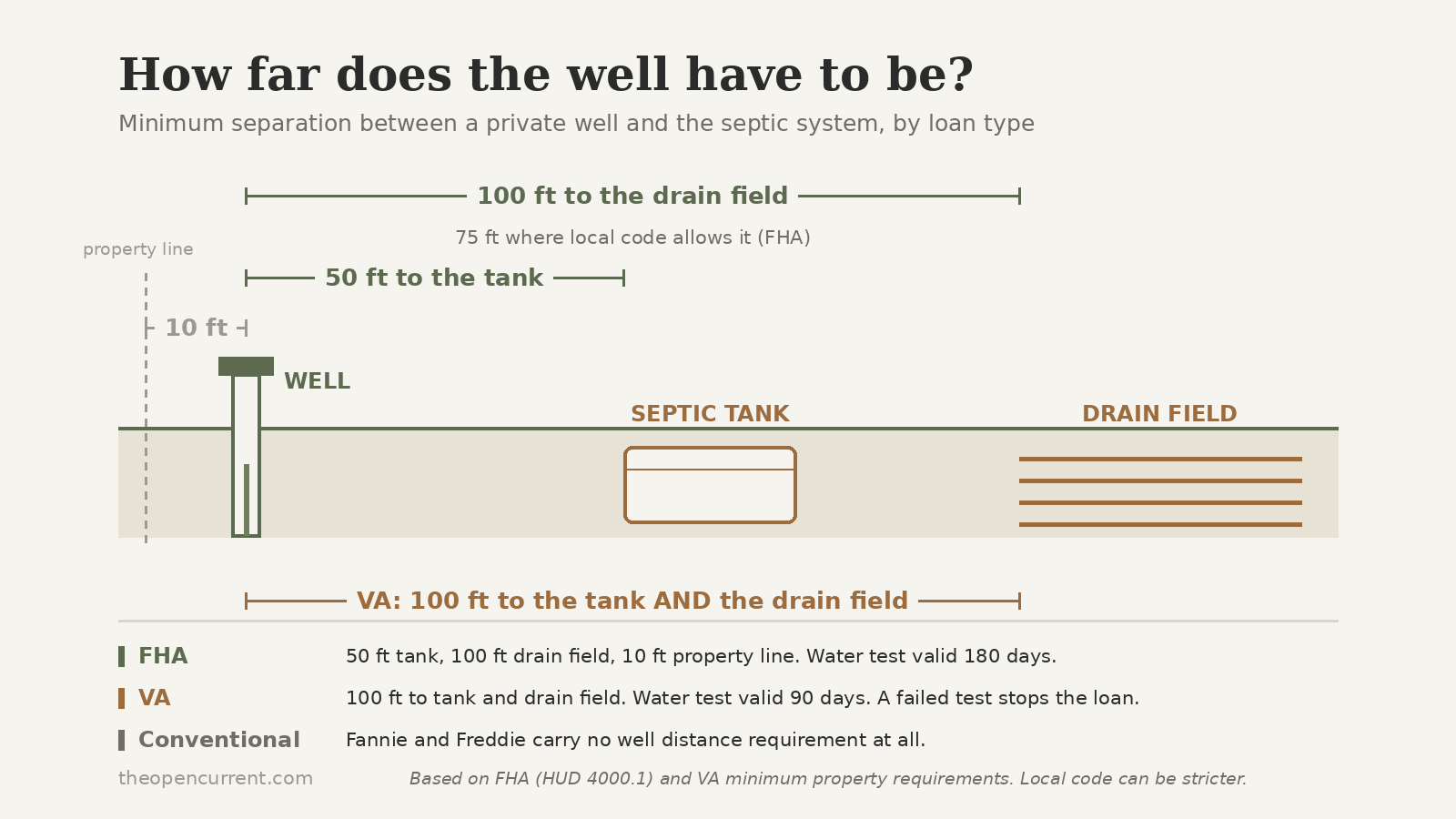
Original diagram. Reuse it with a link to theopencurrent.com.
FHA also wants proof of flow, generally 3 to 5 gallons per minute sustained for about two hours, and enforces limits of 15 ppb lead, 10 mg/L nitrates, 1 mg/L nitrites and zero coliform.
VA is blunt about consequences: a failed water test that can’t be fixed before closing means the loan doesn’t fund. Full stop.
Here’s the kicker, and it’s the most useful thing in this article. If a property fails the FHA or VA distance rules, that doesn’t automatically kill the purchase. Fannie and Freddie conventional loans don’t carry those well distance requirements. Same house, same well, different financing, different answer. If your well sits 60 feet from a drain field, an FHA loan has a problem with that and a conventional loan may not.
On shared wells, FHA has its own set: each home needs at least 3 gpm (5 for proposed construction) over a continuous five hour period, a shut-off valve on each dwelling’s service line, and no more than four living units served. If you’re buying into a shared well with a handshake agreement and no recorded easement, that’s a lawyer conversation, not an inspection one.
The well and septic relationship nobody explains
Notice what all those lending rules are actually about. They’re not really about the well. They’re about how far the well sits from the septic system.
That’s the thing I’d want every rural buyer to understand: these two systems are one system as far as your water safety is concerned. A failing drain field 60 feet uphill from your well casing is a water quality problem, not just a wastewater problem.
Which is why the combined well and septic inspection is usually the right buy rather than the cheap bundle. At $400 to $900 for both, it costs less than booking them separately, and it’s the only way to evaluate the actual risk, which is the relationship between them. If you want the other half of that picture, what a proper septic inspection includes and how long it should take is in septic inspection.
Worth asking the inspector directly: how far is the well from the tank, and from the drain field, and how did you measure it? Pacing it out isn’t measuring it.
The off-grid version, which is different
If the property runs on solar and batteries, a couple of things change and no inspector will raise them.
The flow test is a power event. Running a pump at a controlled rate for two to four hours is a serious chunk of energy on a battery bank, especially in winter. It’s fine, but nobody warns you, and if the house has been empty with the system idling you may not have the charge for it. Worth planning around, and worth watching, because how the system copes with a sustained pump run tells you something useful about both the well and the power system.
Surge matters more than running watts. A submersible pump’s starting surge sizes your inverter, not its running draw. If you’re buying an off-grid place, the pump spec sheet matters as much as the water test. I went into the pressure tank side of that in the well pressure tank buying guide, since tank sizing is what decides how often the thing starts.
There’s no municipal backup. On a city supply a bad result means a filter. Out here it means you have no water, so the tolerance for an ambiguous inspection result should be a lot lower.
Questions to ask before you book
- Are you a licensed well contractor, or a home inspector adding this on?
- Does the price include a flow or yield test, or is that extra?
- Where will you take the water sample, and is there treatment equipment upstream of it?
- Can I get both a raw and a treated sample?
- How long will you run the pump for the yield test?
- Will you measure the distance from the well to the septic tank and drain field?
- What did the water table do this season compared to normal?
- Do you provide written documentation my lender will accept?
- Is there a travel surcharge for this address?
- If something fails, will you quote the repair, or is that a separate contractor?
That third and fourth one is the whole article in two questions, tbh.
Other things that turn up
Abandoned wells. An old unsealed well on the property is a direct conduit from the surface straight into your aquifer. If there’s a second well nobody uses, find out whether it was properly decommissioned.
Missing records. A well with organised records, test results, pump invoices, casing depth, is easier to value and easier to trust. A well with no paperwork invites discount demands and rushed decisions. If you’re selling, dig the folder out. If you’re buying and there’s no folder, factor that in.
Seller disclosure. In most states sellers must disclose known material defects, and for wells that includes past failed tests, previous shock chlorination, pump failures and any history of running dry. The operative word is known. A seller who has never tested has nothing to disclose, which is its own kind of answer.
So what should you actually spend?
If I were buying a rural place tomorrow, I’d budget around $600 to $900 and spend it like this: a proper inspection by a licensed well contractor, a yield test long enough to mean something, and two water samples, raw and treated. If there’s a septic system, bundle them.
What I wouldn’t do is pay $250 for a visual once-over, get a clean sheet of paper, and believe I’d learned anything about the well.
The inspection isn’t the expensive part of owning a well. The expensive part is the thing the inspection was supposed to catch.
FAQ
How much does a well inspection cost?
Usually $250 to $550 for a standard inspection, plus $50 to $400 for water testing depending on the panel. A combined well and septic inspection typically runs $400 to $900. Remote properties often pay a travel surcharge on top.
Is a well inspection included in a home inspection?
No. A general home inspector’s standards of practice typically exclude private wells, so water quality, flow rate and casing evaluation aren’t covered. You need a licensed well contractor or a specialist.
How long should a well flow test take?
Sources disagree. FHA expects sustained flow for about two hours, while a realtor quoted by Bankrate says water is generally run three to four hours to measure gallons per minute and recovery. Anything under an hour tells you about the tap, not the well.
Can a well pass inspection and still be bad?
Yes, and it’s common. The usual causes are a sample taken downstream of treatment equipment, a retest done too soon after shock chlorination, or a flow test run in spring when the water table is high.
What happens if the water test fails?
A first coliform result usually means shock chlorination and a retest about two weeks later. A second positive after shocking points at a structural problem, where the fix ranges from a cheap new cap to casing repair running into the thousands.
Does my mortgage require a well inspection?
It depends on the loan. FHA and VA both require water testing and enforce minimum distances between the well and the septic system. Fannie and Freddie conventional loans don’t carry those well distance requirements, so a property that fails FHA rules may still be financeable conventionally.
What if the well has a low flow rate?
Under 1 gpm normally needs storage tanks. Wells at 1 to 3 gpm are common and workable with the right design. Hydrofracturing runs roughly $2,500 to $8,000 with about 70 to 80 percent success, against $15,000 to $50,000 and up for a new well.
Who pays for the well inspection?
Usually the buyer, though it’s negotiable, and sellers often cover remediation to save the sale. Sort out who pays for what early, before a failed test turns it into an argument.